
Scholarships in China can make your degree free: the best-known one, the Chinese Government Scholarship (CSC), covers tuition, accommodation and insurance and pays a monthly allowance of RMB 2,500–3,500. There are also provincial and city scholarships, university grants and a scholarship for Chinese language learners. Here is what each one covers, who can apply and when. For the overall admission process, see How to Apply to Study in China in 2027.
Key facts • The full Chinese Government Scholarship covers tuition, housing and insurance and pays RMB 2,500 a month to bachelor's students, RMB 3,000 to master's and RMB 3,500 to PhD students. • You can apply through the Chinese embassy in your country (Type A) or directly through a university (Type B). • University scholarships are often partial: a 20–50% discount or a full tuition waiver. • Most scholarship applications run from November to May — start preparing for autumn 2027 now. |
Types of scholarships in China
Scholarships for international students in China fall into four groups: the Chinese Government Scholarship, provincial and city scholarships, university scholarships, and a scholarship for Chinese language learners. They differ in coverage, competition and how you apply.
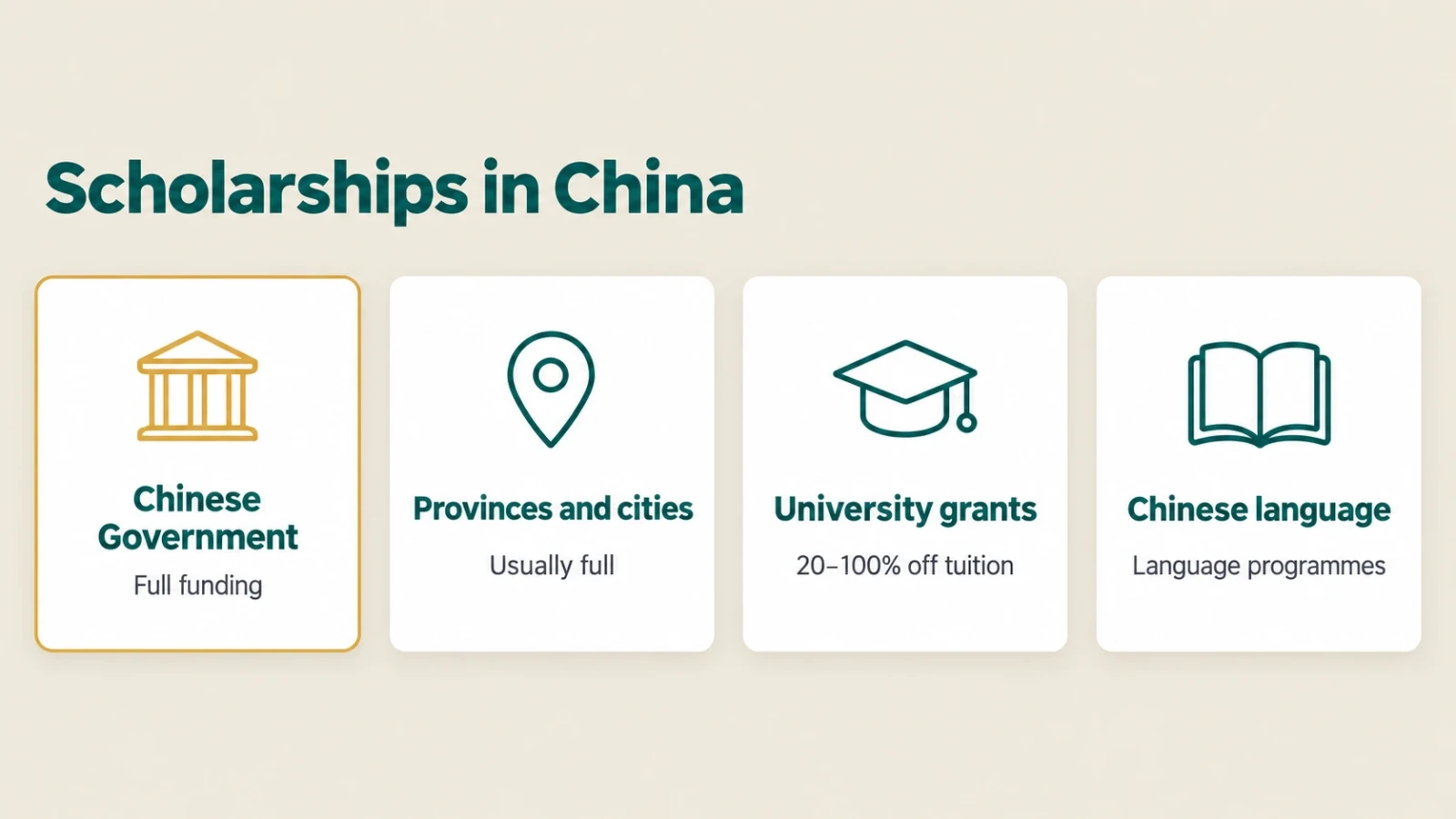
Scholarship | What it covers | How to apply | Competition |
Chinese Government Scholarship (CSC), Type A | Tuition, housing, insurance, monthly allowance | Through the Chinese embassy or your government | High |
Chinese Government Scholarship (CSC), Type B | Same | Directly through a Chinese university | High |
Provincial and city scholarships (e.g. Beijing) | Usually tuition, housing, insurance, allowance | Through the university | Medium |
University scholarships | From a 20% discount to free tuition | Through the university, with your application | Medium |
International Chinese Language Teachers Scholarship | Tuition, housing, allowance, insurance | Through a university or Confucius Institute | Medium |
Source: China University of Petroleum (Beijing), Harbin Institute of Technology
Chinese Government Scholarship (CSC): what it covers
The Chinese Government Scholarship is a full scholarship: you pay no tuition or housing fees, get comprehensive insurance and receive a monthly living allowance. It is awarded by the China Scholarship Council under China's Ministry of Education.
Coverage as published by China University of Petroleum (Beijing):
Level | Monthly allowance | Housing | Insurance |
Bachelor's | RMB 2,500 | Free dorm or a housing subsidy | RMB 800/year, paid by the scholarship |
Master's | RMB 3,000 | Free dorm or a housing subsidy | RMB 800/year, paid by the scholarship |
PhD | RMB 3,500 | Free dorm or a housing subsidy | RMB 800/year, paid by the scholarship |
Source: China University of Petroleum (Beijing)
Tuition is paid directly to the university: it is never paid out to the student. If your programme requires a preparatory Chinese language year, the scholarship usually covers that year too.
Age limits
According to the CSC conditions on the China University of Petroleum (Beijing) website, applicants must be:
- under 25 for bachelor's programmes (high school graduates);
- under 35 for master's programmes (bachelor's degree holders);
- under 40 for PhD programmes (master's degree holders).
Type A and Type B: how to apply for the Chinese Government Scholarship
There are two ways to apply, and the difference is who nominates you.
- Type A — through the Chinese embassy or the education ministry in your country, which nominates candidates under bilateral agreements. Quotas and deadlines are set country by country, so check the announcement of the Chinese embassy in your country.
- Type B (Chinese University Program) — directly through a Chinese university, which selects candidates itself. You apply both in the university's system and in the Chinese Government Scholarship system.
Many universities accept Type B applications from autumn to spring. For example, Xi'an Jiaotong University has described its Chinese University Program window as running from mid-November to mid-March, and Harbin Engineering University and China University of Geosciences publish their own CSC application pages. Dates change every year, so always check the current notice.
Provincial, city and university scholarships
Beyond the government scholarship, provinces, cities and universities run their own grants. Competition is often lower and applying is simpler — through the same portal as your admission application.
Provincial and city scholarships. For example, the Beijing Government scholarship at China University of Petroleum (Beijing) includes comprehensive health insurance and a monthly allowance of RMB 2,500 for 10 months a year. Application deadlines there are 15 May for bachelor's and 30 May for master's and PhD applicants.
University scholarships. Usually a tuition discount. Harbin Institute of Technology offers several levels: a full tuition waiver or discounts of 50%, 30% or 20%, with a deadline of 31 May 2026. You cannot apply for two scholarship types at HIT at the same time.
International Chinese Language Teachers Scholarship. Supported by the Center for Language Education and Cooperation (CLEC). According to China University of Petroleum (Beijing), it fully covers tuition, accommodation, a living allowance and medical insurance; applicants are generally 16–35 years old (up to 45 for working Chinese teachers). It suits a language year or a master's in teaching Chinese.
A free master's in China: what to expect
A fully funded master's in China is possible with any full scholarship: CSC (Type A or B), a provincial scholarship or a full university grant. CSC pays master's students RMB 3,000 a month, which covers basic expenses in most cities except the most expensive ones.
What matters for a master's scholarship:
- Age under 35 for the Chinese Government Scholarship.
- Language: HSK or IELTS/TOEFL as required by your programme.
- A supervisor's letter improves your chances and is mandatory at some universities.
- A study plan tailored to the programme, not a generic one.
How to win a scholarship: step by step
Getting a scholarship takes 6–9 months. Start a year before your studies begin.
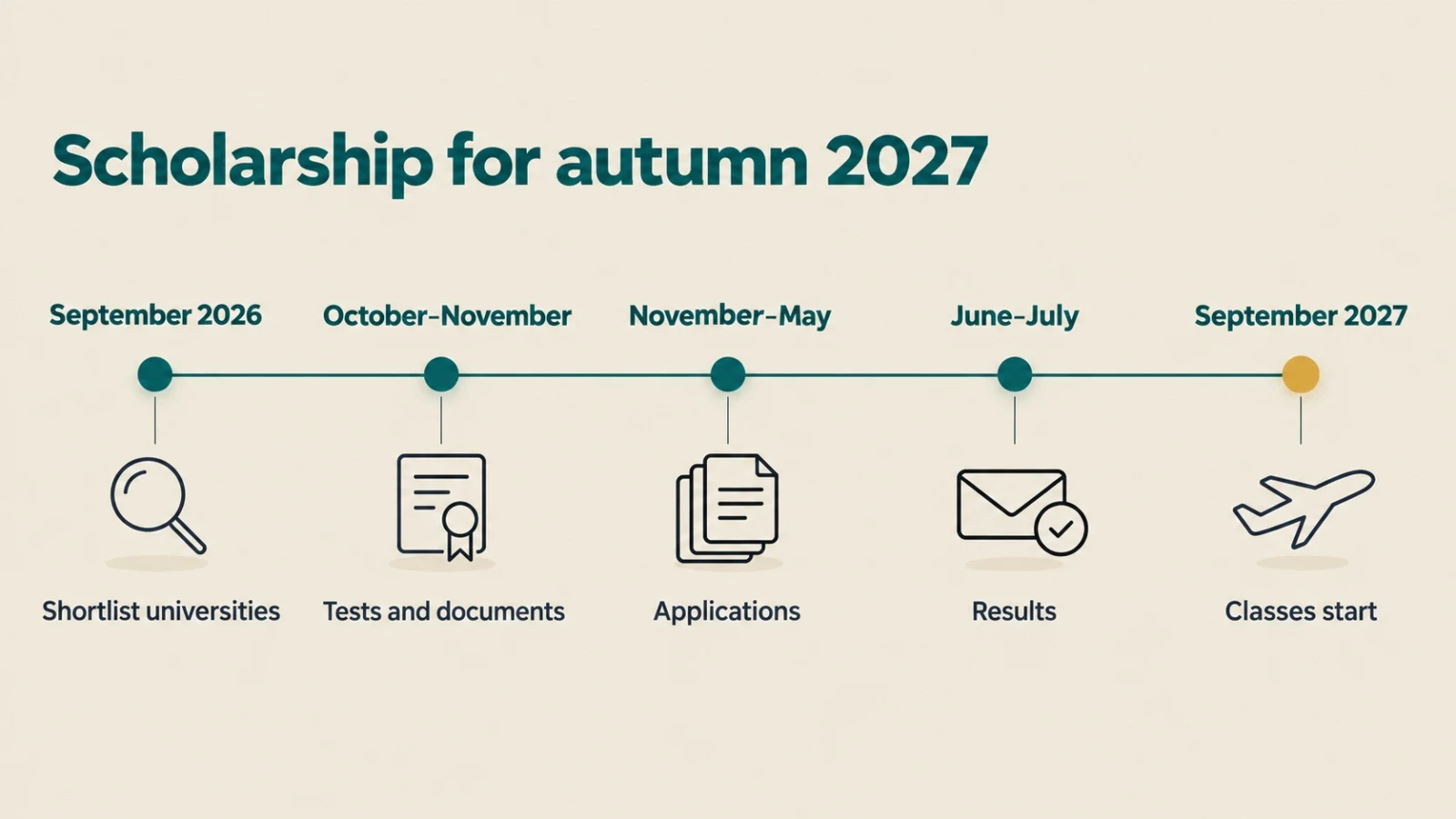
1. Choose your level and programme. A scholarship is tied to a programme and university — choose them first.
2. Take a language test. HSK for Chinese-taught programmes, IELTS or TOEFL for English-taught ones. Bachelor's applicants should also plan for the CSCA exam.
3. Find a supervisor (for master's and PhD) and get a letter of acceptance.
4. Prepare documents: translations, recommendations, study plan, medical form.
5. Apply for several scholarships at once: CSC Type B, a provincial scholarship and a university grant — plus Type A through your embassy if your country has a quota.
6. Apply for a self-funded place in parallel as a backup.
Documents for a scholarship application
A scholarship application needs more than a self-funded one: the committee assesses not only your eligibility but how strong a candidate you are. You will usually need:
1. A passport scan.
2. Your school certificate or degree and transcripts, with notarised translations.
3. A language certificate: HSK, IELTS or TOEFL.
4. A study or research plan — for master's and PhD applicants it is one of the key documents.
5. Two recommendation letters from associate professors or above.
6. A supervisor's letter of acceptance — mandatory at some universities.
7. The Foreigner Physical Examination Form.
8. A police clearance certificate.
Start with the study plan and recommendations: they take the longest, and they are what makes a strong application stand out.
What improves your chances
A scholarship is a competition, so not everyone wins. Your chances improve with:
- a high GPA in your school certificate or degree;
- a language certificate above the minimum level;
- a letter from a supervisor at your chosen university;
- strong recommendations from professors;
- a study plan that links your background with the programme;
- publications, olympiads and projects — for master's and PhD;
- applying to several universities and several scholarship types.
КАРТИНКА 3 — вставить сюда. Сам блок в статью не копировать Тип: Own photo Имя файла: scholarships-in-china-students-en.webp Alt: GE Agency students studying in China on a scholarship (53 симв.) Подпись под картинкой (курсивом, по желанию): Our students studying in China on scholarships Что подобрать: Pick a real photo of the agency's students studying on a scholarship (CSC or a university grant) — on campus or at a ceremony. Get the students' consent to publish. 16:9, at least 1600×900. |
Common mistake Applying only for a scholarship and only to one top university. If you don't get it, you lose a year. Always keep a backup — a self-funded place or a less competitive university. |
How much it costs without a scholarship
Without a scholarship, tuition in China is roughly RMB 14,000–50,000 a year depending on level and university, plus housing, insurance and food. For a full breakdown, see How Much It Costs to Study and Live in China.
A partial university grant can cut these costs in half, so it is worth applying even if you are ready to pay.
Frequently asked questions
Can I study in China for free?
Yes, with a full scholarship: the Chinese Government Scholarship, a provincial scholarship or a full university grant. They cover tuition and housing, and CSC also pays a monthly allowance.
How much does the Chinese Government Scholarship pay?
RMB 2,500 a month for bachelor's students, RMB 3,000 for master's and RMB 3,500 for PhD students, plus free housing or a housing subsidy and insurance.
What is the difference between CSC Type A and Type B?
Type A goes through the Chinese embassy or your government; Type B goes directly through a Chinese university. Coverage is the same; the application route and deadlines differ.
Can I get a free master's degree in China?
Yes. Master's applicants can apply for CSC, provincial and university scholarships. The main conditions are age under 35, a bachelor's degree and a language certificate.
Do I need Chinese to get a scholarship?
Not always. For Chinese-taught programmes you need HSK; for English-taught programmes IELTS or TOEFL is usually enough, if the university offers the programme in English.
When should I apply for a 2027 scholarship?
Most windows run from November 2026 to May 2027. Type A deadlines depend on your country — watch the Chinese embassy's announcements from autumn.
Can I apply for several scholarships at once?
Usually yes: CSC, a provincial scholarship and a university grant. Some universities don't allow applying for two of their own scholarships at once — check the rules.
Quick action plan
1. Choose your level, programme and 3–5 universities.
2. Take HSK or IELTS before the end of 2026.
3. Check whether your country has a Type A quota and when the embassy opens applications.
4. Prepare documents and find a supervisor.
5. Apply for several scholarships and a self-funded place.
6. Once awarded, get your X1 visa and sort out your dorm.
We'll help you win a scholarship to study in China GE Agency will match scholarships to your profile, help you prepare your study plan, recommendations and documents, and apply to several universities. Book a consultation — we'll assess your chances. |
Information checked on 4 October 2026. Scholarship conditions, amounts and deadlines may change — always check the official university websites before applying.