CSCA is a new standardised exam for international applicants planning to enrol in a bachelor’s programme in China. It tests academic fundamentals and, for some programmes, professional Chinese. The result is used by universities as one of the admission documents and in evaluating scholarship candidates.
The main rule for 2027 admission: do not choose CSCA subjects based only on the general name of the major. Mathematics is a basic subject, but the need for Professional Chinese, physics or chemistry depends on the language of instruction, the field, and the rules of the specific university. One university may require Mathematics + Physics, another Mathematics + Chemistry, and a Chinese-medium programme may additionally assign Humanities Chinese or STEM Chinese.
In short CSCA relates primarily to bachelor’s admission. For a language year, most short-term programmes, a master’s degree and a PhD, this exam is usually not required. However, a student on Foundation or a language year may need CSCA later, when transferring to a bachelor’s degree. |
What CSCA is and why the new exam was introduced
The exam’s full name is the China Scholastic Competency Assessment. In official Chinese wording, it means an entrance assessment of the academic level of international students planning to pursue a bachelor’s degree in China. The exam is organised by the China Scholarship Council together with experts from Chinese universities.
Before CSCA, universities assessed an international candidate mainly by school documents, national exams, international tests, language certificates, interviews and their own entrance tests. These systems differ greatly between countries. CSCA creates a single academic metric that a university can compare against the chosen programme.
A CSCA result does not replace the entire selection process. The university still considers the certificate, transcript, subject-specific grades, a language certificate, motivation, an interview, a portfolio and other documents. The official platform explicitly states that each university independently sets the criteria for using the result.
Who needs to take CSCA in 2027
Official notices linking the introduction of the exam tie CSCA to international bachelor’s admission starting with the 2026/2027 academic year. In practice, requirements are already included in many universities’ admission rules. That said, the specific date for submitting a result and the subject set differ.
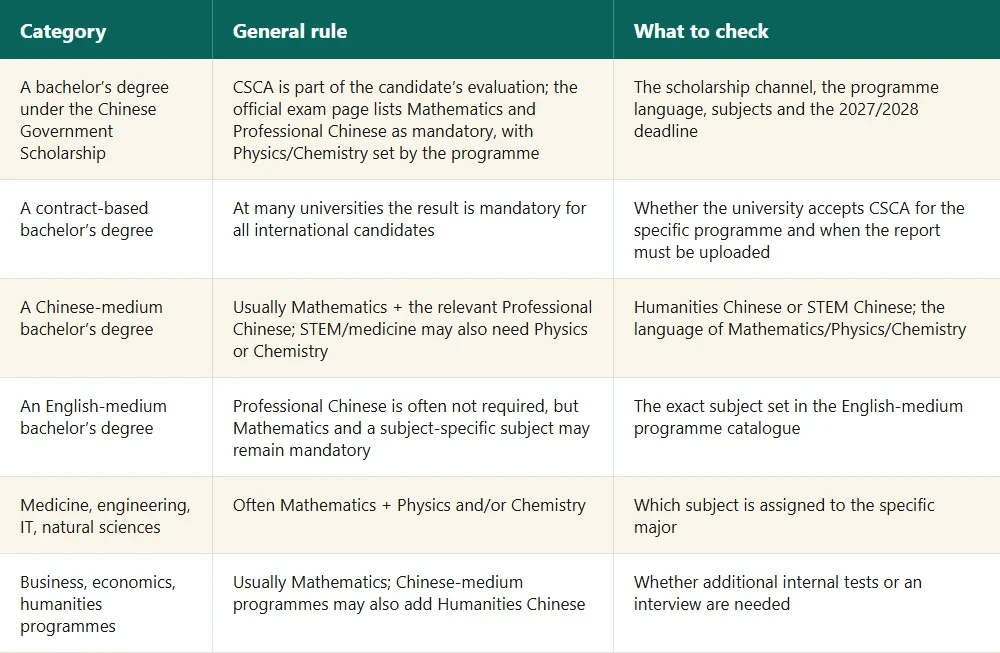
An important caveat: the phrase "a mandatory exam" does not mean every university follows the same process. Shanghai Jiao Tong University, for example, allowed some candidates to first submit other international results but required CSCA to follow later; the university separately stated that SAT, A-Level, IB and its internal test do not replace the final CSCA requirement.
Who usually does not need CSCA
- Candidates for a regular language semester or a language year.
- Applicants for short-term summer school, winter school and non-degree programmes.
- Most candidates for a master’s degree and PhD.
- Students on some Foundation and pre-university programmes — if the university has not linked the preparatory programme to the subsequent bachelor’s degree.
- Exchange and visiting students, unless the programme sets a separate requirement.
Even if CSCA is not needed for the first stage, a student on a language year or Foundation should check in advance the rules of the future bachelor’s programme. The exam may be required before the transfer to the main degree programme.
Which subjects are included in CSCA
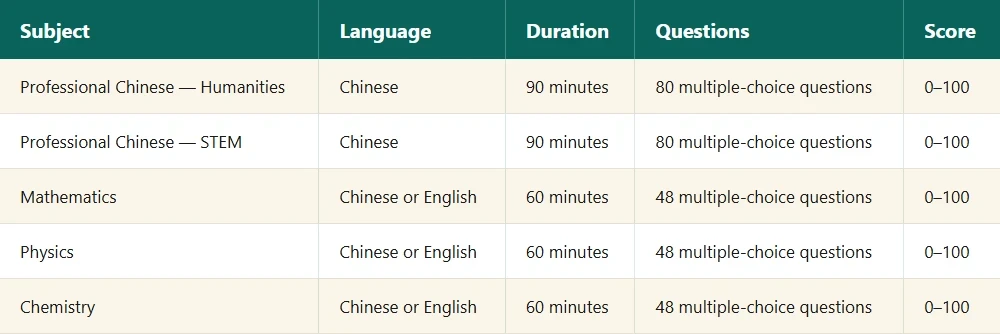
Mathematics, Physics and Chemistry are available in Chinese or English. Choose the language not for personal convenience but based on the university’s requirements and the programme’s language of instruction.
Professional Chinese: Humanities or STEM
Professional Chinese is not an ordinary HSK. The exam tests the ability to work with academic and professional vocabulary, instructions and texts related to the future field of study.
- Humanities Chinese usually applies to the humanities, economics, management, law, art and other fields the university classifies under that profile.
- STEM Chinese is usually used for engineering, IT, natural sciences, medicine and other technical fields.
Classification may differ from an everyday idea of the major. For example, a specific university may classify a management programme under the humanities profile and a medical programme under STEM. The decision is made according to the university’s official list of programmes.
Mathematics
Mathematics is the central CSCA subject. The exam’s official page lists mathematics as mandatory for bachelor’s candidates in the listed categories. University rules confirm that mathematics is required for many English-medium programmes too. For example, Northwestern Polytechnical University assigned Mathematics to all its listed English-medium profiles — engineering, business, materials and biology.
Physics and chemistry
Physics and Chemistry are not universally mandatory for every candidate. They are assigned by major. Engineering often requires Physics; biology, chemistry and materials, and some medical fields — Chemistry; some programmes require one subject of choice, while others require a specific subject or both.
How to determine your subject set
- Identify the exact major and level — CSCA applies to undergraduate applications.
- Identify the language of instruction: Chinese or English.
- Open the target university’s international undergraduate admission guide for 2027.
- Find the CSCA subjects table or the programme catalogue.
- Check whether Professional Chinese is required, and whether it is Humanities or STEM.
- Check whether Physics, Chemistry, or a choice of one is required.
- Confirm the language for Mathematics, Physics and Chemistry.
- Check the deadline by which the result must be uploaded: with the application or later.
- Only then register for the exam.
The main mistake Registering for a "standard set" of Mathematics + Physics without checking the programme. Business may only need Mathematics, materials science may need Mathematics + Chemistry, and a Chinese-medium engineering programme may need STEM Chinese + Mathematics + Physics. |
Examples of requirements at Chinese universities
The following examples show the differences between 2026 programmes. They are useful for understanding the logic but do not replace the 2027 admission rules.
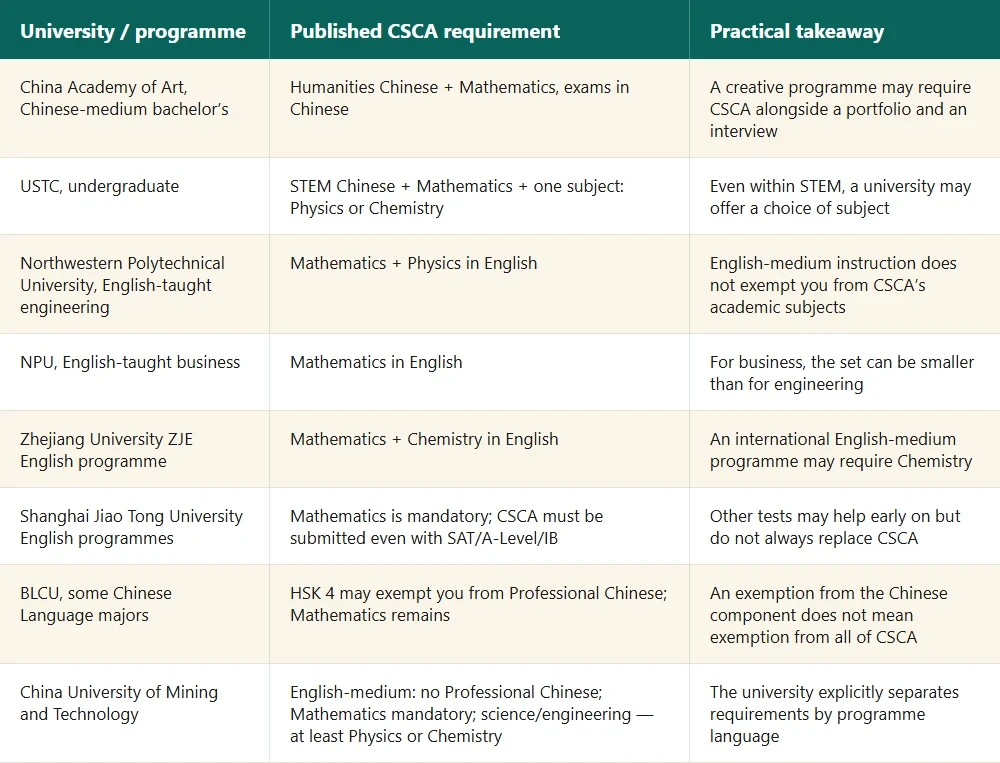
Source: Northwestern Polytechnical University, Zhejiang University, Shanghai Jiao Tong University, China University of Mining and Technology
Does CSCA replace HSK, IELTS, SAT or a national exam
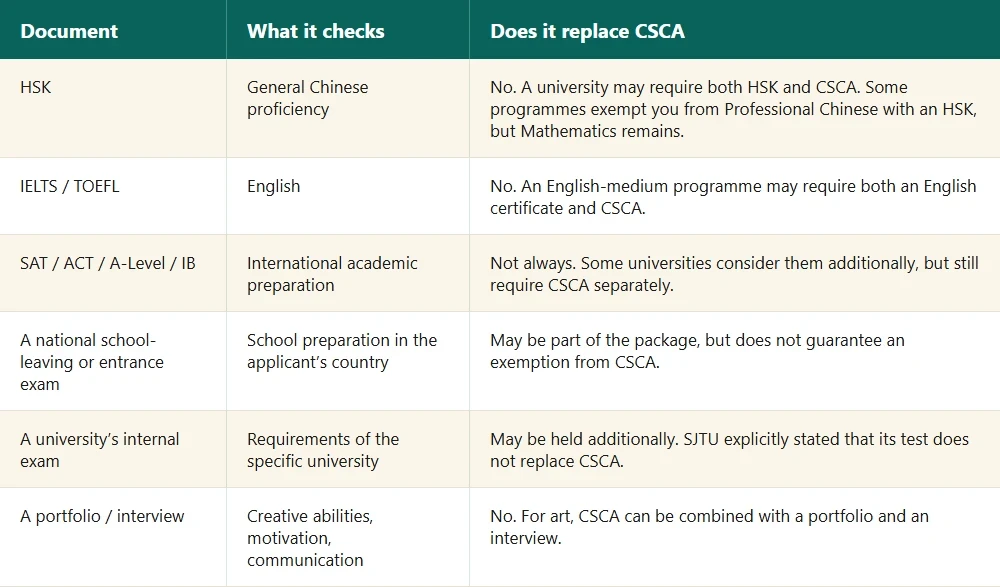
Source: Shanghai Jiao Tong University
CSCA vs. HSK — what is the difference
HSK answers the question: how well does the candidate know Chinese overall. CSCA answers a different question: are they ready to work with academic tasks and subject-specific material at the level required for a bachelor’s degree. So HSK 4 or HSK 5 should not automatically be treated as a substitute for CSCA.
Format, duration and the subject schedule
CSCA is offered in three formats: a home-based online exam with remote proctoring, a centre-based computer exam, and a paper exam at an authorised centre. At the rollout stage the main available format is the home-based online exam, while the network of in-person centres is gradually expanding.
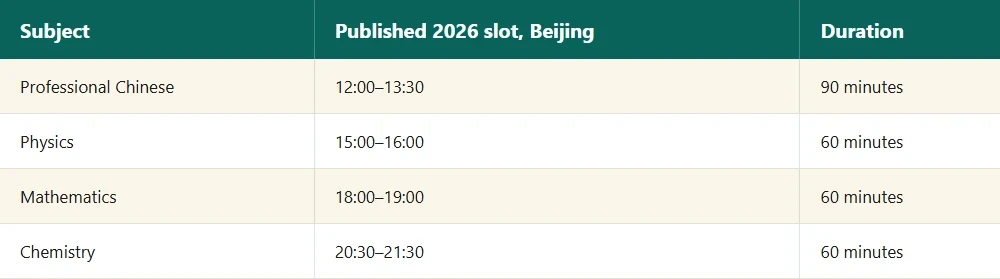
The times shown are an example of the current 2026 schedule. Before the 2027 exam, check the time in your personal account and convert it to the time zone of the candidate’s country.
CSCA 2027 dates and when to take the exam
The official platform lists a regular cycle: exams are held in January, March, April, June and December, with specific dates published separately. As of 20 July 2026, the exact 2027 session calendar had not yet been published.
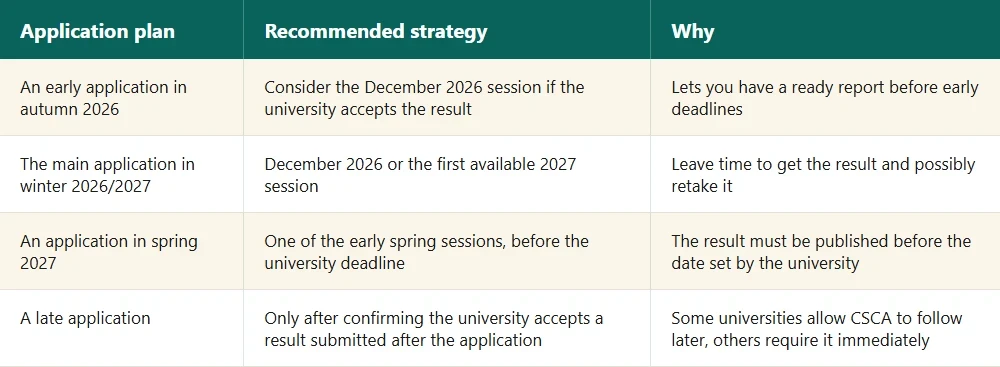
The home-based online exam and the centre-based computer exam publish results within roughly seven business days; the paper format — within 14 business days. Do not plan to sit the exam right up against a deadline: technical issues, holidays and university requests can extend the overall timeline.
Exam cost
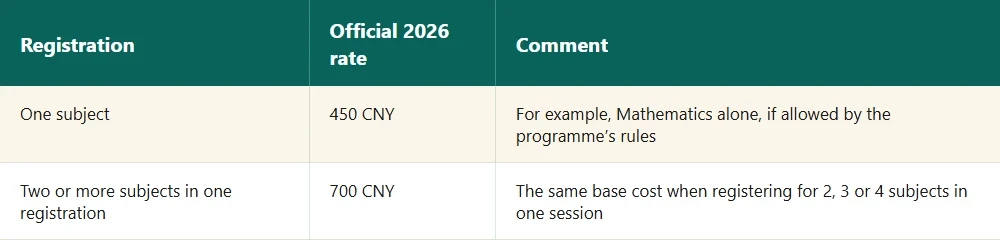
2027 rates need to be re-checked before registration. Payment is made online. The official platform accepts Visa and Mastercard cards issued outside mainland China, as well as WeChat Pay and Alipay. Bank conversion and payment-system fees are possible.
How to register for CSCA
- Create an account on the official CSCA platform using a personal email address.
- Fill in personal details exactly as they appear on your valid ordinary passport.
- Upload an electronic photo in the required format.
- Choose a session, country or city, an available exam format, and the required subjects.
- Choose the language for Mathematics, Physics and Chemistry to match your programme.
- Check your details before paying: an error in a subject after registration can cost you a whole session.
- Pay for the exam and save the confirmation.
- Download the admission ticket or required instructions in your personal account.
- Complete the technical check for a home-based exam.
- After results are published, download the score report and upload it to your university application.
What documents and data are needed
- An original valid ordinary passport. Official CSCA rules do not accept a passport card, an ID, a driving licence, a copy or an electronic screenshot in place of the original.
- An electronic 2-inch photo: JPG/JPEG, a white background, 40–200 KB, no filters or retouching; it is used for face recognition.
- A personal email address the candidate will keep access to until admission.
- A phone number and a current residential address.
- Information about your current school and chosen programme.
- A suitable method for international online payment.
How the home-based online exam works
The home-based format uses two devices: a main computer and an additional smartphone or tablet as a second camera angle. The exam is monitored by a remote proctor; the content, duration and question type match the centre-based computer exam.
- The main device is used to log into the exam system and complete the tasks.
- The additional device monitors the workspace, the candidate and the surrounding area.
- The camera and microphone must work throughout the exam; the system may flag leaving the frame, other people present, unusual sounds and on-screen activity.
- The passport used during the exam must match the registration details.
- Check your internet, device power, camera and microphone access, and the room requirements in advance.
Do not publish this as a universal technical requirement The exact operating system versions, allowed browsers, minimum internet speed and draft-paper rules should be taken from the Candidate Notice for the specific session. These parameters can change. |
Results and the passing score
Each subject is scored on a scale of 0 to 100. There is no single universal passing score for every university and major. Each university independently sets a minimum result, may weigh individual subjects, or use CSCA as part of a broader assessment.
So statements like "a score of 60 guarantees admission" are unreliable. One university may set a formal minimum, another may rank candidates against each other, and a highly competitive programme may expect a much stronger result.
Can you retake CSCA
The exam is held several times a year, so a candidate can plan another session if the result is weak or a subject was chosen incorrectly. Before registering, however, check with the university whether it accepts the best result, the most recent result, or every attempt. There is no single public rule for all universities.
How long the result is valid
As of 20 July 2026 a universal validity period for the report should not be published without referencing a specific rule. The result’s acceptance period must be checked in the university’s admission guide and in the announcement for the specific CSCA session.
How to prepare for CSCA
Preparation does not start with solving random problems, but with fixing the exact subject set. After that, the candidate should download the official syllabus on the CSCA platform and run a diagnostic for each subject.
Preparing for Mathematics
- Check basic algebra: expressions, equations, inequalities and systems.
- Review functions and graphs, including reading and interpreting relationships.
- Practise geometry and coordinate problems.
- Review sequences, probability and basic statistics within the official syllabus.
- Train your speed: 48 questions in 60 minutes — about 75 seconds per question on average.
- Learn mathematical terminology in the chosen exam language.
Preparing for Physics
- First identify the topics from the official syllabus — do not automatically transfer a national school programme or A-Level content.
- Review formulas and units of measurement, then move to multiple-choice problems.
- Split preparation into mechanics, electricity, thermal phenomena, waves and other officially included blocks.
- Practise reading graphs and diagrams.
- Solve mixed practice sets within a 60-minute limit.
Preparing for Chemistry
- Review the basics of the structure of matter, periodic trends and chemical bonding.
- Review calculation problems, reaction equations, solutions and concentrations.
- Split preparation into inorganic and organic chemistry per the official programme.
- Practise terminology in the exam’s English or Chinese language.
- Train quick method selection and checking the dimensional units of your answer.
Preparing for Professional Chinese
- Do not limit yourself to standard HSK vocabulary lists — add academic vocabulary for your chosen profile.
- Practise understanding instructions and long question wording.
- For Humanities Chinese, work with social, humanities and economics texts.
- For STEM Chinese, study scientific notation, processes, cause-and-effect relationships and terminology.
- Train reading speed: 80 questions in 90 minutes.
An 8-week preparation plan
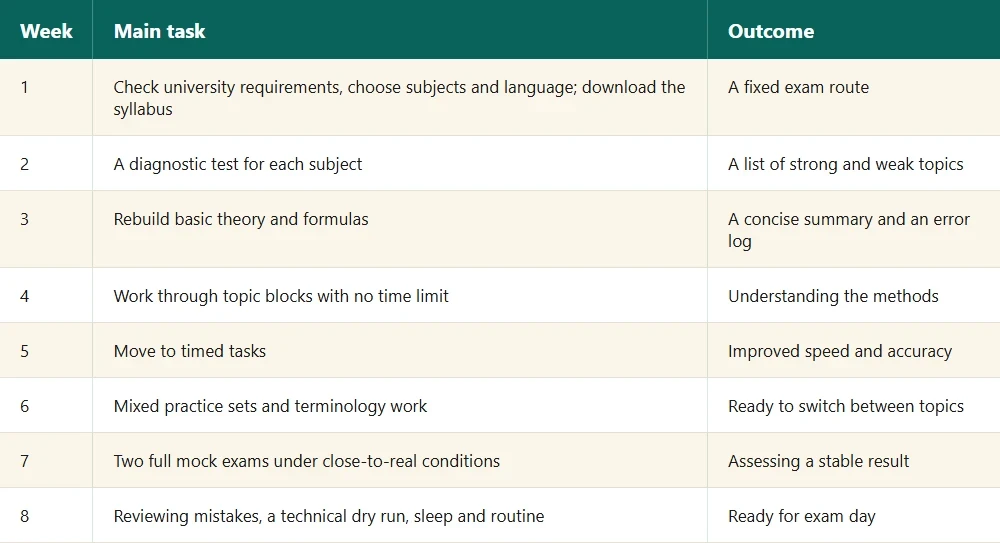
Do not choose a university just because a programme is described as "no entrance exams" in an old marketing document. For the 2027 intake you need to check the current CSCA rules. Possible strategies: start preparing earlier, consider Foundation, choose a programme with a different subject set, or postpone the degree application until the required level is reached.
Common applicant mistakes
- Thinking CSCA is needed for any study in China, including a language year and a master’s degree.
- Assuming an English-medium programme automatically exempts you from CSCA.
- Choosing Humanities Chinese instead of STEM Chinese, or vice versa.
- Taking Mathematics in English when a Chinese-medium programme requires the Chinese version.
- Assuming HSK, IELTS, SAT or a national exam will automatically replace CSCA.
- Registering for Physics instead of Chemistry without checking the programme catalogue.
- Taking the exam too late and missing the deadline for the report.
- Using a school or corporate email you may lose access to later.
- Uploading an unsuitable photo and running into a face-recognition error.
- Not running a technical dry run for the home-based exam.
- Looking for "a single passing score" instead of the rules of a specific university.
- Violating proctoring rules: leaving the frame, using an extra device, or allowing someone else into the room.
For violations, the platform can cancel the result for a single subject or an entire session, ban participation for a set period or permanently, and report the information to the university.
A step-by-step plan for a 2027 applicant
- Build a list of universities and bachelor’s programmes.
- Split the list into Chinese-medium and English-medium programmes.
- Record the CSCA subjects, the exam language, and the university deadline for each option.
- Choose a common subject set that covers the maximum number of programmes.
- Register for a session with a time buffer.
- Prepare using the official syllabus and practice tasks for each subject.
- Take the exam and check the score report’s details.
- Upload the result to your university and grant applications.
- Watch for university messages: they may request an interview, an internal test, or an additional document.
- Do not cancel backup options until you receive the official Admission Notice.
Check the CSCA requirements for your programme Requirements depend on the university, major, language of instruction and the type of funding. GE Agency will check whether you need CSCA, which subjects and language to choose, which session to catch, and how to fit the result into your overall admission strategy. A preliminary check is not a guarantee of admission. |
Frequently asked questions
Is CSCA mandatory for all international students?
No. The exam relates primarily to bachelor’s admission. It is usually not needed for language, short-term, master’s or doctoral programmes.
Do you need to take CSCA for an English-medium bachelor’s degree?
Often yes. Professional Chinese is usually not required, but Mathematics and a subject-specific Physics or Chemistry component may be mandatory.
Does HSK replace the CSCA exam?
No. HSK confirms general Chinese, while CSCA assesses academic readiness. Some programmes exempt you from Professional Chinese with an HSK, but not from Mathematics.
Do IELTS or TOEFL replace CSCA?
No. An English certificate confirms the language of instruction, while CSCA covers academic subjects.
Can you use SAT, A-Level or IB instead of CSCA?
It depends on the university. Some universities consider international tests additionally but still require CSCA.
Which subjects are needed for medicine?
There is no single set. Usually Mathematics and Chemistry and/or Physics are required. The exact list must be taken from the specific medical programme’s rules.
Which subjects are needed for IT or an engineering major?
Most often Mathematics and Physics; a Chinese-medium programme may also need STEM Chinese. Some fields require Chemistry.
Is there a single passing score?
No. Each university sets its own criteria and may consider CSCA together with other documents.
How much does the exam cost?
Under 2026 rates, one subject cost 450 CNY, and two or more subjects in one registration cost 700 CNY. The 2027 rate needs to be checked.
When will the 2027 exams be held?
The platform plans sessions in January, March, April, June and December. Exact 2027 dates are published separately.
Can you take it from home?
Yes, if a home-based online test is available for your country and session. You will need a computer, a second device, and compliance with proctoring rules.
How long do you wait for the result?
For the home-based and centre-based computer formats, the stated timeline is up to seven business days; for the paper format — up to 14 business days.
Can you retake the exam?
The exam is held several times a year. Before a new attempt, check which results the chosen university accepts.
Do you need CSCA after a language year?
Usually not for the language year itself, but it may be required for later admission to a bachelor’s degree.
Can you apply first and send CSCA later?
Some universities allow this, others require the score report immediately. This must be checked before applying.
Conclusion
CSCA is becoming one of the key elements of international bachelor’s admission to China. The main difficulty of the exam is not just preparation but correctly choosing subjects, language and the exam date. Requirements differ by university, so a safe strategy starts with analysing specific programmes rather than registering for a random set of exams.
For 2027 admission you need to track two sources at once: the official CSCA calendar and the admission rules of your chosen universities. Once new guides are published, all dates, subjects and conditions in this article should be updated.