
You can apply to a Chinese university in 2027 after finishing school, college, a bachelor’s degree or a master’s degree. An applicant needs to choose the right level and language of instruction, check the requirements of specific universities, prepare documents in advance, and account for a new requirement for bachelor’s admission — the CSCA exam. China offers spring and autumn intakes, programmes in Chinese and English, language and preparatory courses, and state, provincial and university scholarships.
The essentials to start with As of 19 July 2026, most universities had not yet published final rules for the 2027 autumn intake. So exact deadlines, cost and the list of programmes need to be re-checked once each university’s official instructions are released. Even now, you can assess your profile, choose a route, prepare for CSCA or a language exam, and gather a basic document set. |
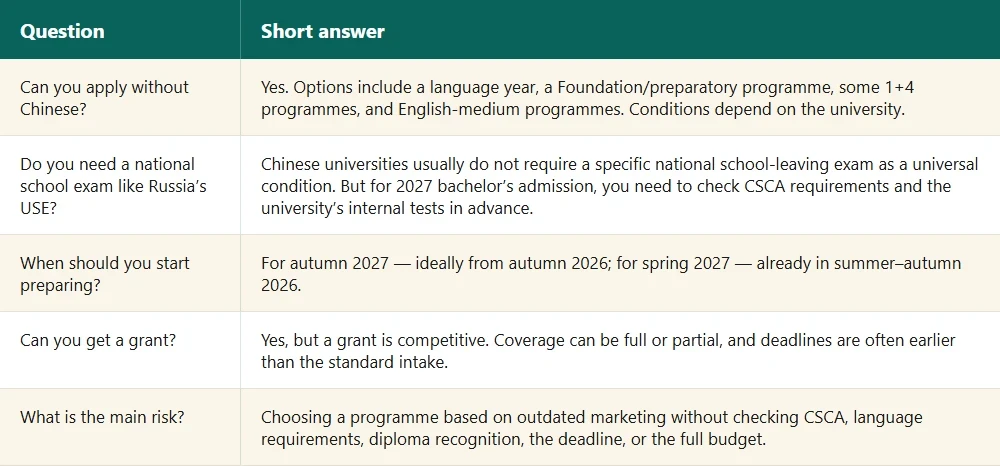
Table of contents
- Can you apply to China in 2027
- Spring and autumn intake
- Who can apply
- What study options exist
- Do you need a national exam, CSCA, HSK and IELTS
- What documents are needed
- How to apply: step by step
- How much studying and living costs
- Grants and scholarships
- How to choose a university and city
- The X1/X2 student visa and travel preparation
- Dormitory, registration and life after arrival
- Can you work while studying
- Common applicant mistakes
- Frequently asked questions
Can you apply to China in 2027
Yes, applying to China in 2027 is realistic for international applicants at very different levels of education. The main question is not "do they accept foreigners," but which route suits a specific person: direct bachelor’s admission, a language or preparatory year, an English-medium programme, a master’s degree, a PhD, or a short-term programme.
Requirements are not the same across the country. Even two universities in the same city may assess age, grades, language, CSCA, financial documents, medical forms and passport validity differently. So a general list of requirements always needs to be supplemented by checking the specific university and the specific intake.
In 2027 it is especially important to account for CSCA. China has introduced a standardised academic test for international bachelor’s applicants. Official notices state that from the 2026/2027 academic year, CSCA results become a mandatory or key part of bachelor’s admission, primarily for universities participating in state scholarship programmes. Some universities already require CSCA from all international bachelor’s applicants.
Conclusion You can no longer plan a 2027 bachelor’s application as "just submitting a certificate and a passport." Depending on the university, you may need CSCA, an HSK or proof of English, an interview, a portfolio or additional tests. |
Spring and autumn intake in China in 2027
China has two main intake periods: a spring intake, usually in February or March, and an autumn intake, usually in August or September. Autumn remains the main intake for most bachelor’s, master’s and doctoral programmes. Spring more often offers language courses, preparatory programmes and some degree programmes.
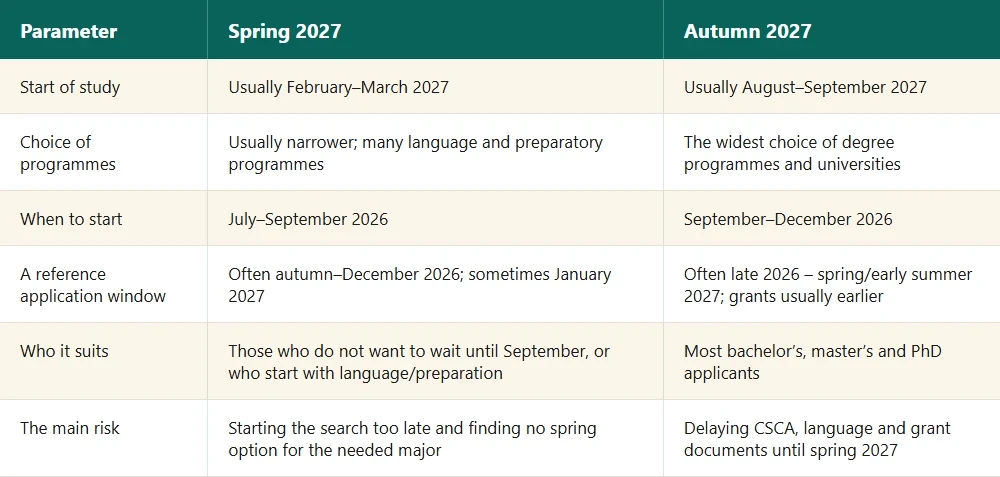
Some official 2027 spring dates are already appearing. For example, Jiangsu University lists 25 December 2026 as the deadline for the 2027 spring intake application, with registration on 3–4 March 2027. Shanghai Jiao Tong University lists a spring semester period for its language programme from 1 March to 2 July 2027. These are examples, not a single calendar for every university.
A tentative calendar for the spring 2027 intake
- July–August 2026: decide on the level, major, language and budget; check which programmes actually open in spring.
- August–October 2026: prepare your passport, education documents, translations, medical and additional documents.
- September–December 2026: submit applications; deadlines for some language scholarships for a March start may fall in October 2026.
- December 2026 – January 2027: receive a decision, meet financial conditions, wait for visa documents.
- January–February 2027: arrange the visa, housing and travel.
- February–March 2027: arrival and registration.
A tentative calendar for the autumn 2027 intake
- September–December 2026: decide on your strategy, start preparing for CSCA, HSK, IELTS or TOEFL.
- November 2026 – February 2027: build a university list and prepare strong documents for grants.
- January–April 2027: the main window for many state and university scholarships; exact dates checked separately.
- January–June 2027: applying to contract programmes; some universities may accept applications until June, July, or later.
- June–August 2027: receiving the Admission Notice and visa documents, payment, arranging the X1/X2.
- August–September 2027: arrival, moving in, a medical check-up and registration.
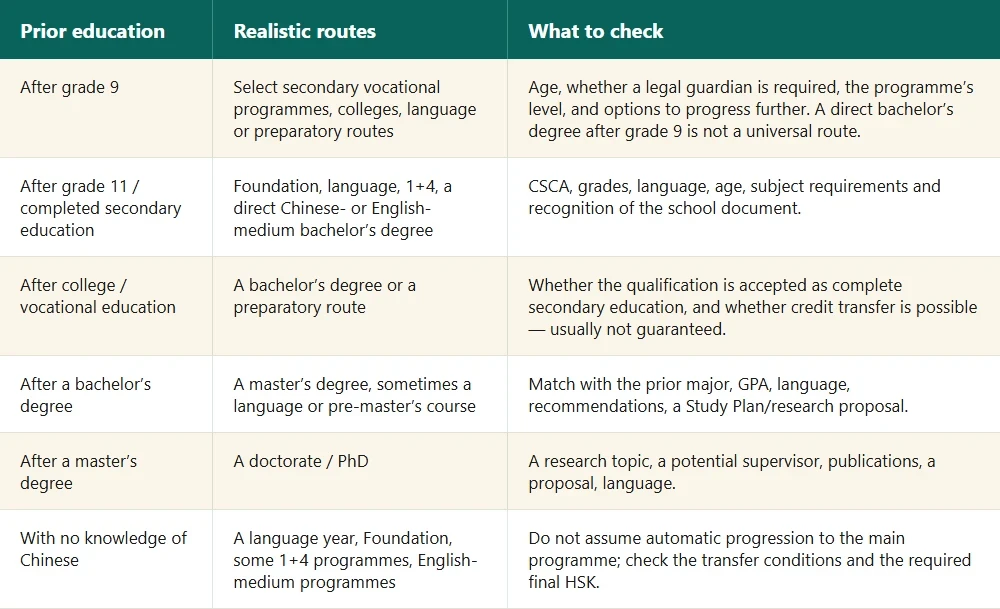
Who can apply to Chinese universities
Age limits
There is no single age limit across all universities. A university may set a limit for a specific level, and a scholarship a separate one. Current rules include, for example, limits of up to 25 for a bachelor’s degree, while language programmes may accept students up to 45 or 55. Applicants under 18 often need guardian documents in China and a financial guarantee.
Citizenship and Chinese heritage
Additional rules apply to foreign citizens of Chinese heritage. Universities may check the date foreign citizenship was acquired, renunciation of Chinese citizenship, and actual residence outside China. This point cannot be assessed from the current passport alone — an individual document review is required.
What study options are available
1. A language semester or a language year
Suits those who want to learn Chinese before enrolling in a degree programme, or to complete a standalone language programme. A zero-level intake is usually available, and a placement test is run after arrival. A language year does not by itself guarantee bachelor’s admission: you must meet the next programme’s requirements, reach the required HSK, and, if needed, pass CSCA.
2. Foundation / a preparatory programme
Foundation combines language and academic preparation. Content depends on the direction: mathematics, physics, chemistry, biology, academic Chinese or English. Before paying, check whether the programme leads to a specific university and major, whether the transfer is conditional or guaranteed by contract, and what HSK and average grade are needed at the end of the year.
3. The 1+4 programme
The term "1+4" usually means one preparatory year plus four years of a bachelor’s degree. However, this is not a single state-wide format. At one university a student may get a conditional place in the bachelor’s programme right away; at another, they may only complete the language stage and then have to submit a new application. So read the official description, transfer conditions and the contract carefully.
4. A direct Chinese-medium bachelor’s degree
Suits an applicant with a sufficient level of Chinese and academic preparation. The university sets the HSK, CSCA subjects, minimum grades and a possible interview. For technical and medical specialities, mathematics and natural sciences are especially important.
5. An English-medium bachelor’s degree
Lets you start the main programme without a high HSK, but does not remove other requirements. IELTS, TOEFL or official confirmation that your prior education was in English may be required. CSCA in mathematics and subject-specific fields may remain required even if Professional Chinese is not.
6. A master’s degree and doctorate
For a master’s degree and PhD, more than just a diploma and language matter. Universities often assess your match with the prior major, average grade, recommendations, motivation, a research plan, publications, a portfolio and a supervisor’s consent. Conditions vary greatly by university and faculty.
7. Short-term programmes and camps
Summer and winter schools, one-month or one-semester programmes suit getting to know China and the language. They are not equivalent to full degree admission but can help test your interest in the country and prepare for a longer programme.
What to check before paying for a preparatory programme Who issues the Admission Notice; what status the programme has; whether tuition and accommodation are included; whether a new competition is required after the preparatory year; the transfer conditions; whether money is refunded on withdrawal; when visa documents are issued; whether the final certificate is recognised by other universities. |
Do you need a national exam, CSCA, HSK and IELTS
Do you need a national school exam to apply to China
A national school-leaving exam such as Russia’s USE is usually not a universal mandatory document for international applicants to Chinese universities. The application is based mainly on the school document and grades. But the phrase "admission without exams" can be misleading for 2027: a university is entitled to require CSCA, an internal test, an interview or additional academic materials.
What CSCA is and who needs it
CSCA — the China Scholastic Competency Assessment — is a standardised exam for international bachelor’s applicants. It assesses academic readiness and is used by Chinese universities in admission and scholarship review. Official materials list the subjects Professional Chinese, Mathematics, Physics and Chemistry. The specific set of subjects is determined by the university and major.
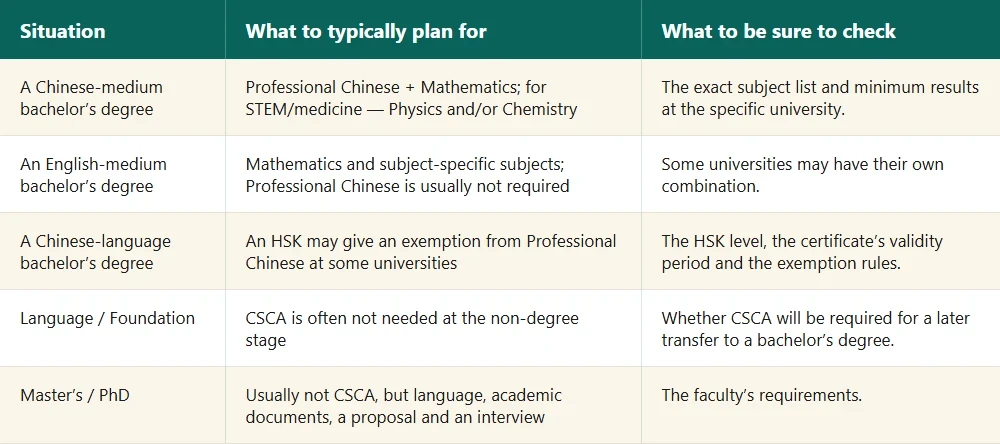
The exam policy is still evolving. An applicant for autumn 2027 should not wait for applications to open: it makes sense to choose an approximate range of majors early and start preparing in mathematics, language and subject-specific fields.
What HSK level do you need
Chinese-language requirements depend on the programme. HSK 4 or HSK 5 is often required for a bachelor’s degree, but the minimum score and additional requirements are set by the university. Humanities, journalism, law and medical programmes may need a higher level. The certificate usually has a limited period of recognition, which should be checked in the instructions.
Do you need IELTS or TOEFL
For English-medium programmes, a university may request IELTS or TOEFL. Some universities accept a Medium of Instruction document confirming that your prior education was entirely in English. For example, some programmes explicitly allow an exemption from a language certificate when official confirmation of prior English-medium education is provided.
Important not to confuse these HSK checks Chinese. IELTS/TOEFL confirm English. CSCA assesses academic readiness for a bachelor’s degree and may include Professional Chinese, mathematics, physics and chemistry. One certificate does not automatically replace another. |
What documents are needed to apply to China
The final set is only formed once a university has been chosen. The list below is a basic set. Translation, notarisation, legalisation or apostille requirements depend on the country where the document was issued, the university, and the stage of application.
Basic documents
- A valid ordinary international passport. Its validity must cover the period set by the university and visa rules.
- An education document: a school certificate, or a college, bachelor’s or master’s diploma.
- An appendix/transcript with subjects, grades and, if needed, an explanation of the grading system.
- A translation of documents into Chinese or English; the certification format is set by the university.
- A photo in the required format.
- The university’s online application form.
- Proof of language: HSK, IELTS, TOEFL, or a Medium of Instruction letter if allowed.
- CSCA results for a bachelor’s degree, if required by the university or programme.
Documents often required additionally
- The Foreigner Physical Examination Form. It is usually valid for six months; an incomplete form, a missing photo, stamp or doctor’s signature can make it invalid.
- A police clearance certificate — if listed in the instructions. It should not automatically be assumed mandatory for every university.
- A motivation letter / Personal Statement.
- A Study Plan or Research Proposal — especially for a master’s degree, PhD and scholarships.
- Recommendation letters — more often for a master’s degree and doctorate.
- A portfolio — for art, design, architecture and creative programmes.
- A financial guarantee, bank statement or sponsor letter.
- Guardian documents for an applicant under 18.
- Preliminary consent from a supervisor or faculty — for some graduate programmes.
- A copy of a current Chinese visa/residence permit and a certificate from your current university, if the student is already in China.
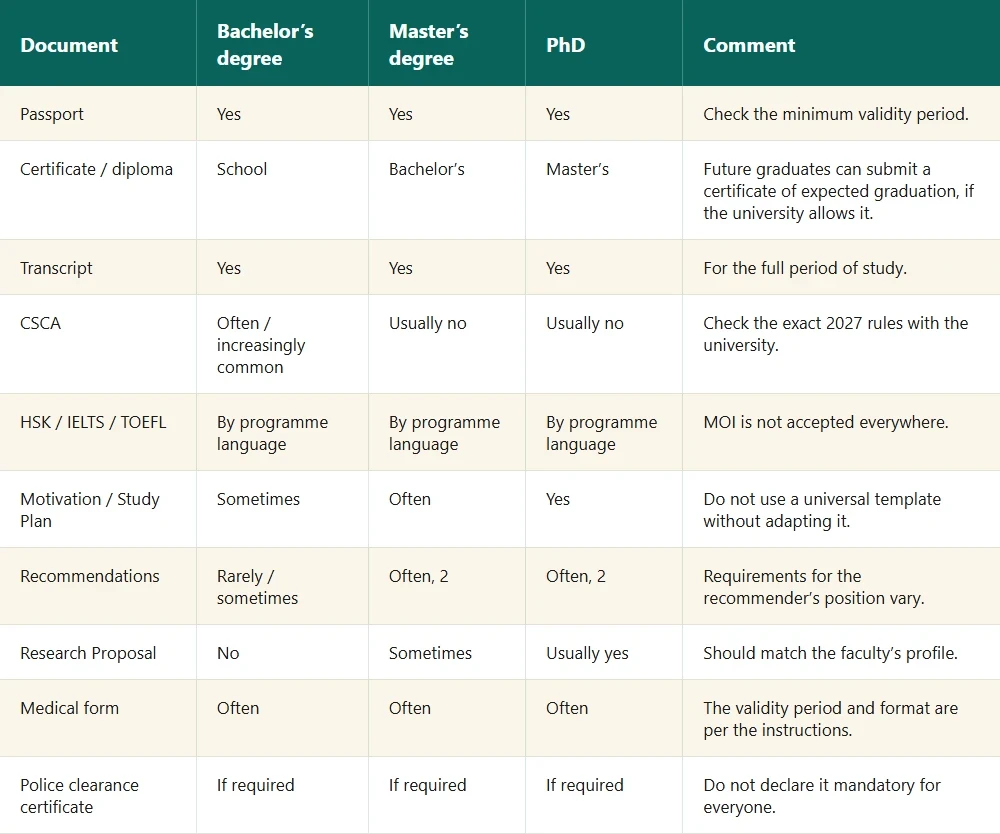
Translation, notarisation, apostille and legalisation
Do not apply the rule "every document must be apostilled" to every applicant. Some universities accept scans of notarised translations at the application stage, others require notarised copies, while originals or legalised documents are checked at registration. The order depends on the country, the type of document, and the university’s policy. A specialist should build an individual checklist once the programmes are chosen.
How to apply to China: step by step
- Define your goal. Level of study, major, language, desired city, budget, spring or autumn 2027.
- Assess your profile. Age, citizenship, education, grades, language, passport validity, health limitations, and readiness for CSCA.
- Build a long list. Collect 10–15 programmes that formally fit, rather than choosing one university by ranking alone.
- Check each programme. The official intake status, deadline, language, CSCA, HSK/IELTS, cost, dormitory, a grant, and diploma recognition.
- Prepare for exams. Register for CSCA, HSK, IELTS/TOEFL or an internal test with enough time for a retake.
- Gather documents. Get certificates, translations, recommendations, a medical form, a motivation letter, a Study Plan and a portfolio.
- Submit applications. Fill out forms without blank fields or contradictions; upload readable files; pay the application fee if required.
- Go through selection. Respond to university requests, attend an interview or exam, and send additional documents on time.
- Get admitted. Check the Admission Notice, financial terms, refunds, the payment deadline and visa documents.
- Arrange the visa and travel. Get the X1/X2, book a dormitory, prepare originals, insurance, registration and an arrival plan.
Why you should not apply to just one university Admission and grants depend on competition, quotas, place availability, document checks and faculty decisions. A sensible strategy includes several universities at different difficulty levels and one or two backup routes. |
How much studying and living in China costs
Cost depends heavily on the city, university, language and major. Below are benchmarks for an initial budget, based on official 2026 university rates. For 2027 admission, every figure needs to be updated once the new fee schedule is published.
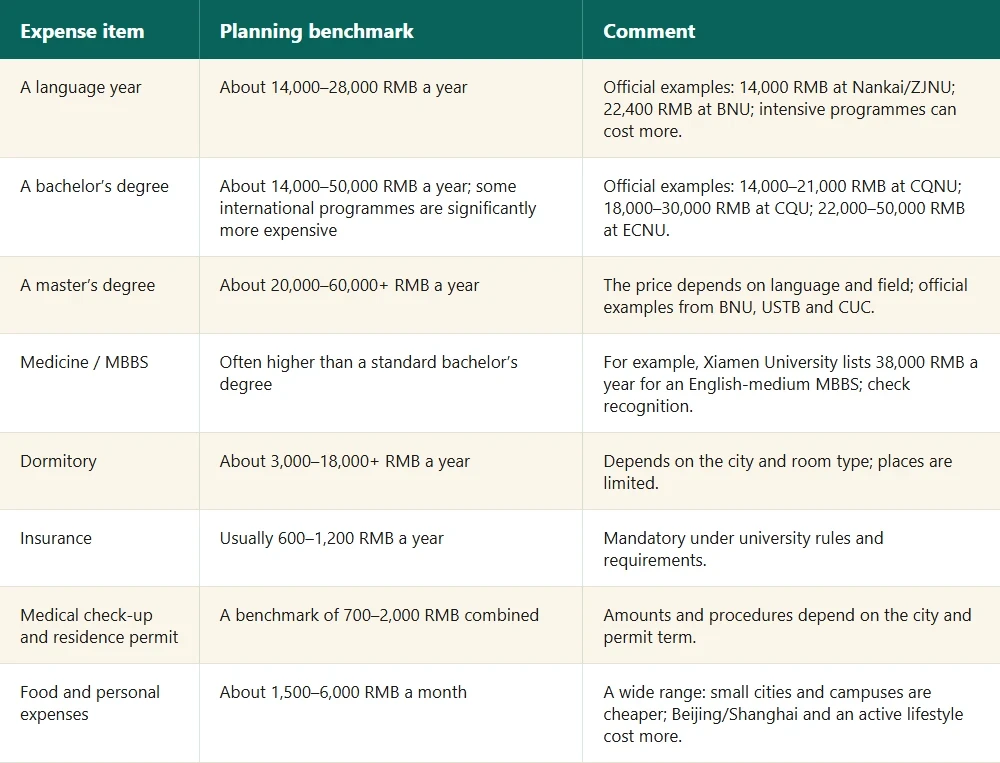
Source: East China Normal University, Xiamen University
Expenses often forgotten
- The application fee: usually non-refundable, even if the student is not admitted.
- Translations, notarisation, legalisation or an apostille — if required.
- CSCA, HSK, IELTS/TOEFL and preparing for them.
- A dormitory deposit, bedding, utilities and internet.
- The visa, a post-arrival medical check-up and the residence permit.
- Flights, a transfer, a SIM card, a bank account and initial expenses.
- The currency exchange difference and bank fees.
- Professional support, if the student uses an agency’s services.
How to list prices on the website The article’s main currency is RMB. If a ruble, dollar or other-currency equivalent is added, it must include the exchange-rate date and a "for reference" note. Do not fix a ruble equivalent without regular updates. |
Grants and scholarships in China
International students can apply for several types of funding. But the word "grant" does not automatically mean free tuition and accommodation: coverage, competition and requirements differ.
The main types of scholarships
Chinese Government Scholarship / CSC / CGS. State programmes. Depending on the category, they may cover tuition, accommodation, medical insurance and a monthly stipend. Applications can go through authorised national bodies or through the university, per the specific programme’s rules.
Provincial and city scholarships. Funded by local authorities and can give a full or partial tuition exemption.
University scholarships. The university independently sets coverage levels, criteria and whether annual confirmation is required.
The International Chinese Language Teachers Scholarship. A dedicated programme for Chinese language and teacher training. It may cover language programmes; HSK/HSKK requirements and deadlines depend on the category.
Scholarships from specific faculties and international programmes. May take the form of a discount, a tuition waiver, or a competitive payment.
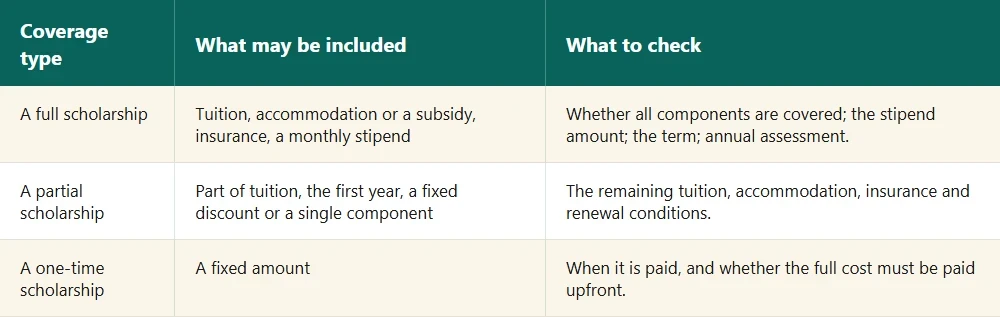
Official university instructions confirm that full state and university scholarships can include tuition, accommodation, insurance and a living allowance, but the exact composition depends on the programme.
What improves your chances of a grant
- High and consistent grades in subject-specific subjects.
- A strong CSCA result for a bachelor’s degree.
- HSK, IELTS or TOEFL above the minimum threshold.
- A clear motivation and a logical link between your prior education and the chosen programme.
- A high-quality Study Plan/Research Proposal.
- An early start: grant deadlines often close earlier than the standard intake.
- Several applications spread sensibly across different competition levels.
What to understand in advance
- A grant cannot be guaranteed before an official decision.
- Some scholarships only apply to the first year or require maintaining an average grade and attendance every year.
- A preparatory or language year is not always included in the main programme’s scholarship.
- At the same time, there are dedicated scholarships specifically for language programmes — do not mix them up with a regular bachelor’s grant.
- Even with a full tuition waiver, a student may still need money for a ticket, a deposit, personal expenses and part of the registration fees.
How to choose a university and city
Ranking matters but should not be the only criterion. The best university for a specific student is one with a suitable major, realistic requirements, an affordable budget, clear housing conditions, and diploma recognition in the country of your future career.
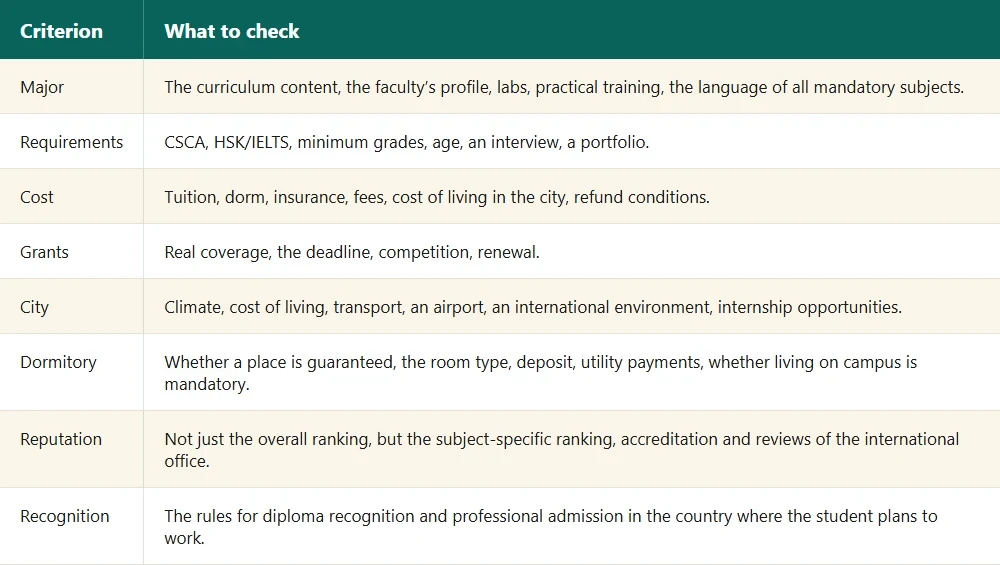
Especially important for medical programmes Before applying to medicine, check not only language and cost but the university’s right to run the chosen programme, the clinical base, the language of practice, and licensing rules in the country of future work. A diploma alone does not guarantee automatic access to medical practice outside China. |
The X1/X2 student visa and preparing for travel
After admission the university issues an Admission Notice and the visa documents required for the type of programme. The student then applies at a Chinese consular office or visa centre in their own country. The final list of documents and timelines must be checked at the place of application.
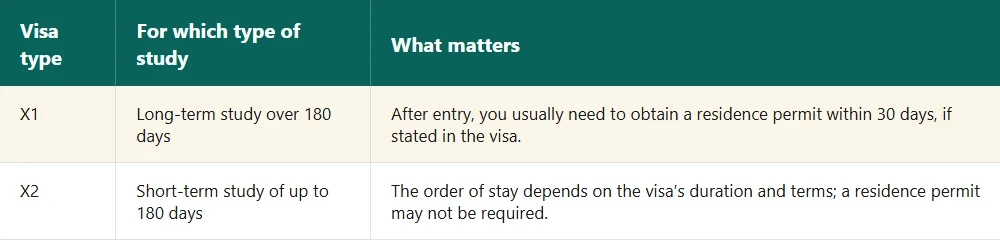
The official visa service defines X1 as a visa for study exceeding 180 days, and X2 for study of up to 180 days. The National Immigration Administration states that holders of a visa requiring a residence permit must apply within 30 days of entry.
What is usually needed for the visa
- An international passport and a visa application form.
- A photo per the requirements of the place of application.
- The Admission Notice.
- A JW201/JW202 or another document required by the programme and the current electronic process.
- Additional documents requested by the consulate or visa centre.
Do not state a fixed visa processing time in the article You cannot promise every student processing in 5–7 business days. The timeline depends on the country, the season, the type of application, document completeness and the consulate’s decision. It’s best to write on the website: "the timeline is confirmed at the visa centre at the place of application." |
Before buying a ticket
- Check the registration date in the Admission Notice.
- Get confirmation of a dormitory or a rental plan.
- Confirm the airport and transfer.
- Prepare original documents and several copies.
- Check the requirements for the medical form and a possible re-examination.
- Find out the rules for bringing medicine and cash.
Dormitory, registration and life after arrival
Arriving in China does not complete the admission process. The student needs to complete university registration, pay mandatory fees, arrange insurance, confirm a medical check-up, and obtain a residence permit if required.
What is usually needed after arrival
- Move in and complete address registration.
- Present original documents: passport, visa, Admission Notice and education documents.
- Pay tuition, dormitory, insurance and registration fees per the instructions.
- Complete or confirm a medical check-up.
- Finish student status registration.
- Apply for a residence permit.
- Arrange a SIM card, a bank account and access to university systems.
An official registration guide for international students describes a standard sequence: moving in, payment, buying medical insurance, student status registration, a medical check and the residence permit.
Dormitory
A dormitory place is not always guaranteed. In large cities, campus rooms may be allocated on a queue basis, by scholarship-holder priority, or after tuition is paid. Check in advance the room type, whether there is a bathroom, utility payments, the deposit, guest rules, holidays, and living off campus.
Medical insurance
Medical insurance is mandatory for international students under state and university rules. A student without the required insurance may not be able to complete registration. Coverage, exclusions, clinics and the reimbursement process differ, so read the policy terms carefully.
Can you work while studying in China
A study visa does not automatically give the right to work freely. To work off campus or do an internship, a student usually needs university approval and must have the place and term of the activity recorded in the residence permit through the exit-entry administration. Without the corresponding off-campus work-study or internship endorsement, such work is prohibited.
Requirements for academic performance, attendance, length of study and permitted employment also apply. You should not plan to pay for tuition through unofficial work after arrival. The possibility of part-time work should be discussed with the university’s international office and the local immigration service.
Common applicant mistakes
- Starting too late — especially dangerous for a grant, CSCA, HSK and the spring intake.
- Choosing a university only by ranking — a high ranking does not make up for a missing programme, language, budget or recognition.
- Trusting an old programme description — a deadline, cost and language of instruction can change from one intake to the next.
- Ignoring CSCA — for 2027 bachelor’s admission, this is one of the key changes.
- Confusing language, Foundation and 1+4 — each route has different transfer conditions and final requirements.
- Treating a grant as guaranteed — the decision is made by the university or the scholarship body.
- Sending the same motivation letter everywhere — a generic text does not explain your choice of programme or strengthen your application.
- Not checking recognition of a medical programme — this can affect the ability to work professionally after graduation.
- Underestimating the full budget — besides tuition, there is a dormitory, insurance, exams, documents, flights and daily life.
- Not reading the refund conditions — an application fee is usually non-refundable, while tuition and a deposit are returned under separate rules.
Frequently asked questions
Can you apply to China without knowing Chinese?
Yes. Realistic options are a language year, Foundation, some 1+4 programmes, and English-medium study. But transferring to a Chinese-medium bachelor’s degree later may require an HSK and CSCA.
Can you apply to China without a national school exam?
A national exam is usually not a single mandatory condition. The university assesses your certificate and grades, but may require CSCA, an interview or an internal test.
Do you need to take CSCA in 2027?
It is safe for a bachelor’s applicant to assume CSCA will be needed. The final list of subjects and requirements is set by the university. Different rules apply for language programmes, a master’s degree and PhD.
Is there a spring intake in 2027?
Yes, but the choice is usually smaller than in autumn. Language, Foundation and select degree programmes are more often available. Deadlines may fall in autumn–December 2026.
When does the autumn 2027 intake start?
Some universities will open applications in late 2026, many at the start of 2027. Grant applications usually close earlier than the standard intake.
Can you apply after grade 9?
Select colleges, vocational and preparatory programmes may be available, but a direct bachelor’s degree after grade 9 is not a standard route. You need to check age, guardian requirements and further study options.
What HSK level do you need for a bachelor’s degree?
Often HSK 4 or HSK 5, but the level, score and certificate validity are set by the specific university and major.
Can you apply for an English-medium programme without IELTS?
Some universities accept a Medium of Instruction document if your prior education was entirely in English. Others require IELTS/TOEFL with no exceptions.
Can you get a full grant?
Yes, programmes exist that include tuition, accommodation, insurance and a stipend. But a grant is competitive, and the coverage depends on the programme.
How much does studying in China cost?
For basic planning, you can use 14,000–50,000 RMB a year for many language and standard degree programmes, but international, art and medical programmes can cost significantly more.
Can you work while studying?
Only in compliance with the rules: university approval and a corresponding endorsement in the residence permit for off-campus work-study or an internship.
What documents are needed for the visa?
Usually a passport, an application form, the Admission Notice and a visa document from the university. The exact list depends on the visa type and place of application.
Can you transfer from another university?
Sometimes, but an automatic transfer with full credit recognition is not guaranteed. A student often has to submit a new application and separately request recognition of subjects.
When is the best time to start preparing?
For autumn 2027 — already in autumn 2026; for spring 2027 — as early as possible in summer–autumn 2026.
A short action plan
- Determine your programme, language and desired intake.
- Check whether you need CSCA, HSK, IELTS or an internal exam.
- Build a list of several universities.
- Prepare your documents and budget in advance.
- Apply for grants earlier than the standard intake.
- After admission, arrange your visa, dormitory and registration.
Start your 2027 China application with a clear plan GE Agency will help assess your profile, select universities and programmes, check requirements and deadlines, prepare documents, submit applications, obtain the Admission Notice and visa documents, and organise your move and settling in. Leave a request and share your citizenship, age, education, major, language, budget and desired intake — spring or autumn 2027. |
Information verified on 19 July 2026. Requirements, cost and deadlines may change. Check the official instructions of your chosen university for the 2027 intake before applying.