Cost-of-living methodology
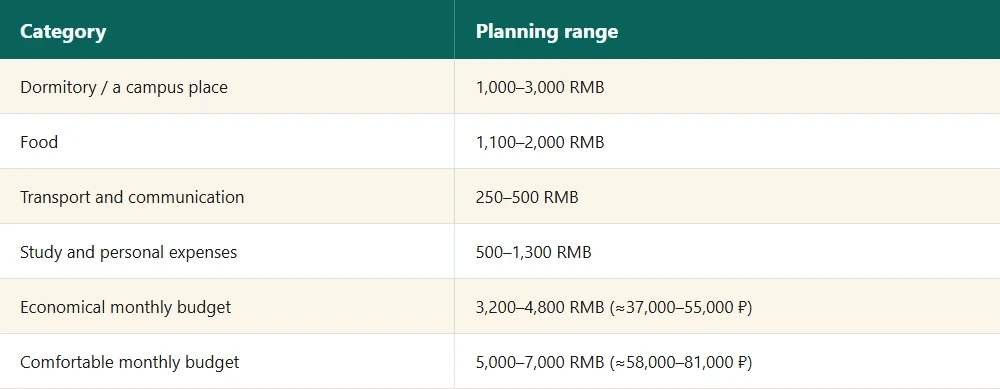
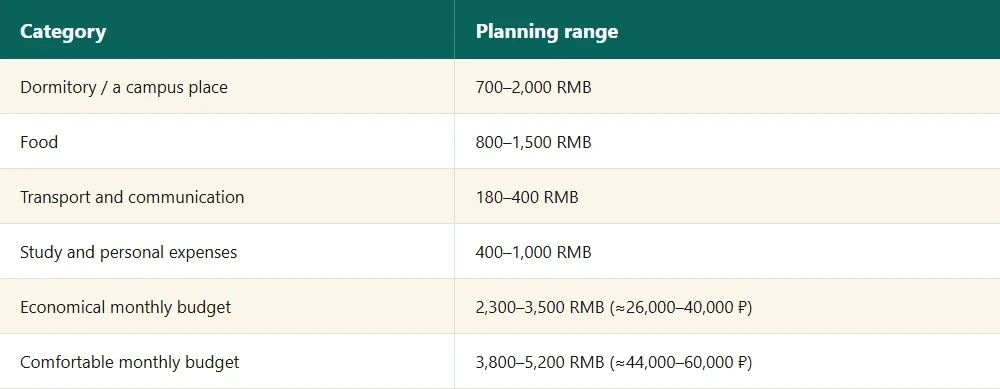
All budgets in this article are planning ranges for a single international student. They are based on prices and university rates available in 2026 and are intended for financial planning ahead of the 2027 intake.
- Included: a dormitory or shared rental, food, city transport, mobile communication, basic study and personal expenses.
- Not included: tuition, application fee, medical insurance, flights, a visa, a housing deposit, major purchases and travel.
- Economical budget: a dormitory, a university canteen, public transport and moderate personal expenses.
- Comfortable budget: a better dormitory type or shared rental, more frequent off-campus meals, sport and leisure.
- Exchange rate used for reference: 1 RMB ≈ 11.5 ₽, per the Bank of Russia’s official rate on 17 July 2026. Ruble figures are rounded.
Important Do not choose a city based only on average rent. In Chinese universities, the same university may have several campuses, and dormitories differ by room type, booking timeline and availability. The final budget is calculated only after choosing a specific university and programme. |
Best cities in China for international students in 2027
Choosing a city in China matters just as much as choosing a university. It shapes your daily budget, climate, the language you use, access to internships, the pace of life, and how easily an international student can adapt in the first few months.
Beijing and Shanghai offer the greatest concentration of well-known universities and international opportunities, but require a higher budget. Shenzhen and Hangzhou are especially appealing for technology, innovation and the digital economy. Guangzhou combines strong medical and engineering programmes with a more affordable cost of living. Harbin stands out for its technical universities, low costs and a cultural environment that many Russian-speaking students find easy to relate to.
There is no universal "best city." For a future engineer, Harbin may be optimal; for a career in international finance, Shanghai; for studying Chinese, Beijing; and for an applicant who wants a balance of budget and opportunity, Guangzhou or Hangzhou. So the comparison should be based not on tourist popularity but on how well the city matches a specific educational goal.
The short answer Beijing — for top universities and Chinese language; Shanghai — for international business and finance; Guangzhou — for a balance of cost, medicine and trade; Shenzhen — for IT and innovation; Hangzhou — for digital, e-commerce and a comfortable environment; Harbin — for engineering and a minimal budget. |
How to choose a city to study in China
1. Major first, then city
The most common mistake is choosing a city for its fame and only then looking for a programme. The right sequence is the reverse: determine your major, language of instruction, level of study and budget; then compare cities that have suitable universities. Engineering needs a lab base and industry ties, medicine needs clinical practice and the language used with patients, and business needs location and a professional environment.
2. The real budget, not just the tuition fee
Even an affordable programme in an expensive city can end up financially harder than a higher tuition fee in a budget-friendly city. Add up tuition, dormitory, insurance, food, transport, flights and a reserve. If a dormitory is not guaranteed, calculate shared and standalone rental, a deposit and a commission in advance.
3. The language of study and the language of life
An English-medium programme does not mean Chinese is unnecessary. It affects everyday independence, communication with administration, medicine, internships and professional contacts. In large international cities you can stay inside an English-speaking circle for longer; in Harbin, or a less international district, Chinese becomes necessary sooner.
4. Climate and health
The difference between Harbin and Guangzhou is not just weather — it is a different way of life. A cold, dry winter requires clothing and adjustment; southern humidity requires resilience to heat and air conditioning. For students with chronic conditions, climate and access to healthcare should be part of the decision.
5. Campus and distances
A city’s name does not show its real geography. A university may be located in a suburb, have several campuses, or move students between them. Before paying, check the exact faculty and dormitory address, the nearest metro station, and the average commute time.
6. Career and the practical environment
Beijing is strong in research, education and government institutions; Shanghai in finance and international business; Shenzhen in technology and hardware; Guangzhou in trade, manufacturing and medicine; Hangzhou in digital and e-commerce; Harbin in engineering, aerospace and shipbuilding. But a city only works together with a strong programme, Chinese language skills and a portfolio.
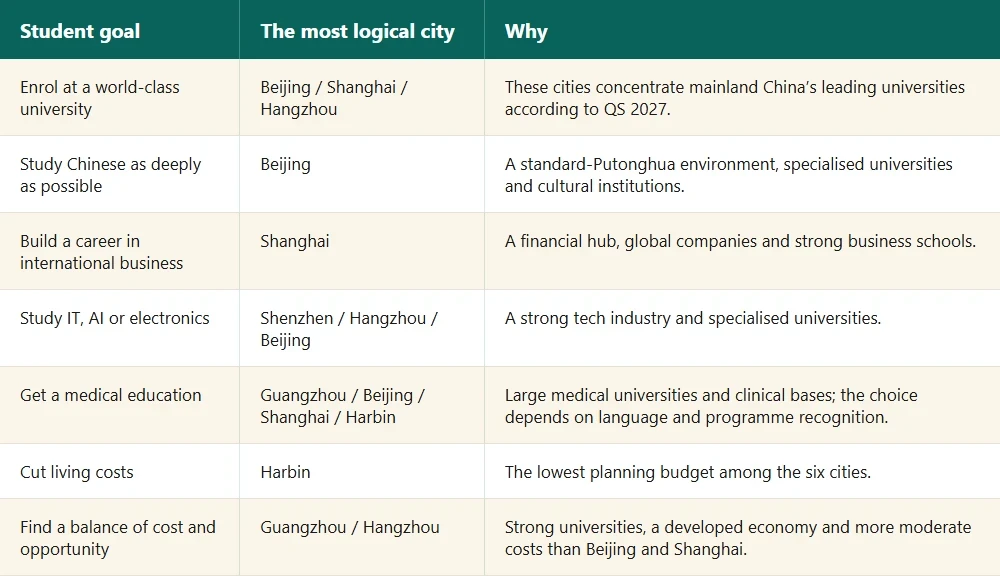
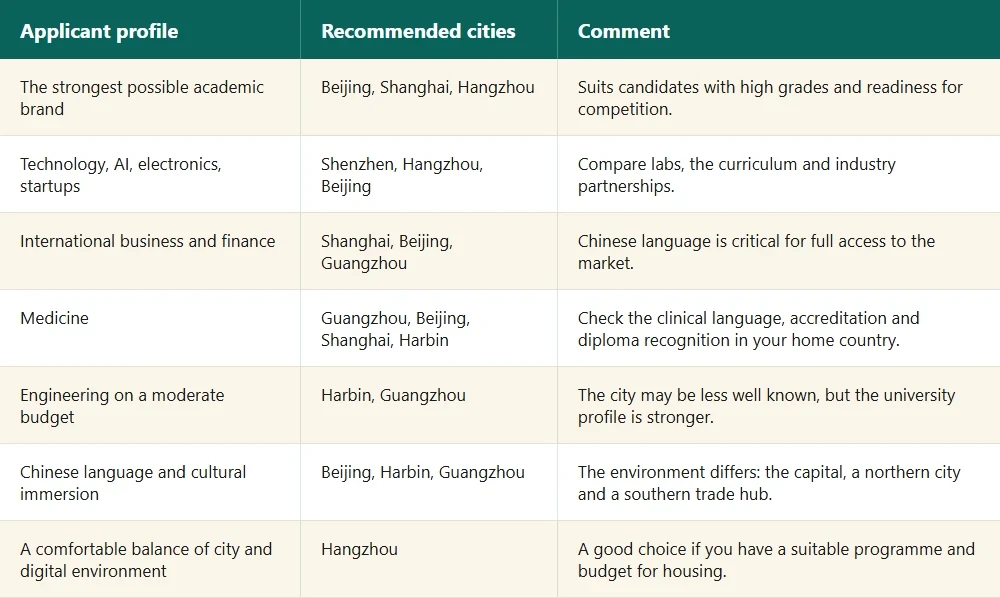
A city-selection matrix
What to check before your final decision
- Campus: the exact address of the faculty and dormitory, not just the university’s main address.
- Dormitory: whether a place is guaranteed, when booking opens, and the cost of a specific room type.
- Language: what language the main subjects, exams, labs and clinical practice are taught in.
- Full budget: tuition, housing, insurance, food, transport, flights, a deposit and a reserve for at least two months.
- Programme: availability of the needed specialisation, subjects by semester, labs, faculty and graduation requirements.
- Documents: application deadlines, legalisation, a language certificate, CSCA or other entrance requirements for the specific intake.
A practical principle If two cities seem equally suitable, the advantage should go not to the more famous city but to the university with the better programme, a confirmed dormitory and a clear full budget. |
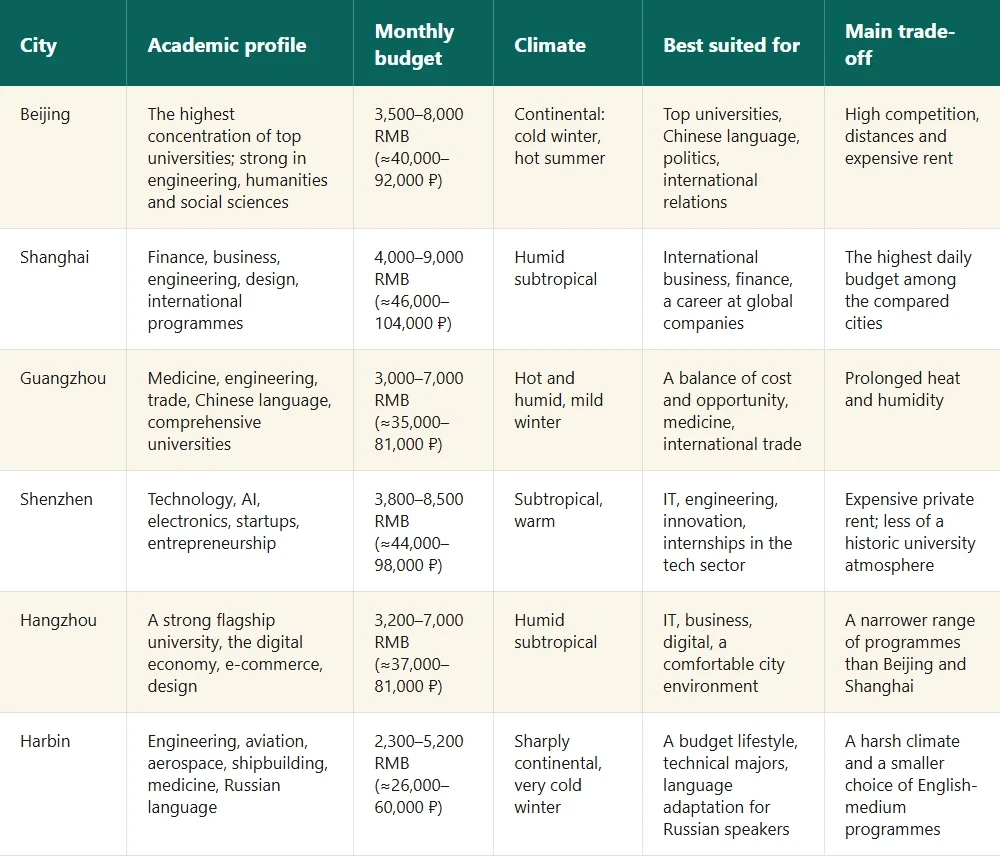
Comparing the best cities in China for international students
The ranges reflect different living models: the lower bound is a dormitory and an economical lifestyle; the upper bound is more comfortable housing, off-campus meals and broader personal expenses. Tuition is not included in the budget.
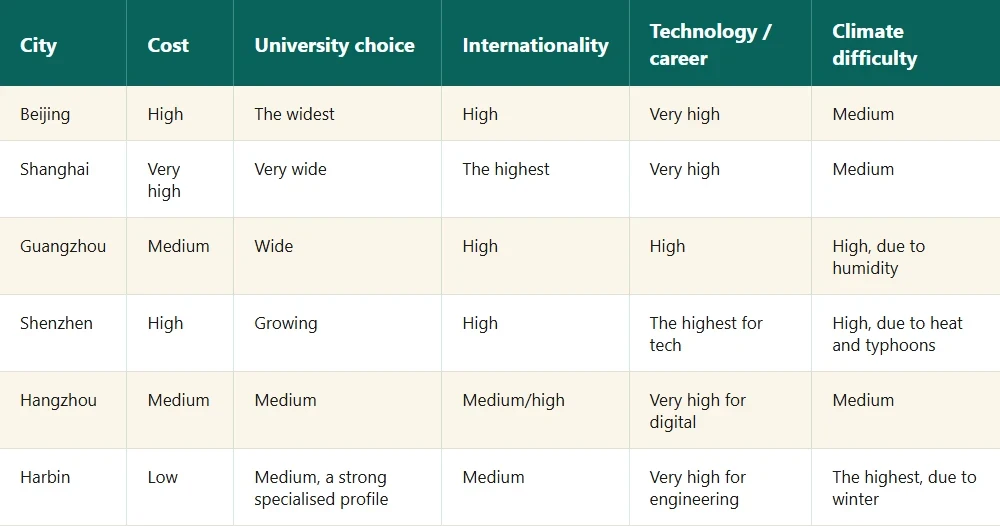
Comparison by key criteria
1. Beijing
The best choice for the highest academic level and deep immersion in Chinese culture.
Beijing is China’s education capital. It is home to Peking University and Tsinghua University, ranked 13th and 14th in the QS World University Rankings 2027, along with dozens of specialised universities in languages, economics, aviation, education, medicine and international relations. The city suits an applicant ready for strong competition, a large scale, and an intensive academic environment.
Why international students choose Beijing
Beijing offers the widest choice of strong universities in a single city. You can pick either an elite research programme or a more applied option with a moderate cost.
For studying Chinese, the capital is especially effective: a student interacts daily with standard Putonghua, while cultural and government institutions turn the city into an extra classroom.
In Beijing it is easier to build an academic path in international relations, economics, political science, law, philology, engineering, IT and natural sciences.
The city offers a large international community, professional events, conferences, and contacts with companies, embassies, research centres and public organisations.
Leading universities and strong fields
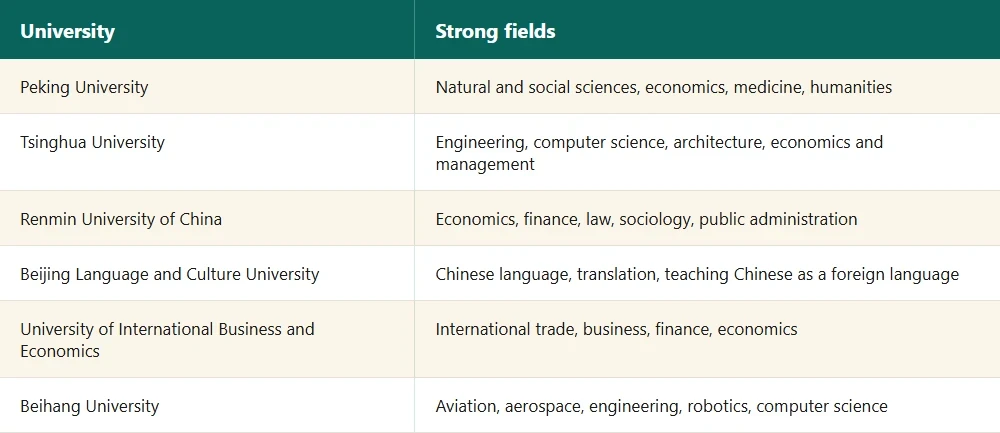
Source: Peking University, Tsinghua University, Renmin University of China, Beijing Language and Culture University, University of International Business and Economics, Beihang University
Cost of student living
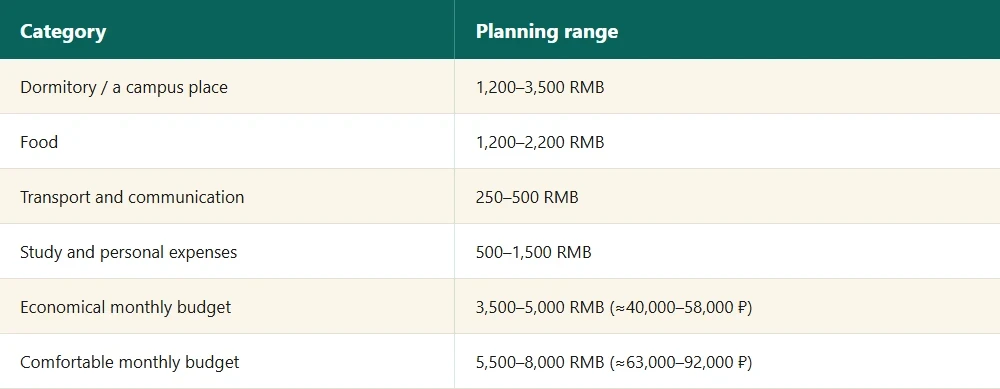
Cost of living and housing
The biggest expense in Beijing is housing. According to Numbeo data for June 2026, renting a one-bedroom apartment in the city centre averaged over 6,800 RMB a month, and about 3,900 RMB outside the centre. It makes more sense for a student to rely on a university dormitory, a shared rental, or housing closer to campus but not necessarily in central districts. A dormitory place is usually much cheaper than a standalone apartment, but the number of rooms is limited and booking may run on a short timeline.
Transport and the city’s scale
Beijing is huge. Even a well-developed metro does not eliminate long commutes: choosing the wrong district can add an hour or more to your daily schedule. When comparing universities, look not just at the city’s name but at the specific campus, the nearest metro station, dormitory availability and the distance to the faculty.
Climate and adaptation
Winter in Beijing is cold and dry, summer is hot. Spring can be windy, and the temperature swing between seasons is noticeable. Students from warm countries will need winter clothing and time to adjust; for Russians, the climate often feels more familiar than the humid heat of southern China.
Career and internships
Beijing is especially strong for an academic career, research projects, government and international relations, education, media, technology and large national companies. However, an international student should not base their choice solely on an assumed part-time job: internship and work rules depend on visa status, university permission and current requirements.

Beijing is worth choosing for an ambitious applicant for whom an academic brand, a wide choice of programmes and access to China’s largest education ecosystem matter. For a student on a limited budget, the city remains realistic only with a dormitory place, a scholarship or clearly calculated shared rental.
2. Shanghai
An international megacity for business, finance, engineering, design and a global career.
Shanghai combines a university environment with mainland China’s largest financial and business hub. Fudan University and Shanghai Jiao Tong University rank 26th and 36th in the QS World University Rankings 2027; the city is also home to Tongji University, East China Normal University, Donghua University and Shanghai University. It is one of the most approachable cities for a foreigner, but also one of the most expensive.
Why international students choose Shanghai
Shanghai offers strong programmes in finance, economics, international business, engineering, architecture, design, medicine and data-related fields.
The city makes it easier to find an English-speaking environment, international companies and mixed student communities. This reduces stress in the first months but can slow down learning Chinese if a student stays only within a foreign-language circle.
Universities are closely tied to the business world. For master’s and business students, guest lectures, case competitions, professional communities and corporate events are especially valuable.
Shanghai suits those who see their studies as a step in an international career and are willing to pay for infrastructure, mobility and a global context.
Leading universities and strong fields
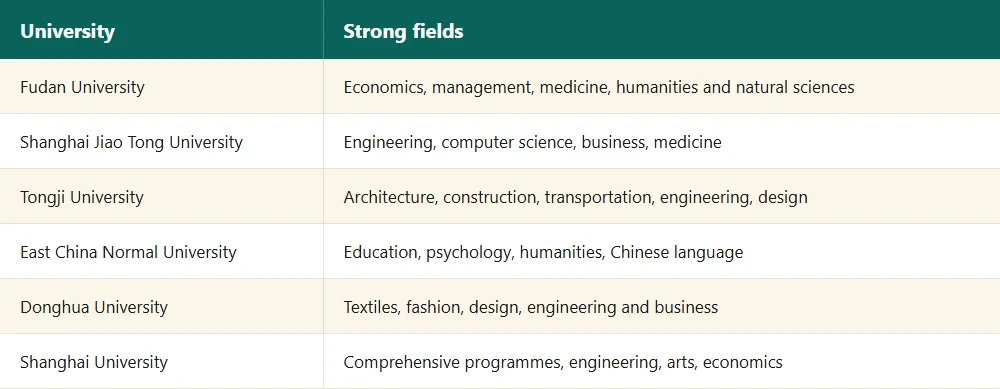
Source: Fudan University, Shanghai Jiao Tong University, Tongji University, East China Normal University, Donghua University, Shanghai University
Cost of student living
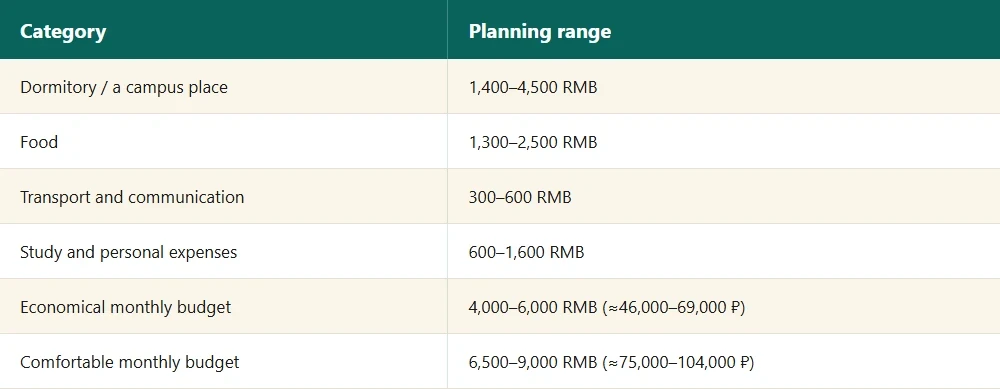
Cost of living and housing
According to Numbeo data for June 2026, a standalone one-bedroom apartment in central Shanghai cost on average around 6,400 RMB a month, and about 3,950 RMB outside the centre. University dormitories are cheaper, but the rate depends on the campus and room type. For example, Shanghai Jiao Tong University listed a range of 6,600–12,600 RMB per semester for some international programmes. So the city budget should only be calculated once the campus is confirmed and accommodation is verified.
The city environment
Shanghai is convenient because international services, cafés, cultural events and professional gatherings are available almost around the clock. At the same time the city has several business and university centres. A campus can be far from central districts, so the lifestyle of an SJTU student in Minhang and a Fudan student in Yangpu will differ noticeably.
Climate
Summer is hot and humid, winter is cool and damp. Winter temperatures are usually higher than in Beijing or Harbin, but due to the humidity, indoors and outdoors can feel colder. Air conditioning and heating depend on the type of housing.
Career and language
Shanghai is especially useful for students who want to grow in finance, international trade, consulting, logistics, design, engineering and technology. English may be enough for a specific programme, but Chinese significantly expands access to internships, networking and daily life.

Shanghai is optimal for a student oriented toward international business, a career at a major company, finance, engineering or creative industries, and who values a global environment. On a limited budget the city should only be chosen once a dormitory and a full financial plan are confirmed.
3. Guangzhou
A balanced city for medicine, engineering, international trade and affordable living in southern China.
Guangzhou is a major education, trade and medical hub in southern China. It is home to Sun Yat-sen University, South China University of Technology, Jinan University, South China Normal University, Southern Medical University and Guangdong University of Foreign Studies. In terms of university level, internationality and cost of living, the city is often more practical than Beijing and Shanghai.
Why international students choose Guangzhou
Guangzhou offers a strong choice of programmes in medicine, engineering, business, international trade, Chinese language and education.
The city is part of the Greater Bay Area economic system and is connected by high-speed transport to Shenzhen, Hong Kong, Foshan and other hubs in the region.
The cost of private rent is on average lower than in Beijing, Shanghai and Shenzhen, and food can remain affordable when using university canteens and local eateries.
The city has long had a large international community, including students, entrepreneurs and professionals from Africa, the Middle East, the CIS and Asia.
Leading universities and strong fields
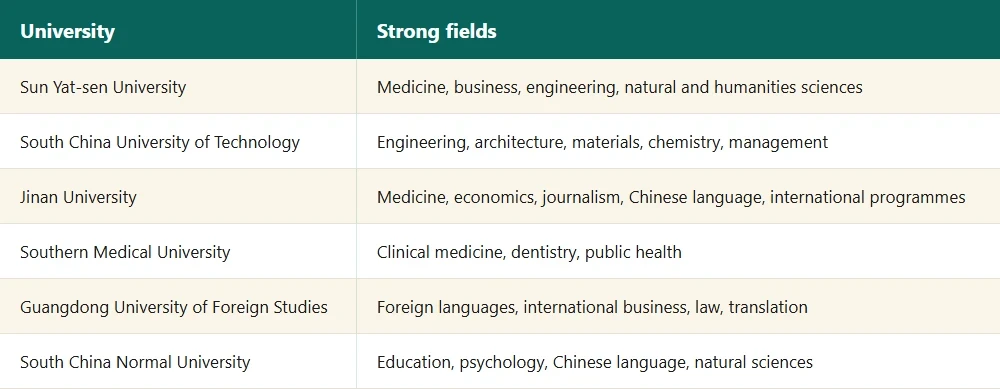
Source: Sun Yat-sen University, South China University of Technology, Jinan University, Southern Medical University, Guangdong University of Foreign Studies, South China Normal University
Cost of student living
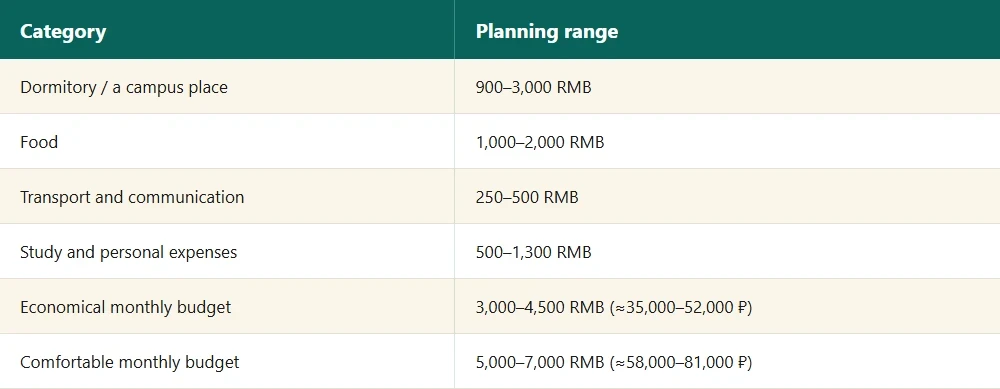
Cost of living and housing
According to Numbeo data for June 2026, average rent for a one-bedroom apartment in central Guangzhou was about 3,600 RMB, and about 1,900 RMB outside the centre. For a student this is one of the most attractive figures among China’s largest cities. However, university campuses are spread across different districts, so low rent should not come at the cost of a two-hour daily commute.
Medicine and international trade
Guangzhou is especially interesting for international applicants to medical programmes and students who want to link their education to import, export, logistics and Asian markets. The city hosts the Canton Fair, and its business environment is oriented toward manufacturing and international trade. For a future doctor, it is most important to check the language of clinical practice, internship requirements and diploma recognition in their home country.
Climate
The climate is hot and humid, with a long summer and a mild winter. For students from northern countries, the absence of a harsh winter can be an advantage, but humidity, the rainy season and heavy use of air conditioning require adaptation.
Language and daily life
Cantonese is heard in daily life, but teaching, official communication and most interactions take place in Putonghua. Learning standard Chinese remains a sufficient base, and getting to know Cantonese culture becomes an added benefit.

Guangzhou is one of the best all-round options for an international student: sufficiently strong universities, a moderate budget by megacity standards, an international environment and access to the southern economic cluster. The city is especially worth considering for future doctors, engineers and trade specialists.
4. Shenzhen
A city of technology and startups for students who value innovation, industry and a modern career.
Shenzhen has grown into one of Asia’s largest technology hubs. The city is home to Shenzhen University, Southern University of Science and Technology, Harbin Institute of Technology (Shenzhen), CUHK-Shenzhen and Shenzhen MSU-BIT University. Unlike Beijing or Shanghai, its university history is younger, but its ties to the tech industry are especially strong.
Why international students choose Shenzhen
Shenzhen is a natural environment for computer science, artificial intelligence, electronics, robotics, telecommunications, biotechnology and entrepreneurship.
The city is tied to Greater Bay Area companies and manufacturing chains. A student sees not just theory but a real hardware, software, fintech, EV and smart-manufacturing ecosystem.
Many new universities are building international, English-medium programmes. SUSTech, for example, highlights a high share of faculty with overseas experience and English-medium instruction for international students.
For Russian-speaking applicants, Shenzhen MSU-BIT University is of particular interest — a joint Russian-Chinese university — though the programme and language of instruction should be checked for the specific intake.
Leading universities and strong fields
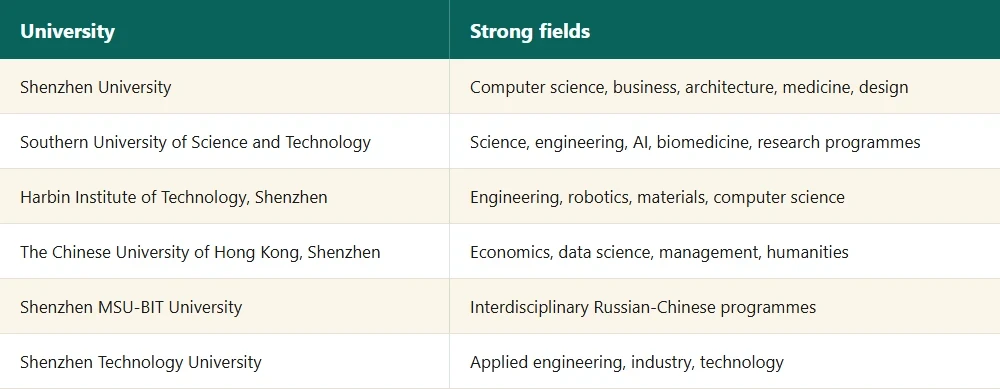
Source: Shenzhen University, Southern University of Science and Technology, Harbin Institute of Technology, Shenzhen, The Chinese University of Hong Kong, Shenzhen, Shenzhen MSU-BIT University, Shenzhen Technology University
Cost of student living
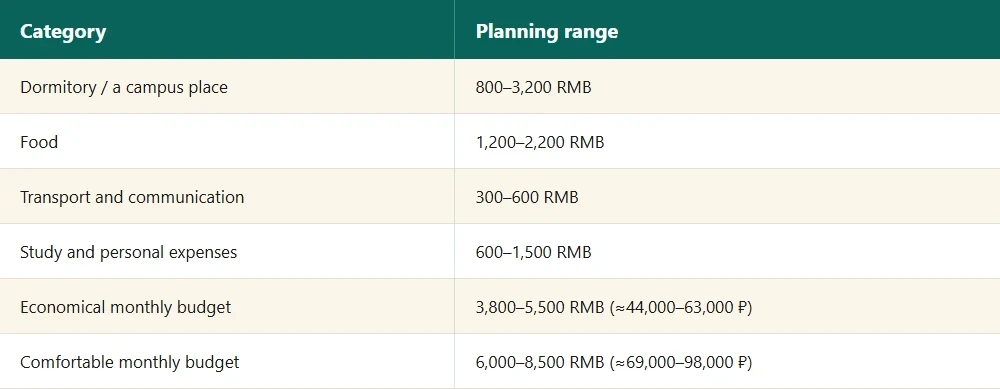
Cost of living and housing
Shenzhen is expensive primarily because of housing. According to Numbeo data for June 2026, a standalone one-bedroom apartment in the centre cost on average around 5,300 RMB, and about 3,500 RMB outside the centre. A university dormitory changes the picture completely: SUSTech, for example, listed the cost of a four-bed room in some visiting programmes at 600 RMB a month. These figures cannot be applied to every programme, but they show how important it is to secure campus housing.
Studying close to industry
Shenzhen’s advantage shows when your major matches the city’s economy. For a student in computer science, electronics, AI, engineering management or entrepreneurship, the city can offer more practical context than a university with a higher overall ranking but weaker industry ties.
Climate and lifestyle
The city is warm, green and modern. Summer is humid and hot, with possible typhoons and heavy rain. Winter is mild. Shenzhen feels faster and younger than China’s historic cities, and a large share of residents from other provinces makes Putonghua the main language of communication.
Career
For practice and professional contacts, Shenzhen is very strong, but an international student still needs Chinese language skills, relevant abilities and a properly arranged internship. Simply being present in a tech city does not guarantee employment; the university, portfolio and specialisation are decisive.

Shenzhen suits a student who wants to study at the heart of the tech industry, is ready to develop practical skills, and sees their education as part of a career in AI, electronics, engineering, business or innovation. For a classic humanities track, Beijing or Shanghai often offer a wider choice.
5. Hangzhou
A balance of a strong university, the digital economy, a comfortable environment and a more moderate scale.
Hangzhou is known for Zhejiang University, one of China’s leading universities, ranked 47th in the QS World University Rankings 2027. The city is also linked to Alibaba and the digital economy, and its university ecosystem includes Zhejiang University of Technology, Zhejiang Gongshang University, China Academy of Art, Hangzhou Normal University and Communication University of Zhejiang.
Why international students choose Hangzhou
Hangzhou provides access to a world-class university without the scale of Beijing or Shanghai. For many students this is the optimal balance of academic quality and everyday comfort.
The city is especially interesting for computer science, e-commerce, digital marketing, business, data-related fields, design, media and art.
The city’s tech economy creates an environment for case studies, practical projects and entrepreneurial thinking.
Life in Hangzhou is usually a bit calmer and cheaper than in Shanghai, while high-speed rail lets you take advantage of opportunities across the whole Yangtze River Delta region.
Leading universities and strong fields
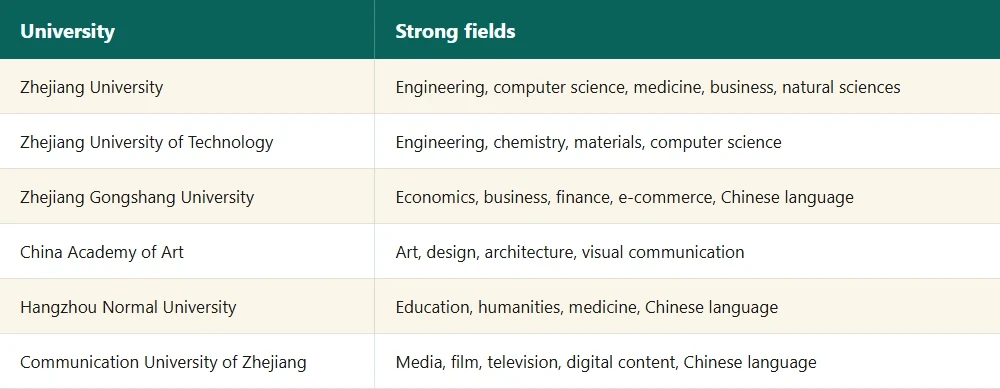
Source: Zhejiang University, Zhejiang University of Technology, Zhejiang Gongshang University, Hangzhou Normal University, Communication University of Zhejiang
Cost of student living
Cost of living and housing
According to Numbeo data for June 2026, rent for a one-bedroom apartment in central Hangzhou averaged around 4,170 RMB, and about 2,500 RMB outside the centre. This is cheaper than central rent in Beijing, Shanghai and Shenzhen, but it is no longer a budget-level figure. Zhejiang University has several campuses and publishes separate rates for international dormitories, so housing needs to be calculated by the specific place of study.
The digital economy and areas of study
Hangzhou is often called one of the centres of China’s digital economy. This is especially valuable for students choosing e-commerce, data analytics, fintech, computer science, digital media and management programmes. That said, a programme’s academic level needs a separate assessment: Alibaba’s presence in the city does not replace the quality of the curriculum and faculty.
City environment and climate
Hangzhou is green, visually appealing and well developed for tourism. Summer is hot and humid, winter is cool and damp. The city’s popularity raises housing costs in convenient districts, and tourist areas can get crowded on holidays.
Who it especially suits
The city suits students who want a strong flagship university or a modern digital-field programme without living in the largest possible megacity. For art and design, China Academy of Art makes Hangzhou a distinct hub of its own.

Source: Zhejiang University
Hangzhou is a strong choice for students in IT, business, digital, media and design, and for those who value a balance between academic level and the quality of the city environment. When choosing, distinguish the city’s prestige from the quality of a specific university: not every programme in Hangzhou is automatically linked to its tech brand.
6. Harbin
The most affordable of the six cities and one of the best options for engineering, aviation, aerospace and adaptation for Russian speakers.
Harbin is a major university hub in Northeast China. Harbin Institute of Technology ranks 190th in the QS World University Rankings 2027 and is known for engineering, aerospace and computer-related fields. The city is also home to Harbin Engineering University, Harbin Medical University, Northeast Forestry University, Northeast Agricultural University and Heilongjiang University.
Why international students choose Harbin
Harbin offers strong technical universities at a lower cost of living than the megacities on the eastern and southern coasts.
The city is especially interesting for engineering, aerospace, automation, shipbuilding, computer science, materials science, medicine and forestry technologies.
The region’s historical ties with Russia are visible in the architecture, culture and presence of the Russian language. This can ease the psychological adaptation of Russian-speaking students, though it does not remove the need to learn Chinese.
A calmer pace and a more compact university life help students focus on their studies.
Leading universities and strong fields
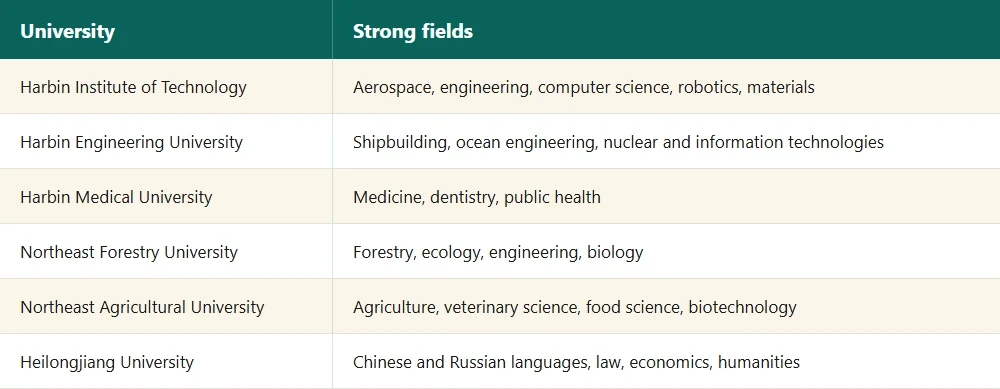
Source: Harbin Institute of Technology, Harbin Engineering University, Harbin Medical University, Northeast Forestry University, Northeast Agricultural University, Heilongjiang University
Cost of student living
Cost of living and housing
Numbeo estimated rent for a one-bedroom apartment in central Harbin at about 2,170 RMB a month in May 2026, though the sample size for the city was significantly smaller than for Beijing or Shanghai, so this figure should be treated with some caution. For an international student, a dormitory remains the most predictable and economical option. Even accounting for winter clothing and seasonal costs, Harbin usually allows for a lower overall budget.
Climate
The main factor to weigh is winter. Temperatures can drop well below zero, the season is long, and good footwear and outerwear are essential. For a student from a warm country, the climate can be a serious source of stress. For Russians, the cold is familiar, but the dry air, wind and specifics of the heating system also require adjustment.
Academic specialisation
Harbin should not be chosen purely to save money. Harbin Institute of Technology and Harbin Engineering University have a strong technical reputation. For an engineering student, the city can offer a more logical trajectory than a trendier megacity with a less suitable programme.
Language and the international environment
Russian-language elements in the city are useful, but the main academic and everyday communication remains Chinese or English, depending on the programme. In a smaller international community, a student starts using Chinese in daily life sooner, which can speed up language progress.

Harbin is not simply "a cheap city" but a specialised choice for engineering, aviation, aerospace, shipbuilding, medicine and natural sciences. It especially benefits a student who ranks the quality of a specific technical programme above a megacity’s international image and is ready for a harsh winter.
Which city to choose: the final recommendation
Choosing the right city starts with three questions: which major do you need, what budget is realistically available for the whole academic year, and how ready are you for a specific climate and pace of life. After that, the choice usually narrows to two or three options.
Conclusion
In 2027, an international student should not limit their choice to just Beijing and Shanghai. These cities genuinely lead in the concentration of strong universities, but Guangzhou, Shenzhen, Hangzhou and Harbin may better match a student’s major, budget and career goal.
Beijing is the best all-round choice for academic ambition and Chinese language. Shanghai is best for global business and an international environment. Guangzhou offers a sensible balance of cost, medicine and trade. Shenzhen suits technology and entrepreneurship. Hangzhou suits digital fields and a comfortable city environment. Harbin suits engineering, a low budget, and students ready for a cold climate.
Get a personal shortlist from GE Agency GE Agency helps compare not just cities but specific universities, programmes, language of instruction, requirements, cost and available grants. A personal recommendation takes into account the applicant’s education, grades, age, desired major, budget and intended year of admission. |