
Shenzhen is one of China’s largest technology and entrepreneurial hubs, a city bordering Hong Kong and a key player in the Guangdong–Hong Kong–Macao Greater Bay Area. In 2025 its permanent population passed 18.24 million, with a GDP of 3.873 trillion RMB.
For international students, Shenzhen’s main advantage is the concentration of universities, research institutes and companies in artificial intelligence, electronics, semiconductors, robotics, telecommunications, fintech, biotechnology, urban innovation and advanced manufacturing. The city also offers a range of education models: a classic state university, a research-intensive STEM university, an English-medium joint university, a Russian-Chinese university, and graduate campuses of Peking University and Tsinghua University.
Shenzhen is more expensive than most Chinese student cities, especially for off-campus housing. However, dormitories at many universities are subsidised, and strong scholarship schemes can significantly reduce the overall cost. The widest price gap is between state universities charging 24,000–40,000 RMB in tuition and CUHK-Shenzhen, where the official bachelor’s tuition for the 2027 intake is 162,000 RMB a year.
Important for the 2027 intake CUHK-Shenzhen has already published dates and rates for 2027. Most other universities will publish their 2027 brochure later. Do not automatically carry over 2026 prices, programme lists and language requirements to the next intake. |
Why international students choose Shenzhen
- A technology ecosystem — the city is tied to companies and industries in electronics, telecommunications, drones, AI, robotics, fintech, e-commerce and smart manufacturing.
- Different university models — Shenzhen University, SUSTech, CUHK-Shenzhen, HIT Shenzhen, Shenzhen MSU-BIT University and Shenzhen Technology University.
- English-medium programmes — CUHK-Shenzhen offers more than 20 undergraduate programmes primarily in English; SUSTech runs an English-medium, highly international environment.
- World-class graduate education — PKU Shenzhen and Tsinghua SIGS offer international candidates master’s and doctoral programmes in engineering, finance, law, environment, materials, AI and public health.
- Proximity to Hong Kong and the Greater Bay Area — the city is next to Hong Kong and connected to Guangzhou, Dongguan, Foshan, Macao and other regional hubs.
- A mild winter — the average annual temperature is around 23°C; summer is long, humid and rainy, and typhoons and heavy rain require some adjustment.
Who studying in Shenzhen suits
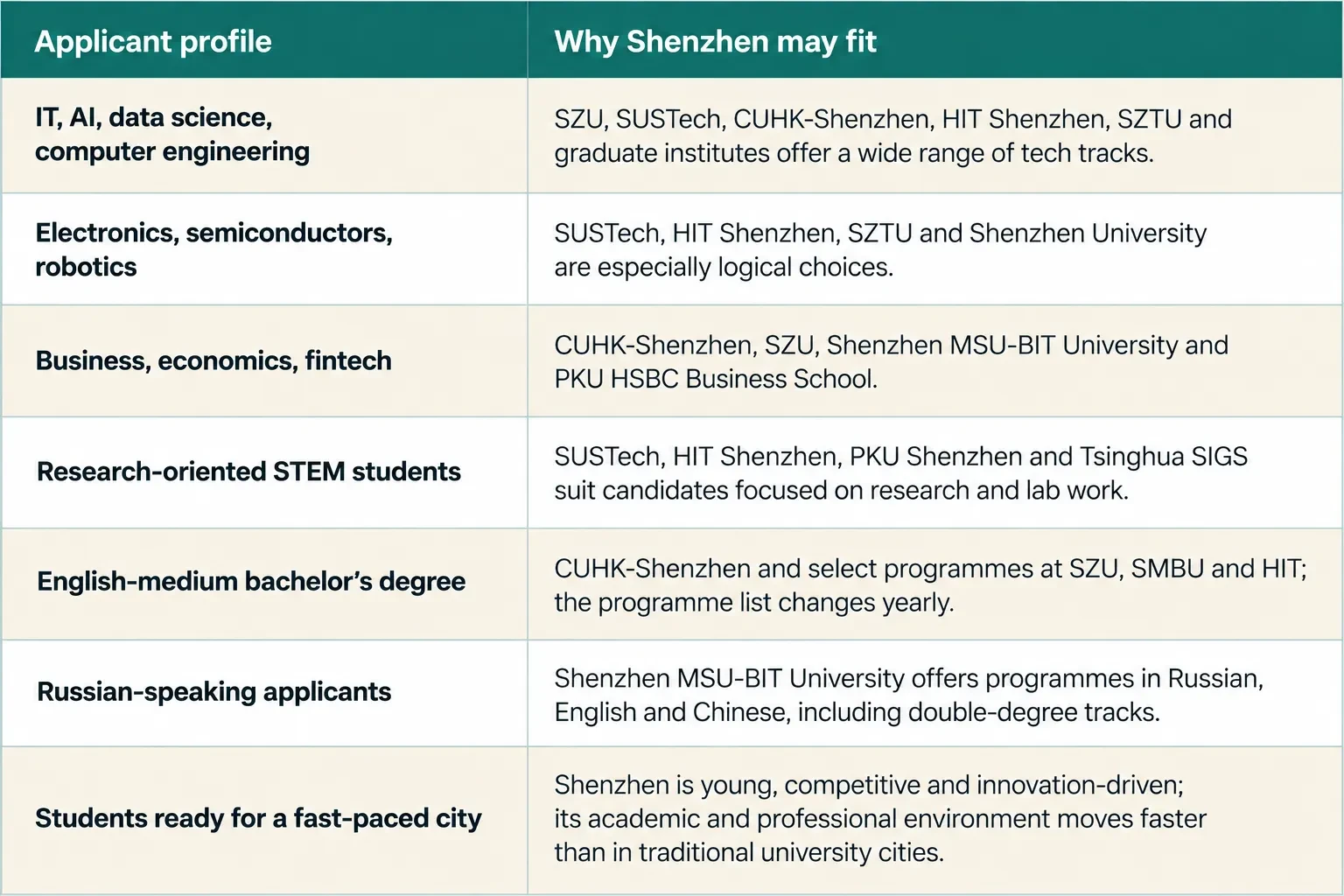
When another city may be better For humanities, politics, history and the highest concentration of national academic institutions, Beijing is more often chosen. For global finance and a more developed international cultural environment — Shanghai. For a more moderate budget — Guangzhou, Harbin, Wuhan, Xi’an or Changchun. |
Best universities in Shenzhen for international students
In Shenzhen it is especially important to distinguish universities with a full international bachelor’s programme from graduate-only campuses. PKU Shenzhen and Tsinghua SIGS are not typical options for a school graduate: they focus primarily on master’s and PhD study.
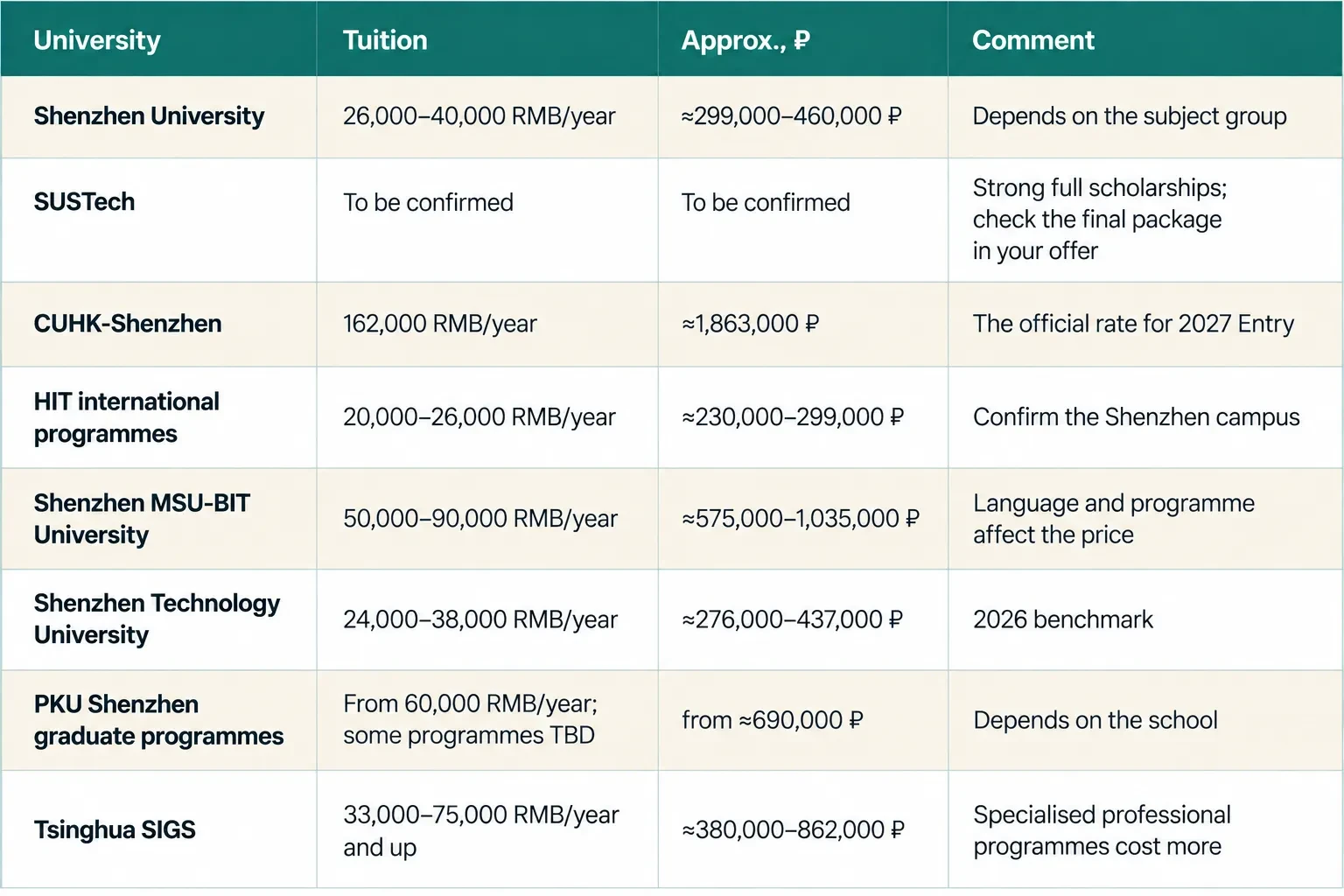
University profiles
Shenzhen University — 深圳大学
The city’s main comprehensive university. In 2026 the international bachelor’s programme accepted applications in two rounds: 1 January–20 March and 20 March–31 May. Tuition was 26,000 RMB for liberal arts, 30,000 RMB for science and engineering, and 40,000 RMB for medicine, arts and physical education. Chinese-medium programmes required HSK 4 or HSK 5 depending on the field; English-medium ones required IELTS 5.5, TOEFL iBT 80 or Duolingo 100.
Who it suits SZU suits applicants who want a wide choice of majors and a relatively moderate cost. Strong areas: computer science, electronics, architecture, business, communication, medicine, materials and Chinese studies. The main risk is a dormitory shortage: the university openly warns that some students may need to live off campus. |
Southern University of Science and Technology — 南方科技大学
A young, research-intensive university focused on science, engineering, technology and interdisciplinary research. International students study in an English-medium, highly international environment; the university highlights its residential college system, mentoring and full scholarships for strong candidates.
Who it suits SUSTech suits candidates with strong maths and natural sciences, research potential and readiness for a competitive selection process. Some programmes may involve an online test and interview. For 2027, tuition, the admission test, the list of majors and the scholarship package need separate confirmation. |
The Chinese University of Hong Kong, Shenzhen — 香港中文大学(深圳)
A premium English-medium university with an international teaching model. For the 2027 intake, tuition is 162,000 RMB a year, accommodation is 2,400 RMB, and recommended personal expenses are about 2,000 RMB a month. There are Early Bird, Regular and Late rounds; deadlines: 1 November 2026, 7 March 2027 and 18 April 2027.
Who it suits CUHK-Shenzhen is especially attractive for business, economics, finance, data science, computer science, engineering, communication and medicine. Selection is competitive: the university targets candidates in the top 20% and requires proof of English, for example IELTS 6.5 or TOEFL iBT 80. Strong entry scholarships may cover part or all of the tuition fee. |
Harbin Institute of Technology, Shenzhen — 哈尔滨工业大学(深圳)
The Shenzhen campus of one of China’s strongest engineering universities. HIT’s general international brochure for 2026 stated tuition of 20,000 RMB for Chinese-medium and 26,000 RMB for English-medium bachelor’s programmes, insurance of 800 RMB, and accommodation of 800–1,000 RMB a month.
Who it suits A candidate should check two things: whether the chosen programme is actually offered on the Shenzhen campus, and where the study will actually take place. HIT’s full international list of majors does not automatically apply to Shenzhen. With the campus confirmed, this is a strong option for AI, engineering, robotics, computer science and materials. |
Shenzhen MSU-BIT University — 深圳北理莫斯科大学
A joint university of the Shenzhen municipal government, Beijing Institute of Technology and Lomonosov Moscow State University. In 2026 programmes were offered in Russian, English and Chinese. Tuition was 50,000 RMB for select English-medium programmes, 70,000 RMB for most Russian-medium tracks, and 90,000 RMB for arts; the dormitory cost 2,400 RMB a year.
Who it suits Especially attractive to Russian-speaking candidates interested in mathematics, physics, biology, AI, materials, economics or Russian philology. Internal exams may be part of admission; rules differ by citizenship and programme. Check in advance whether the chosen track is a single or double degree. |
Shenzhen Technology University — 深圳技术大学
An applied university focused on intelligent manufacturing, robotics, automation, electronics, IoT, AI and industrial design. In 2026 international tuition was 24,000 RMB for liberal arts, 28,000 RMB for science and engineering, and 38,000 RMB for art. Applications were accepted until 1 May 2026.
Who it suits SZTU suits students who value applied engineering and a practical link to industry. The campus is in Pingshan, far from central Nanshan, which lowers some costs but increases commute time. International students were offered single rooms at 8,000 RMB per semester. |
Peking University Shenzhen Graduate School — 北京大学深圳研究生院
PKU’s graduate campus, with nine schools: electronic and computer engineering, chemical biology, environment and energy, urban planning, advanced materials, AI for Science, the HSBC Business School, Transnational Law, and humanities/social sciences. For 2026 international admissions, the main deadline was 31 May.
Who it suits This is an option for a master’s or PhD, not a typical bachelor’s degree. Tuition depends on the school and programme; for example, published pages list 60,000 RMB a year for the HSBC Business School and 120,000 RMB a year for the School of Transnational Law, with a single room at 15,840 RMB a year. |
Tsinghua Shenzhen International Graduate School — 清华大学深圳国际研究生院
Tsinghua University’s graduate campus. In 2026, dozens of master’s and doctoral programmes were open to international candidates, most with full-English instruction available. The general application period ran from 15 September 2025 to 31 May 2026.
Who it suits For standard engineering master’s programmes tuition was 33,000 RMB a year, for a PhD — 40,000 RMB; specialised programmes cost more. International students are entitled to campus accommodation, and scholarships include CSC, tuition scholarships and SIGS awards. This is one of the strongest graduate STEM options in Shenzhen. |
Popular fields of study in Shenzhen
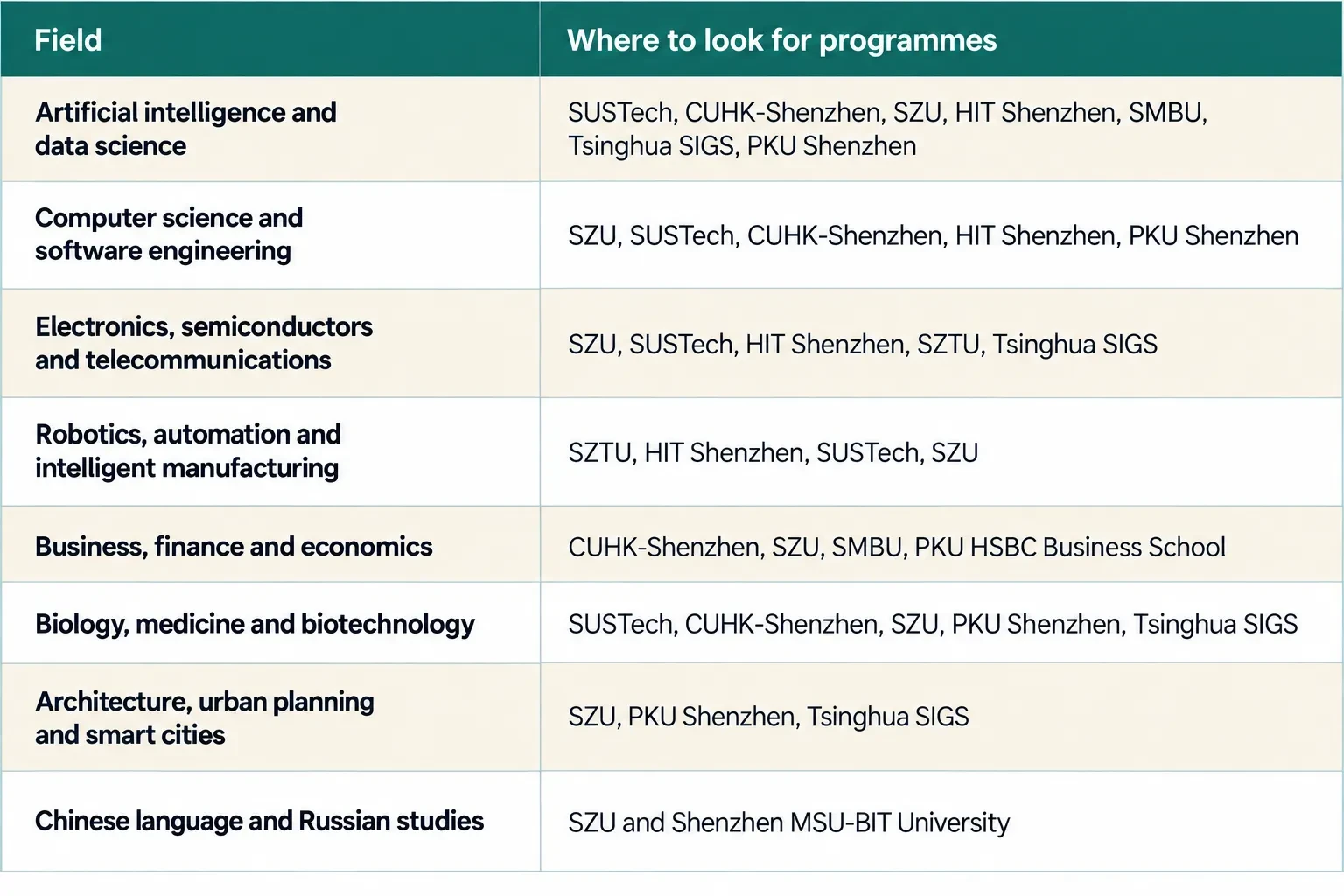
The programme matters more than the brand In Shenzhen the same university can offer programmes on different campuses, in different languages and with different degree models. Check the official programme title, teaching language, degree-awarding institution, campus location and internship rules. |
Tuition costs in Shenzhen in 2027
The figures below are reference points for planning. CUHK-Shenzhen’s rates apply directly to the 2027 intake; other figures are based on official 2026 materials and should be updated once new brochures are released.
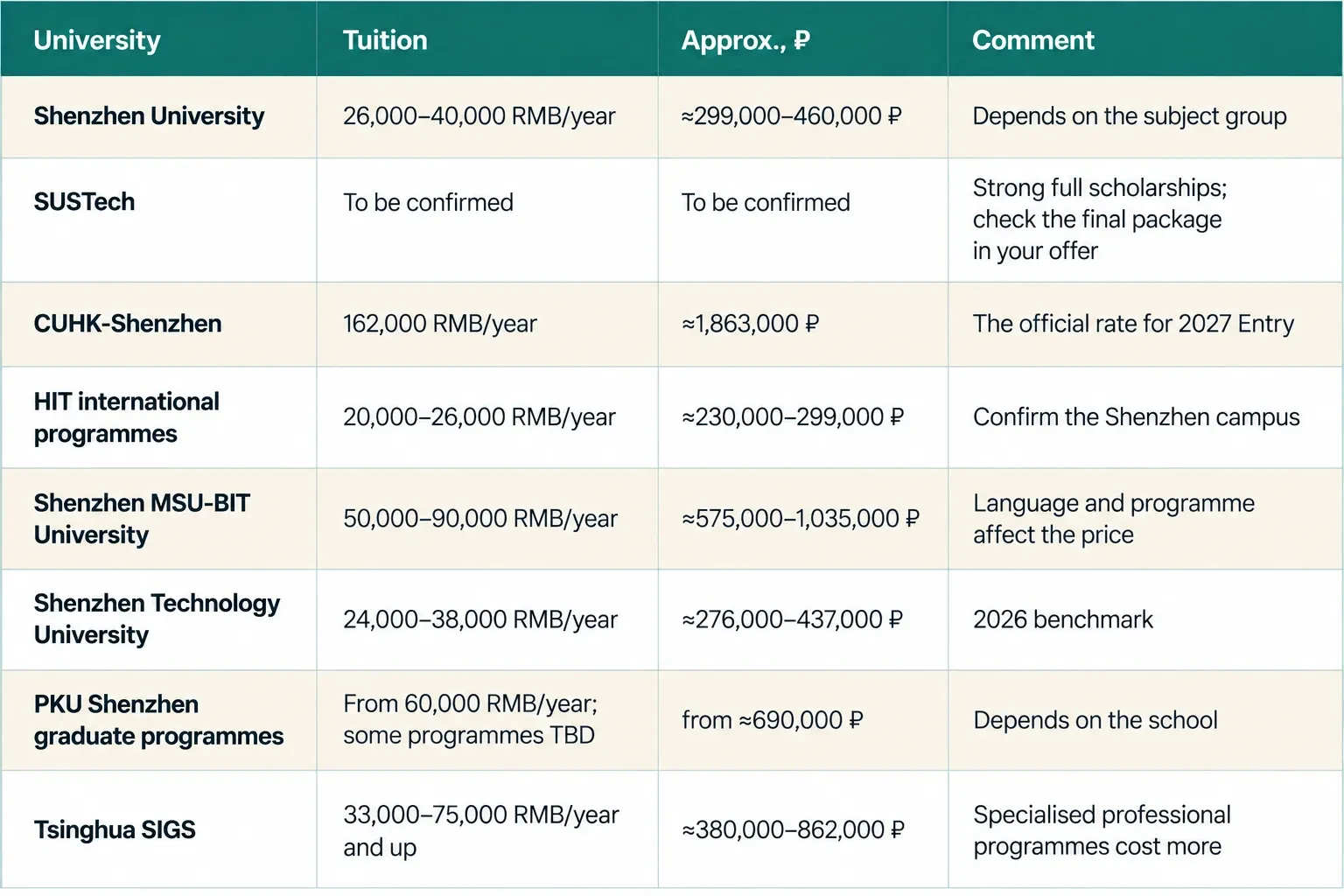
The exchange rate used for the ruble figures The tables use a technical rate of 1 RMB = ≈11.5 ₽. Update the rate and the calculation before publishing and before signing any contract. |
Dormitory and rent
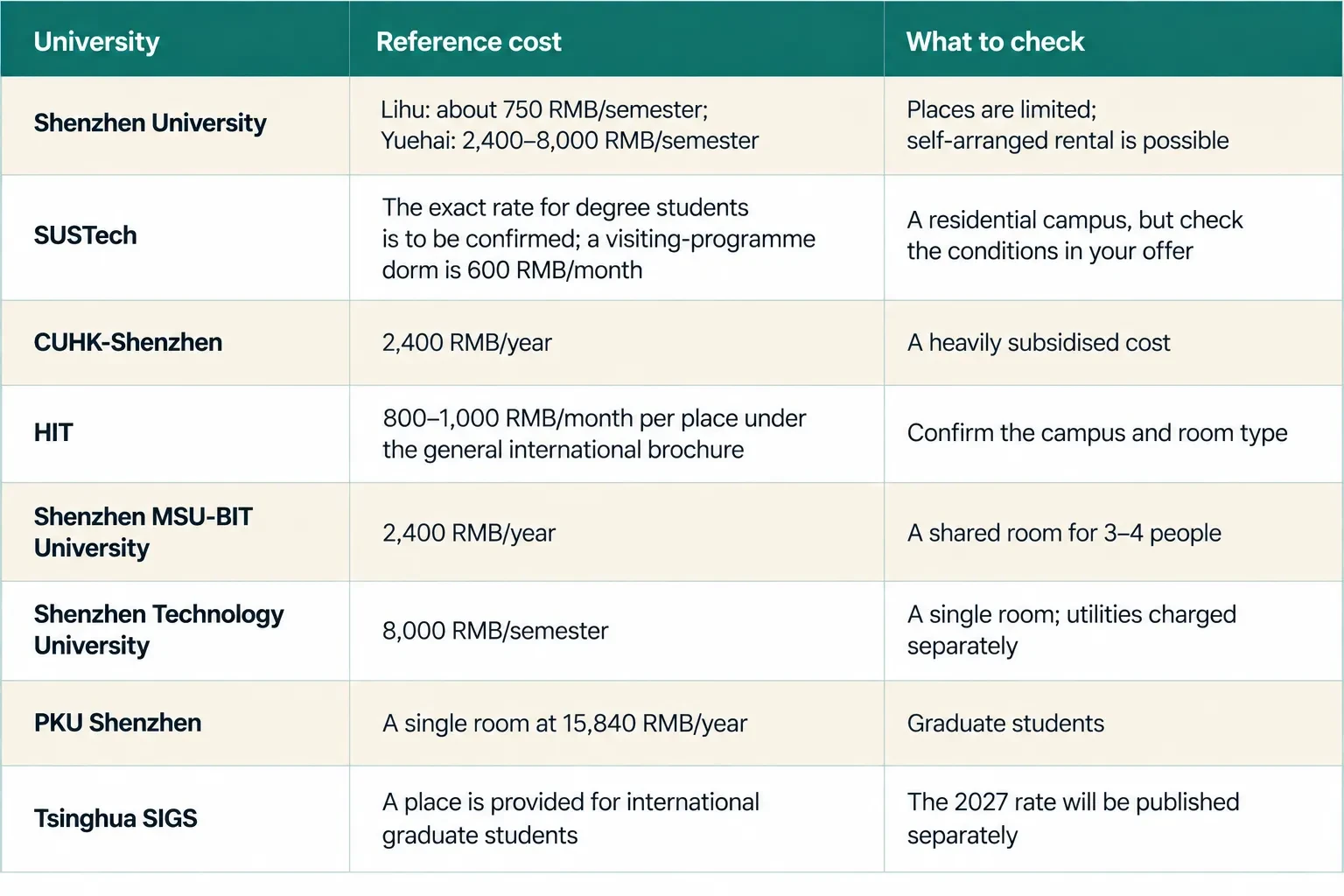
Off campus, Shenzhen is among China’s expensive cities. For planning, you can budget 2,500–5,000 RMB a month for a room in a shared apartment, and 4,500–9,000 RMB for a small studio. Prices in Nanshan and Futian are usually higher than in Longgang, Pingshan and outer districts. These ranges are not university rates and should be checked at the time of renting.
Three annual budget scenarios
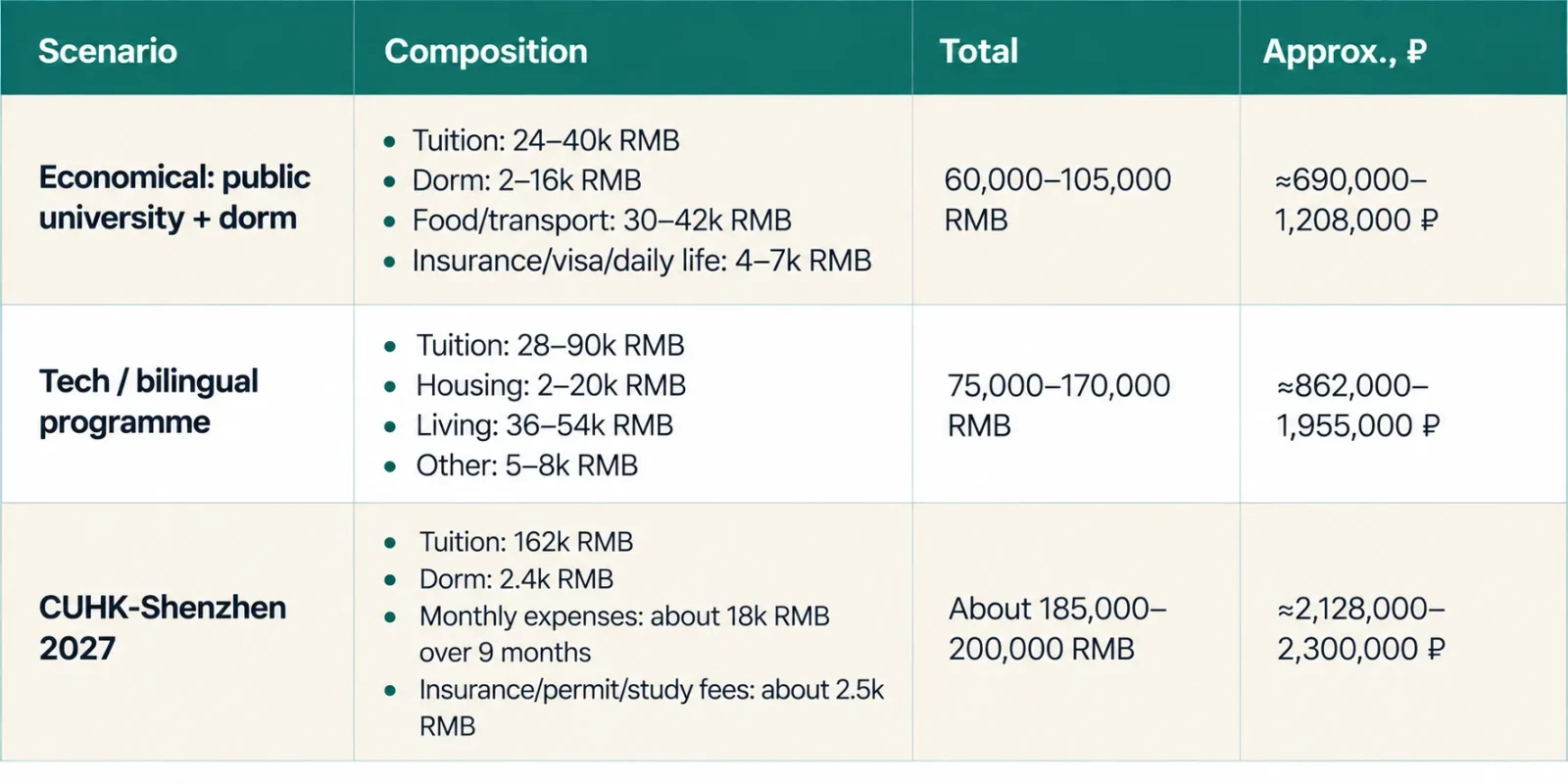
First-month reserve Even with a dormitory, budget an extra 5,000–10,000 RMB for a deposit, bedding, a SIM card, transport, a medical check-up, a residence permit, a campus card and everyday purchases. |
Language of instruction, HSK, IELTS and entrance tests
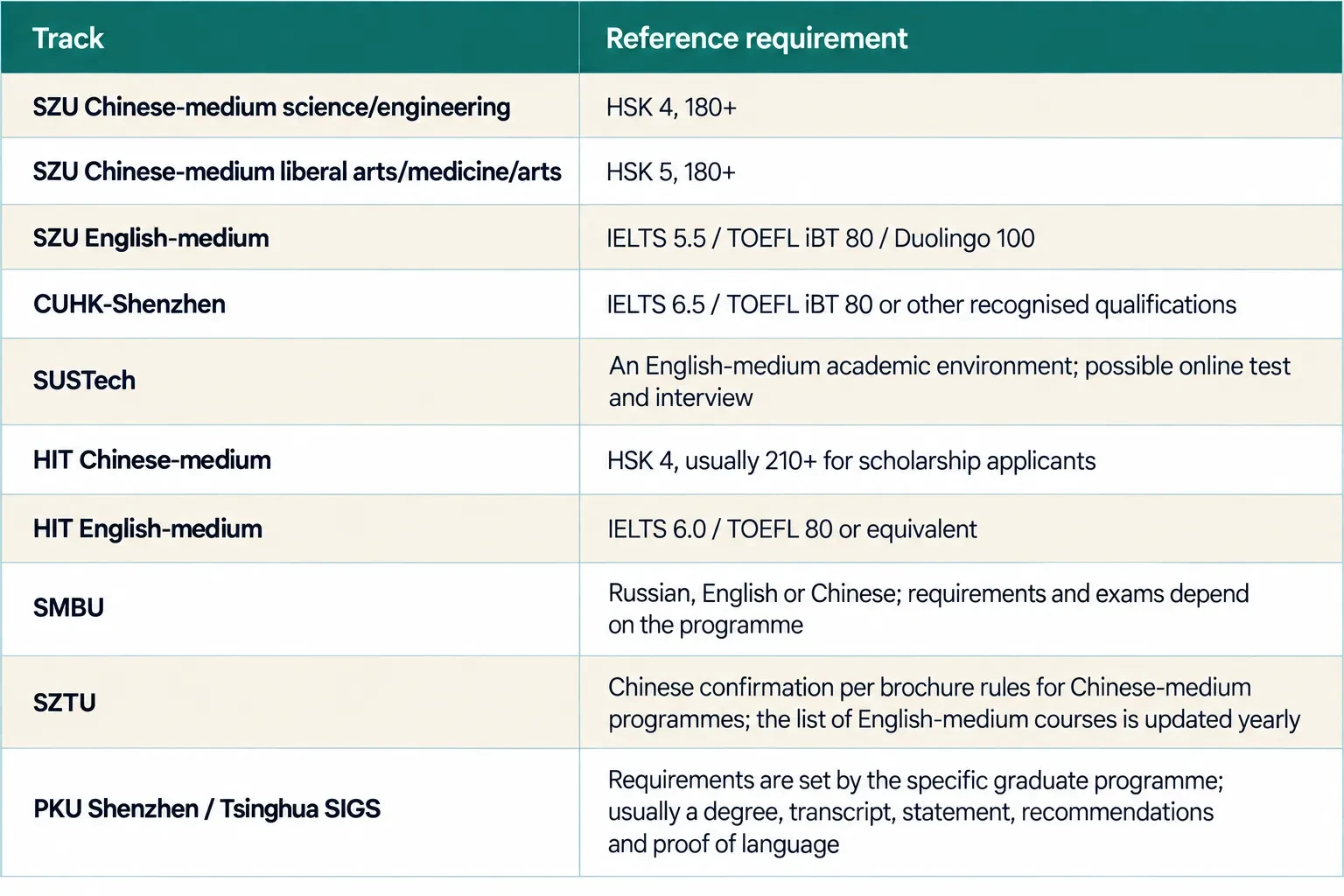
CSCA Uniform CSCA rules for all Shenzhen universities cannot be assumed for 2027. Some universities use their own tests, interviews or international qualifications. Each bachelor’s programme’s brochure and list of admission subjects must be checked. |
Scholarships in Shenzhen
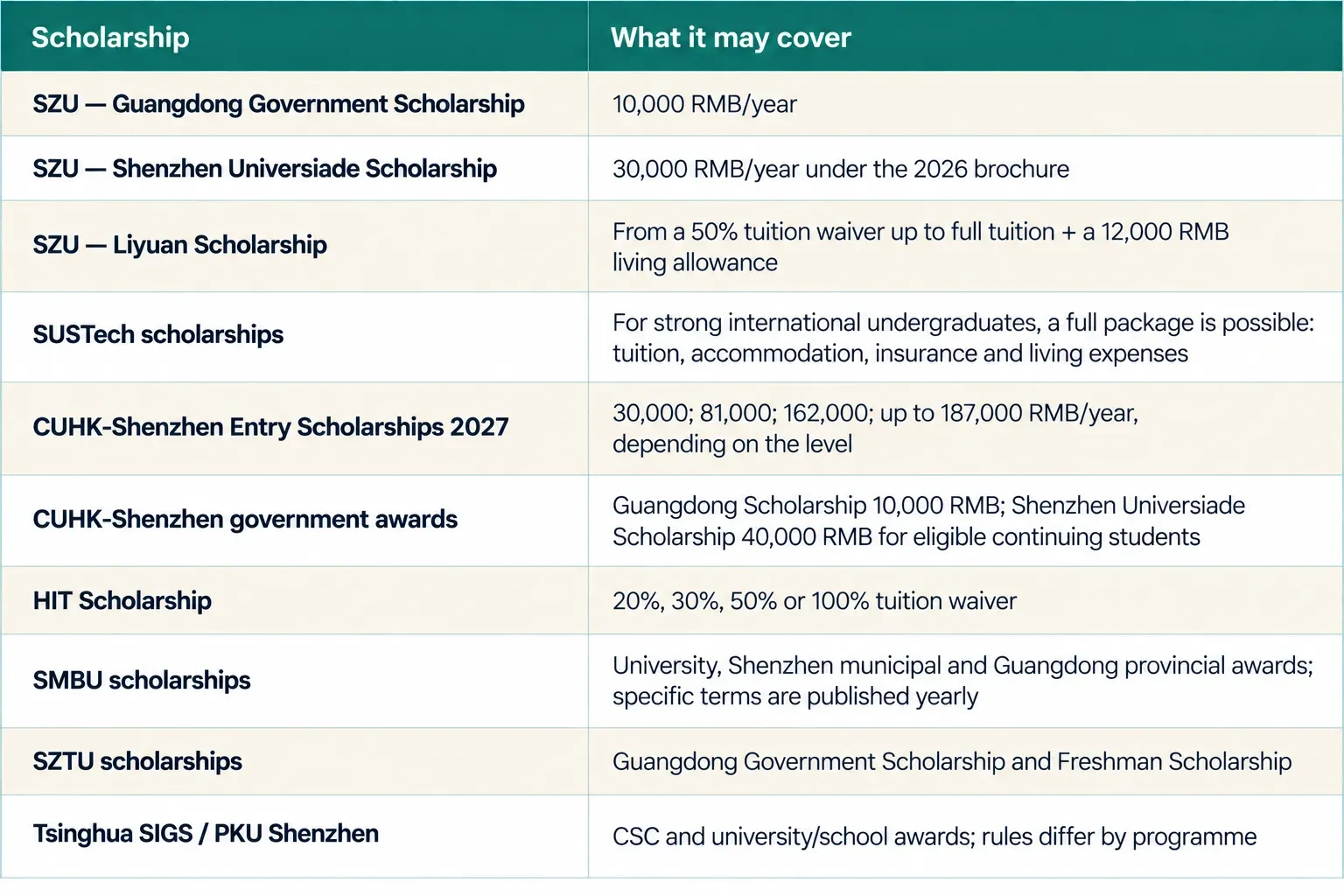
A scholarship should not be treated as a guaranteed discount. Many awards depend on early application, strong grades, an English/Chinese certificate, a research profile, extracurricular achievements and an interview. Even a full tuition scholarship holder may need a deposit or a temporary financial reserve.
How to apply to a Shenzhen university in 2027
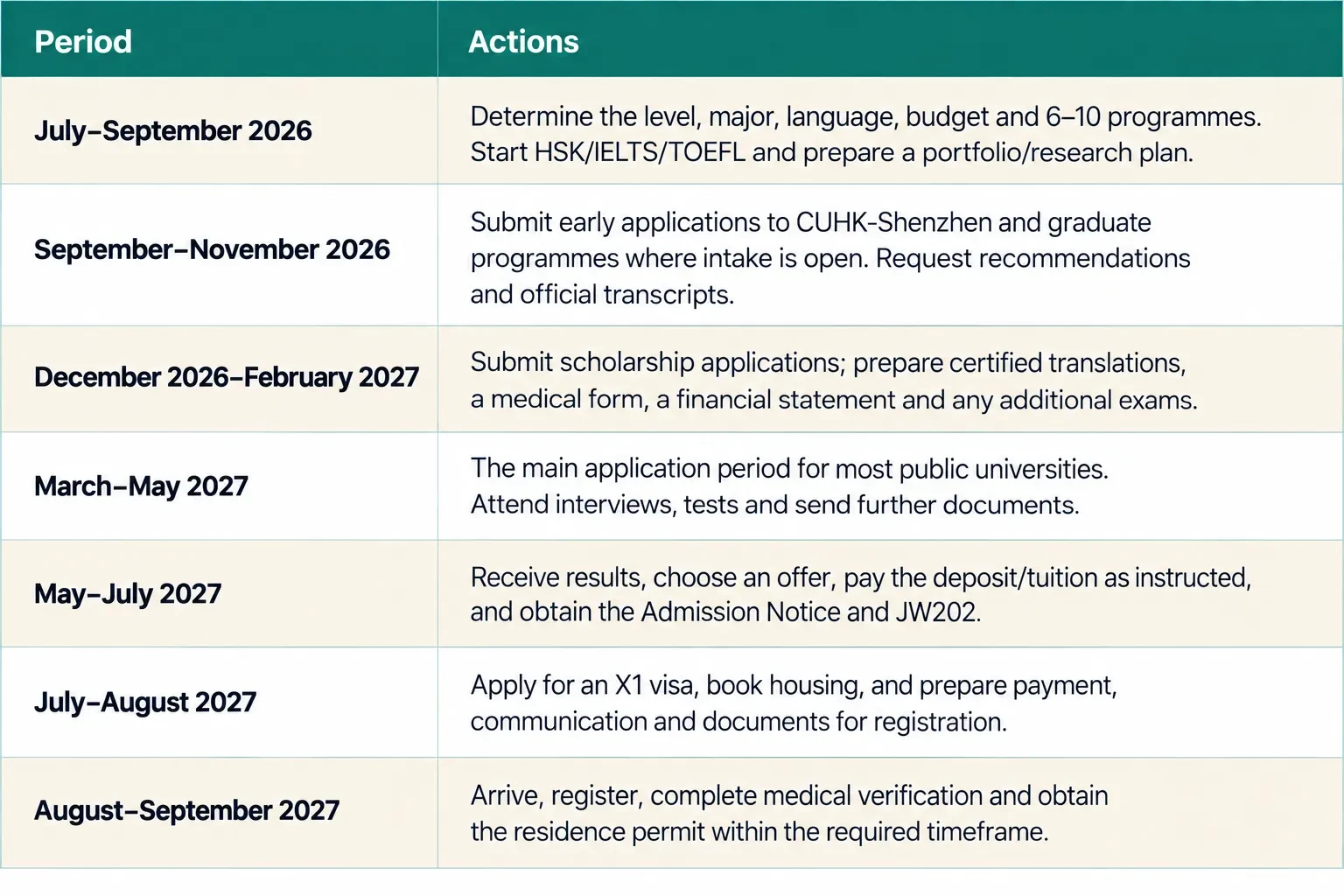
Application documents
- an international passport;
- a certificate or diploma from your previous level of education;
- a full transcript with grades;
- notarised translations into Chinese or English;
- HSK, IELTS, TOEFL, SAT, IB, A-Level or another required certificate;
- a study plan or personal statement;
- a CV;
- two recommendation letters for programmes that require them;
- the Foreigner Physical Examination Form;
- a police clearance certificate, if stated in the brochure;
- a financial statement or sponsor letter;
- a portfolio for art/design/architecture;
- a research proposal and confirmation of a potential supervisor for some graduate programmes;
- guardianship documents for minors;
- an application fee payment receipt.
Chinese heritage and change of citizenship Candidates whose parents are Chinese citizens, or who previously held Chinese citizenship, should carefully check the requirements of Document [2020] No. 12: the length of time holding a foreign passport and actual residence outside China. |
Districts, transport and student life
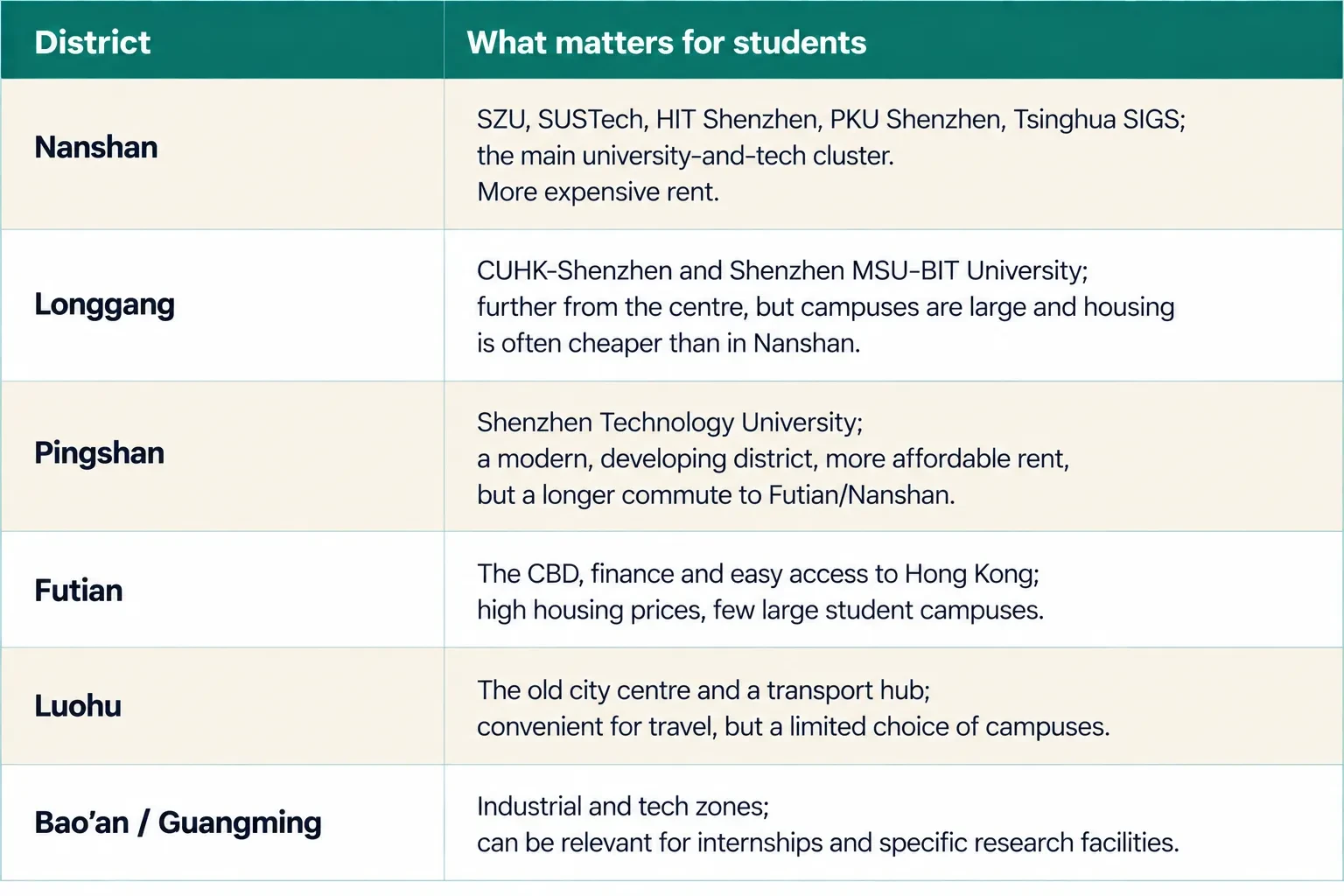
The metro is the main way to get around. The network connects university districts to business centres and transport hubs; when choosing housing, count time "door to classroom" and the number of transfers rather than distance in kilometres.
The climate is subtropical: the average annual temperature is around 23°C, and summer is long, humid and rainy. The main everyday challenges are heat, air conditioning, heavy rain and typhoons. Winter is short and mild, but dormitories can feel cold due to a lack of central heating.
Advantages and disadvantages of Shenzhen
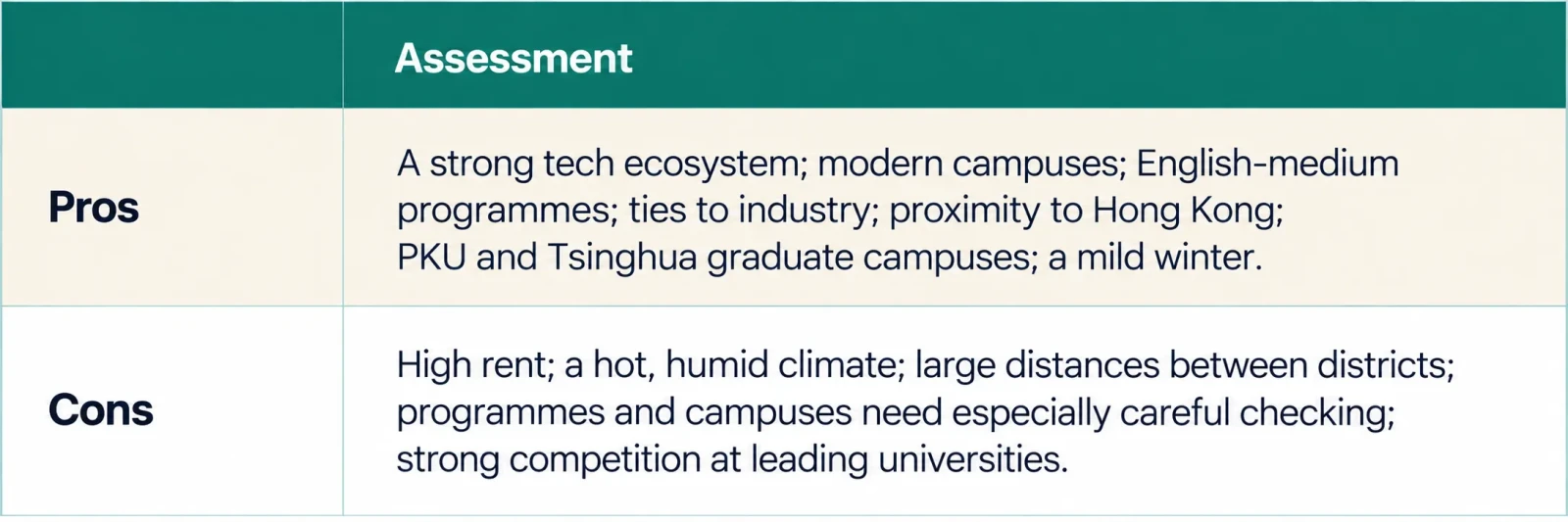
The main takeaway Shenzhen is especially strong for students who want to build their education around technology, business and innovation. But it is not a universal choice: with a limited budget, an interest in the humanities, or reluctance to live in a fast-paced megacity, it makes sense to compare other cities. |
Common applicant mistakes
- Assuming any HIT programme is automatically run on the Shenzhen campus.
- Confusing PKU Shenzhen and Tsinghua SIGS with bachelor’s universities.
- Estimating the budget only by tuition and ignoring off-campus rent.
- Applying to CUHK-Shenzhen late and losing access to most scholarships.
- Not checking the language of instruction and the list of internal exams at SMBU.
- Relying on an SZU dormitory without confirming the place.
- Choosing a Nanshan apartment without calculating the full annual budget.
- Not accounting for the deposit, financial statement and payment deadlines for an offer.
- Carrying 2026 requirements over to the 2027 intake without re-checking.
Frequently asked questions
Can a foreigner apply to a Shenzhen university?
Yes. Several universities in the city accept international students for bachelor’s, master’s, PhD and non-degree programmes. Requirements depend on citizenship, level and programme language.
Which Shenzhen university is best for IT?
For IT and AI, it’s worth comparing SUSTech, Shenzhen University, CUHK-Shenzhen, HIT Shenzhen, Tsinghua SIGS and PKU Shenzhen. The choice depends on the study level and budget.
Can you study in Shenzhen in English?
Yes. The most systematic English-medium bachelor’s programme is offered by CUHK-Shenzhen; English-medium tracks also exist at SZU, HIT, SMBU and other universities.
How much does studying in Shenzhen cost?
At state universities the benchmark is usually 24,000–40,000 RMB a year; joint and premium programmes can cost 50,000–162,000 RMB or more.
How much do you need for living expenses per month?
With a dormitory, 2,500–4,500 RMB is often enough, excluding tuition. Renting an apartment can bring the budget to 5,000–10,000 RMB a month or more.
Are there scholarships?
Yes. University scholarships, the Guangdong Government Scholarship, the Shenzhen Universiade Scholarship, CSC, and special CUHK-Shenzhen entry scholarships are all available.
Is an HSK required?
Usually yes for Chinese-medium programmes. For English-medium programmes an HSK may not be required, but IELTS, TOEFL or another recognised certificate is needed.
Is CSCA required?
It depends on the university and programme. For 2027 you need to check the official brochure of each bachelor’s programme.
When should you apply for the 2027 intake?
Preparation is best started in summer–autumn 2026. CUHK-Shenzhen accepts Early Bird applications until 1 November 2026; most public universities open their main intake in winter or spring.
Which district is best for a student?
The best district is usually determined by the campus. Nanshan is convenient for SZU, SUSTech, HIT, PKU and Tsinghua; CUHK-Shenzhen and SMBU are in Longgang; SZTU is in Pingshan.
Shenzhen or Guangzhou?
Shenzhen is more oriented toward technology, entrepreneurship and premium English-medium education. Guangzhou offers a wider classic university choice and often a more moderate budget.
Can you apply on your own, without an agency?
Yes, but the applicant is fully responsible for the shortlist, translations, exams, scholarship forms, payment, visa documents and housing. An error in the campus or programme language can make an application useless.
Applying to Shenzhen with GE Agency
In Shenzhen it is especially important to correctly match the university, campus, language, tuition, admission test and scholarship strategy. GE Agency helps turn a large choice of programmes into a clear admission plan.
- analysing your profile, major, language and budget;
- sorting options into safe, target and ambitious;
- checking the campus location and the degree-awarding institution;
- comparing HSK, IELTS/TOEFL, CSCA, SAT/IB/A-Level and internal tests;
- calculating tuition, accommodation, living expenses and the first month;
- preparing forms, a CV, a study plan, recommendations, a portfolio and a research proposal;
- translations and checking the document set;
- submitting applications and liaising with universities;
- working on scholarship applications;
- obtaining the Admission Notice and JW202;
- visa, pre-departure and organisational support.
Get a personal shortlist of Shenzhen universities for 2027 and a full budget calculation The GE Agency team will match your major, language, academic profile and financial capacity against the real requirements of the programmes. |