
Studying in Shanghai for international students in 2027
Shanghai is mainland China’s largest international business hub and one of the country’s strongest education cities. It is home to Fudan University, Shanghai Jiao Tong University, Tongji University, East China Normal University, Shanghai International Studies University, Donghua University, Shanghai University of Finance and Economics, Shanghai University, NYU Shanghai and dozens of other institutions.
For an international applicant the city combines academic programmes, an international business environment, tech companies, financial institutions, major exhibitions and career events. In 2026 Fudan ran a large careers conference for international students with more than 50 companies and representatives from dozens of universities — a good example of how closely education and the job market are linked in Shanghai.
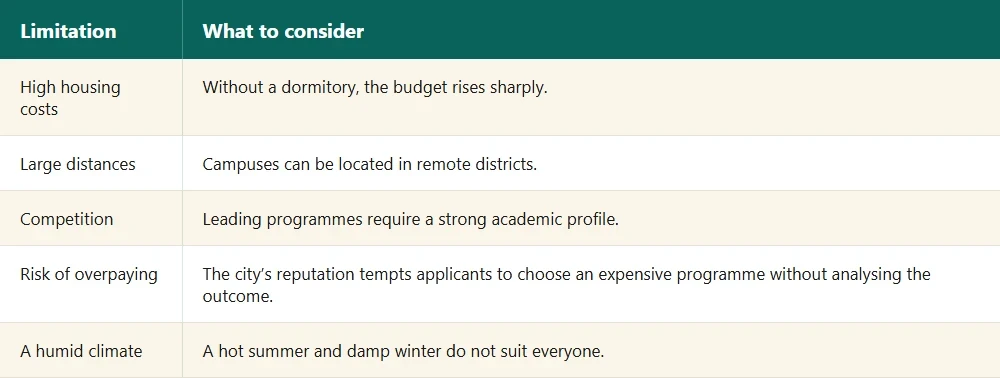
At the same time, Shanghai remains one of China’s most expensive cities. The main budget risk is not only the tuition fee but housing. Even a student at a strong state university can face a high final cost if they do not get a dormitory place and have to rent an apartment near campus.
Important for the 2027 intake As of the preparation date — 20 July 2026 — most universities had not yet published their 2027 admission brochures. This article uses official 2026 terms, already published 2026/27 rates and working budget ranges. They are not a promise of an unchanged price. |
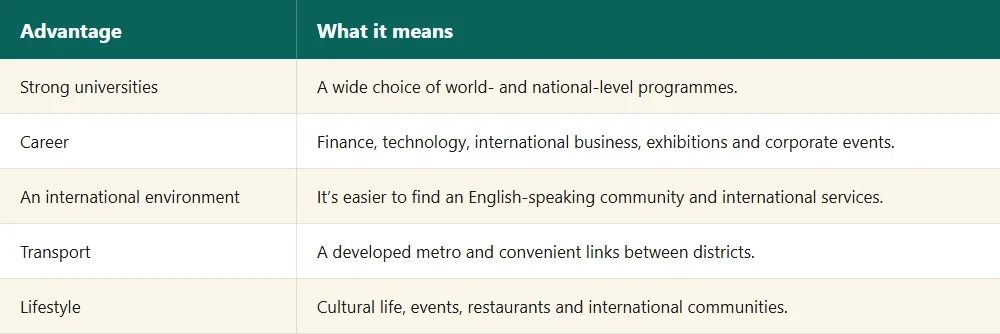
Why international students choose Shanghai
- Strong universities — Fudan and SJTU are among China’s most competitive universities; Tongji is known for architecture, construction and engineering; ECNU for education, humanities and social sciences.
- An international business environment — the city is especially useful for economics, finance, management, international business, marketing, logistics and careers at international companies.
- Technology and innovation — Pudong, Zhangjiang, university labs and corporate centres provide an environment for computer science, data, AI, engineering and biotechnology.
- Languages and international relations — SISU, Fudan, ECNU and other universities offer strong programmes in linguistics, translation, media, international relations and China studies.
- A wide choice of English-taught programmes — Shanghai offers a broad range of English-medium bachelor’s and master’s programmes, from state universities to the international NYU Shanghai model.
- Convenient transport — the metro connects the main districts and university campuses; fares start at 3 RMB, and international bank cards work at many stations.
Who studying in Shanghai suits
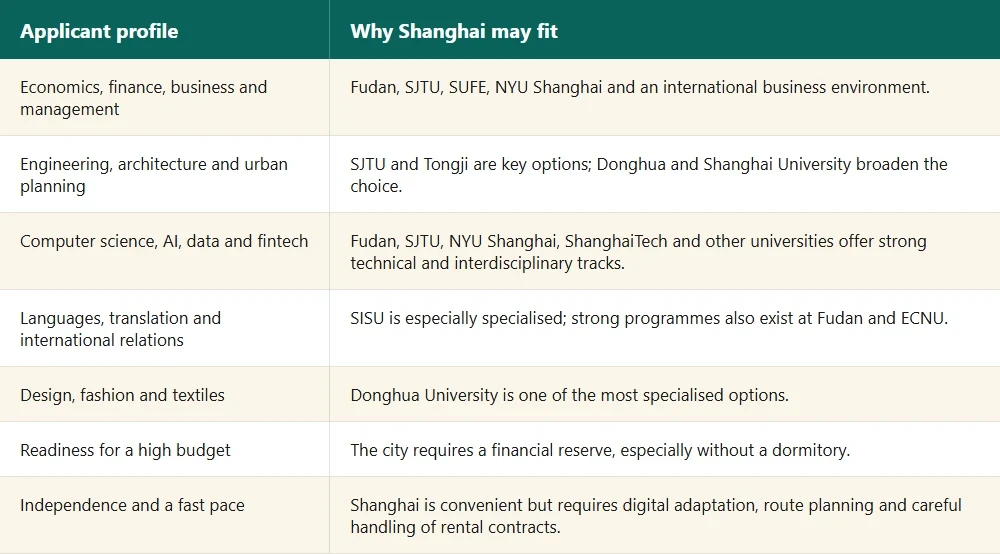
Source: Fudan University, Shanghai Jiao Tong University, Shanghai University of Finance and Economics, NYU Shanghai, Tongji University, Donghua University, Shanghai University, Shanghai International Studies University, East China Normal University
When another city may be better If the budget is limited, cheap dormitory access is a priority, or the student is not ready for an intense megacity, it is worth comparing Nanjing, Suzhou, Hangzhou, Wuhan, Xi’an, Harbin or other university centres. |
Best universities in Shanghai for international students
Shanghai universities differ in more than ranking. It is more important to compare the programme profile, campus, language, admission requirements, tuition fee, dormitory availability and scholarship coverage.
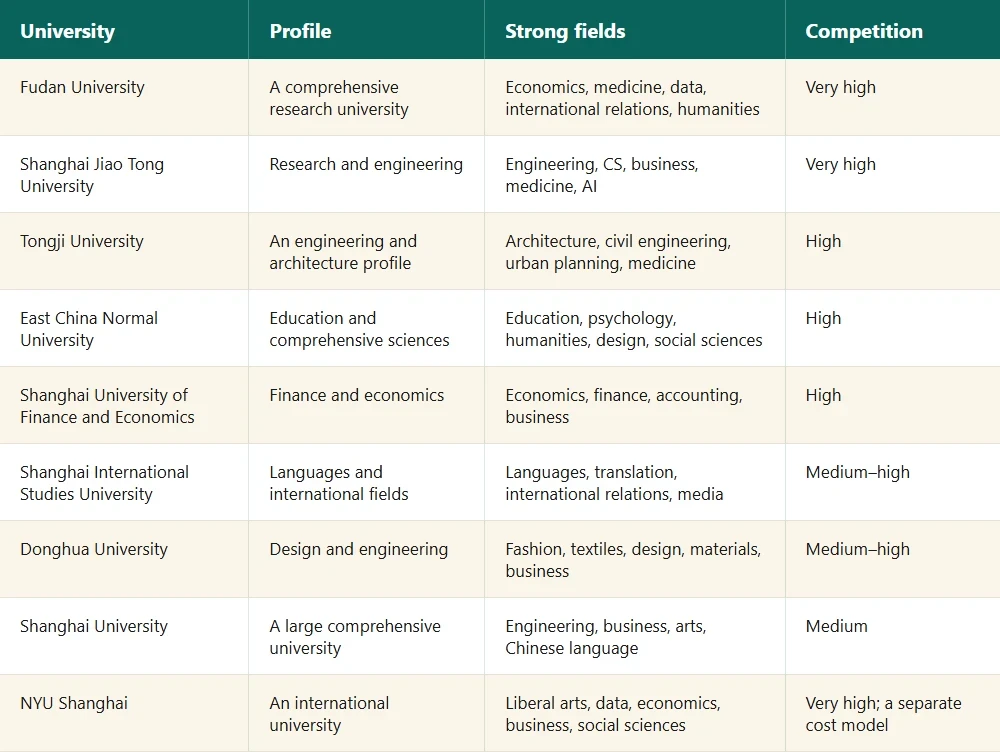
Source: Fudan University, Shanghai Jiao Tong University, Tongji University, East China Normal University, Shanghai University of Finance and Economics, Shanghai International Studies University, Donghua University, Shanghai University, NYU Shanghai
The competition level is an editorial estimate for early orientation. It is not an official university metric.
Fudan University — 复旦大学
One of China’s best-known research universities. International students can study on Chinese- and English-medium programmes, including economics, fintech, data science, MBBS, and international organisations and global governance. In 2026 the university separately published CSCA subjects for its Chinese-medium bachelor’s programme. It suits strong candidates with a high average grade, confirmed language skills and a well-prepared application.
Shanghai Jiao Tong University — 上海交通大学
A strong option for engineering, computer science, materials, electrical engineering, management and medicine. In 2026 the English-taught Engineering Cluster required mathematics as part of CSCA or alternative international exams at a preliminary stage; the main deadline was 31 March. For some English-medium programmes, tuition was 65,000–80,000 RMB a year.
Tongji University — 同济大学
Best known for architecture, urban planning, civil engineering, transportation and engineering. Official rates for international students included about 24,600 RMB a year for Chinese-medium science programmes, 33,800 RMB for English-medium architecture and urban planning, and 35,000 RMB for English-medium civil engineering; MBBS was about 45,000 RMB.
East China Normal University — 华东师范大学
A strong university in education, psychology, Chinese language, humanities, social sciences, design and a number of English-taught programmes. In 2026 the university published separate undergraduate brochures, and dormitory booking was tied to advance tuition payment and room availability.
Shanghai University of Finance and Economics — 上海财经大学
A specialised option for economics, finance, accounting, statistics, business and public finance. When choosing, study the programme, language and requirements of the specific school: the cost of English-medium and professional programmes can differ noticeably from Chinese-medium academic tracks.
Shanghai International Studies University — 上海外国语大学
Specialises in languages, translation, international relations, journalism, area studies and business communication. In 2026 the Chinese-medium bachelor’s programme cost about 22,000–24,800 RMB a year; bachelor’s programmes required CSCA results, and subject requirements depended on the major.
Donghua University — 东华大学
Known for fashion, textiles, materials, design, engineering and management. The university also offers Chinese language: the 2026 autumn semester course cost 10,800 RMB, with a 600 RMB application fee. This is a useful benchmark for a language year, but degree programmes have separate rates.
Shanghai University — 上海大学
A large comprehensive university with engineering, business, arts, Chinese language and international programmes. The official 2026 calculator listed an application fee of 500 RMB, dormitory costs from 12,700 RMB a year for a four-bed room up to 51,000 RMB for a single room, and average living expenses of about 35,000 RMB a year.
NYU Shanghai — 上海纽约大学
An international teaching model within NYU’s global network. The cost is fundamentally higher than most state universities: for international students, tuition for a standard course load in 2026/27 was 231,437 RMB per semester, excluding housing, insurance and other expenses. NYU Shanghai should only be added to a shortlist after a separate financial calculation and a review of aid options.
Which majors are especially strong in Shanghai
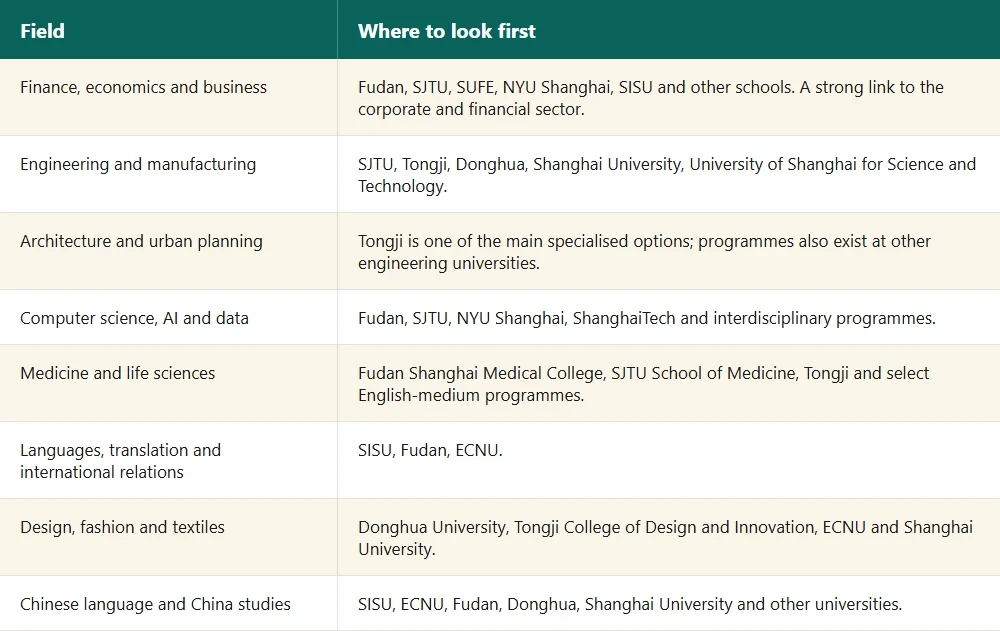
Source: Fudan University, Shanghai Jiao Tong University, Shanghai University of Finance and Economics, NYU Shanghai, Shanghai International Studies University, Tongji University, Donghua University, Shanghai University, University of Shanghai for Science and Technology
Language of instruction, HSK, IELTS and CSCA
Chinese-medium programmes
An HSK is usually required for bachelor’s and master’s study in Chinese. The level depends on the major: humanities, economics and medical programmes often require a higher result than some technical fields. The certificate must be valid at the time of application or registration — check the rules with the specific university.
English-medium programmes
A university may request IELTS, TOEFL or another official document. Sometimes citizens of English-speaking countries or graduates of fully English-medium programmes can get an exemption, but this must be confirmed by the university.
CSCA for bachelor’s admission
Since 2026, Shanghai Jiao Tong University, Fudan University, SISU, Tongji and other universities have started directly including CSCA in requirements or admission-material lists for some international bachelor’s programmes. The subject set depends on the major: mathematics, physics, chemistry or professional Chinese.
A practical takeaway A candidate for the 2027 bachelor’s intake needs to shortlist programmes as early as autumn 2026, list the CSCA subjects required, and check whether the result must be submitted with the application or can follow by a set date. |
Tuition costs in Shanghai in 2027
For 2027 planning, use the published 2026 rates plus a 5–10% reserve. Shanghai has an especially wide spread: a state Chinese-medium programme may cost around 20,000–30,000 RMB a year, an English-medium engineering one 35,000–80,000 RMB, and an international programme like NYU Shanghai — hundreds of thousands of RMB a year.
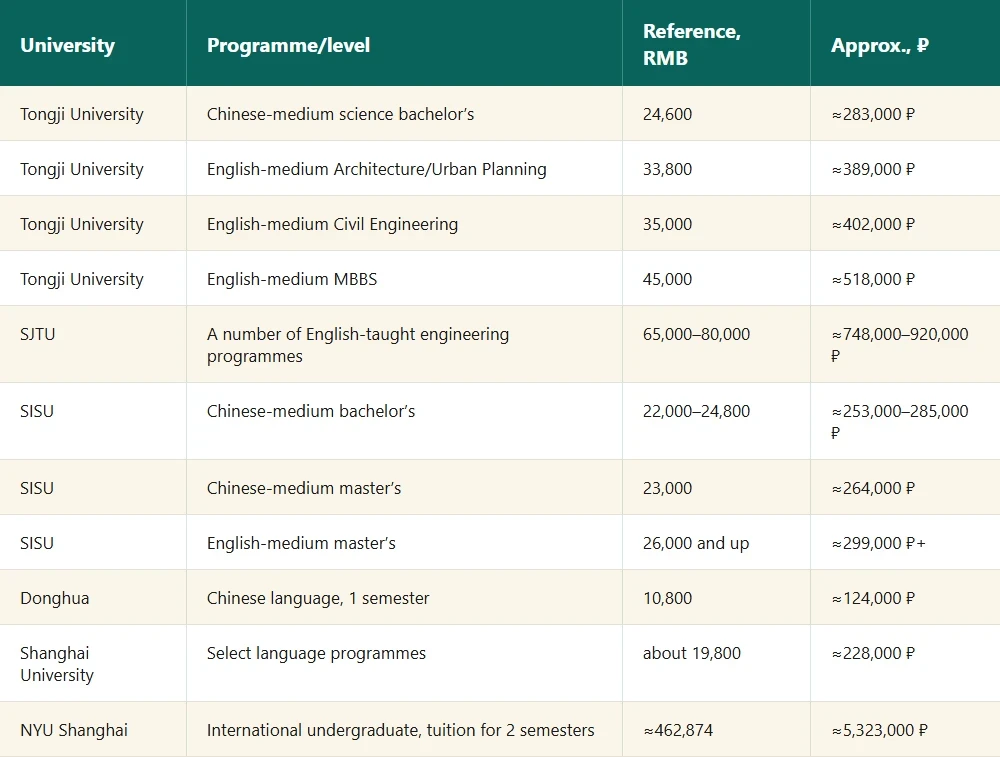
Source: Tongji University, Shanghai Jiao Tong University, Shanghai International Studies University, Donghua University, Shanghai University, NYU Shanghai
Also account for:
- application fee — usually 500–800 RMB;
- insurance — often 800 RMB a year for long-term students;
- residence permit — roughly 400 RMB for a term of up to one year;
- dormitory deposit and payment;
- a medical check-up and supporting medical documents;
- textbooks, lab and faculty fees;
- translations, notarisation, legalisation or an apostille;
- flights, visa, document delivery and initial setup.
Compare the full budget In Shanghai a 25,000 RMB programme can end up more expensive than a 40,000 RMB one if the first does not provide a dormitory and requires renting in an expensive district. Compare tuition + housing + food + insurance + transport + deposit. |
Dormitory and rent in Shanghai
A dormitory place cannot be considered guaranteed together with the admission notice. In 2026 Fudan opened a separate online booking window for a short period in August; without a room, a student could be placed on a waiting list.
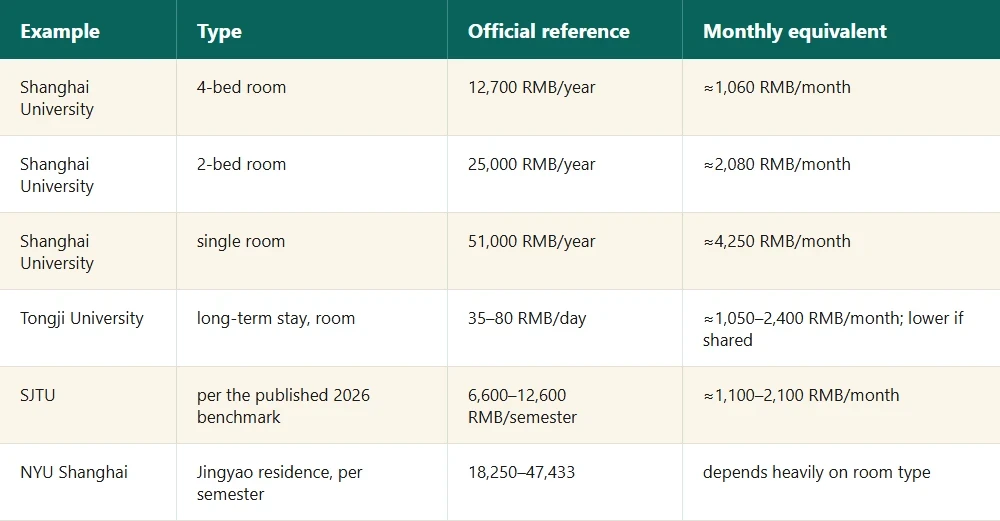
Source: Shanghai University, Tongji University, Shanghai Jiao Tong University, NYU Shanghai
For off-campus rental, the working ranges should be used with caution: a room in a shared apartment is roughly 3,000–6,000 RMB a month (the price depends on the district, metro access, condition and the number of flatmates); a small standalone apartment is often 6,000–12,000 RMB and up (central districts and areas near popular campuses can be significantly more). A deposit, prepayment, agent commission, management fee, internet and utility payments are all possible. When living off campus, an international student must register their place of residence; the procedure is repeated if the address changes.
Rental rule Do not transfer a deposit before verifying the landlord’s identity, the right to lease the property, the address, refund conditions and an official contract. The Shanghai city portal publishes a separate practical guide to renting for international students. |
Cost of student living in Shanghai
Shanghai University uses an average living-expenses benchmark of about 35,000 RMB a year, but it assumes a controlled student lifestyle and does not include an expensive standalone rental. A realistic monthly budget needs to be built starting from housing.
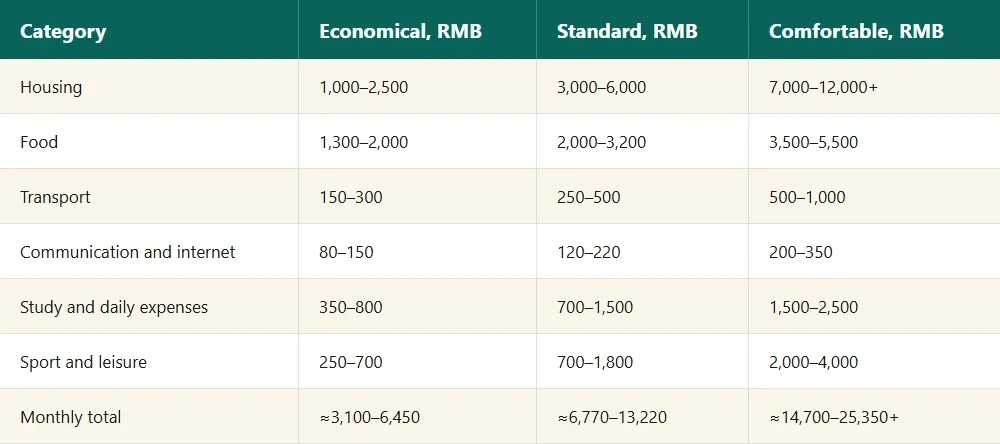
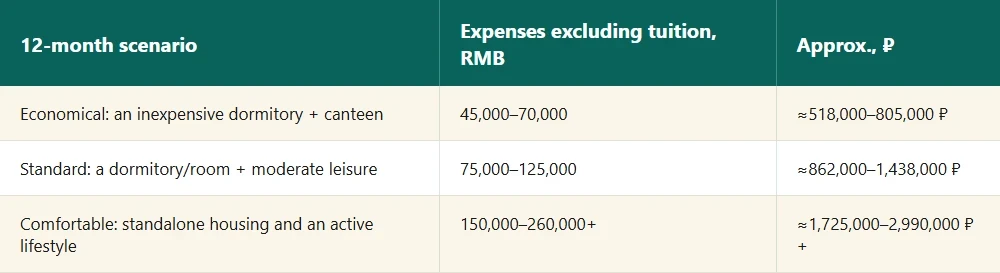
First-month reserve Budget an extra 8,000–25,000 RMB for a deposit, temporary housing, bedding, medical procedures, a SIM card, airport transfer, and banking and everyday expenses. |
Transport, districts, climate and daily life
Metro and distances
The metro is the main student transport. The base fare is 3 RMB for trips of up to 6 km, then the price rises with distance. The system supports several payment methods, including international bank cards at compatible turnstiles and services.
Campuses can be far apart: Fudan is in Yangpu and Pudong, SJTU in Xuhui and Minhang, Tongji in Siping and Jiading; SISU and Donghua each have several campuses.
Districts and choosing housing
Yangpu is convenient for Fudan and Tongji; Minhang for SJTU’s main campus; Songjiang for the university town and some campuses of SISU, Donghua and other universities; Pudong for NYU Shanghai, Zhangjiang and select programmes. Choose housing by the specific campus address, not just the university name.
Food
University canteens keep costs roughly in the 10–30 RMB range per meal. International cafés, Western restaurants and delivery in central districts noticeably raise the budget. If you have religious or medical dietary restrictions, check halal, vegetarian and allergy-friendly options in advance.
Climate
Summer in Shanghai is hot and humid, winter is cool and damp. In many buildings, winter can feel colder than the temperature suggests, so warm home clothing and checking the room’s air conditioning and insulation matter.
Digital adaptation and safety
Students need to set up mobile payments, cards, university apps, delivery, a SIM card and a bank account. The official Shanghai Guide for New Students combines information on transport, registration, housing, health checks, safety and daily life.
Scholarships and grants for studying in Shanghai
Shanghai Government Scholarship
The Shanghai Municipal Government Scholarship has categories A and B. Category A usually covers tuition, accommodation, a living allowance and comprehensive medical insurance; category B covers tuition and medical insurance. Applications go through the participating university, and exact deadlines depend on the institution.
Chinese Government Scholarship (CSC)
CSC can be arranged through the embassy/national channel or through a university programme. In Shanghai, many leading universities publish separate instructions for postgraduate scholarships, high-level graduate programmes and bilateral programmes.
University scholarships
SJTU, Tongji, Fudan, ECNU, Donghua, Shanghai University and other universities offer their own merit-based awards. Coverage may include 25%, 50% or 100% of tuition, an accommodation subsidy and insurance. For example, one SJTU 2026 programme provided a full tuition waiver, a living allowance of 1,500 RMB/month and an accommodation subsidy of 1,100 RMB/month for a first-class scholarship.
The main mistake Do not treat a scholarship as confirmed until you receive the official award notice. Admission and scholarship decisions can arrive separately, and funding often requires an annual review of results. |
How to apply to a Shanghai university in 2027
- Determine your level of education, major, language and the full budget you can afford.
- Build a long list of programmes and check the campus, tuition, dormitory and scholarship options.
- Split universities into ambitious, realistic and backup options.
- Check HSK, IELTS/TOEFL, CSCA and any additional entrance tests.
- Prepare your passport, diploma/certificate, transcript, translations and proof of finances.
- Draft a personal statement, study plan, CV, research proposal and recommendations if required.
- Apply before early scholarship deadlines rather than leaving everything for the last round.
- Take an interview, entrance test or university qualification assessment.
- Get the admission result, pay the required deposit and confirm your place.
- Obtain the Admission Notice and JW201/JW202/DQ, and apply for an X1 or X2 visa.
- Book a dormitory separately or arrange rental safely.
- After arrival, complete registration, insurance, a health check and residence permit procedures.
Recommended preparation calendar
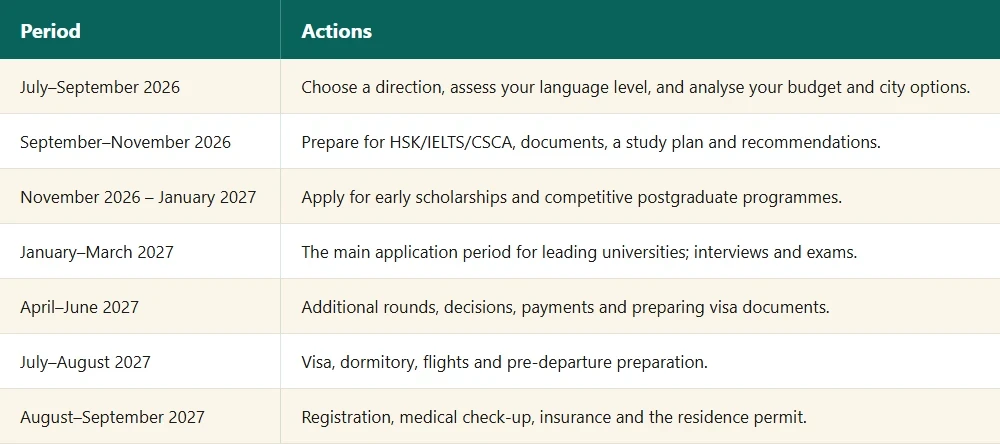
2026 deadlines as a reference Tongji accepted bachelor’s and Shanghai Government Scholarship applications until 31 March 2026; SJTU’s English Engineering Cluster — until 31 March; SISU’s deadlines depended on the campus and programme. For 2027 the calendar must be confirmed once new rules are published. |
Application documents
- an international passport with a sufficient validity period;
- a diploma/certificate and transcript;
- an official translation of documents into Chinese or English;
- a photo in the required format;
- an HSK or English proficiency certificate;
- a CSCA result for programmes that require one;
- a personal statement or study plan;
- a CV for graduate programmes;
- recommendation letters;
- a research proposal for some master’s and PhD programmes;
- a police clearance certificate;
- the Foreigner Physical Examination Form;
- proof of finances or a Statement of Financial Support;
- a portfolio for art/design/architecture;
- additional tests or interview materials.
Translation rule Documents not in Chinese or English usually need to be accompanied by an official translation. Notarisation, apostille or legalisation requirements depend on the country, university and stage of application. |
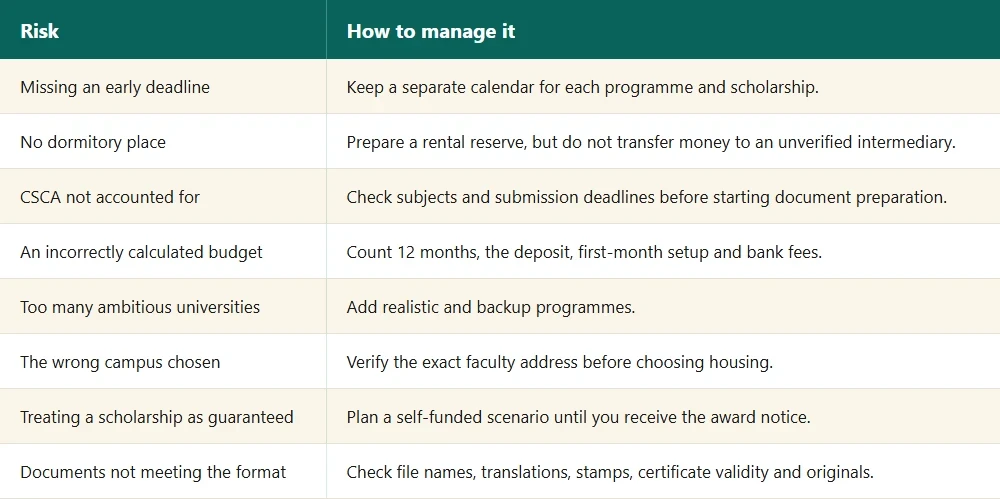
Main risks and how to manage them
Pros and cons of studying in Shanghai
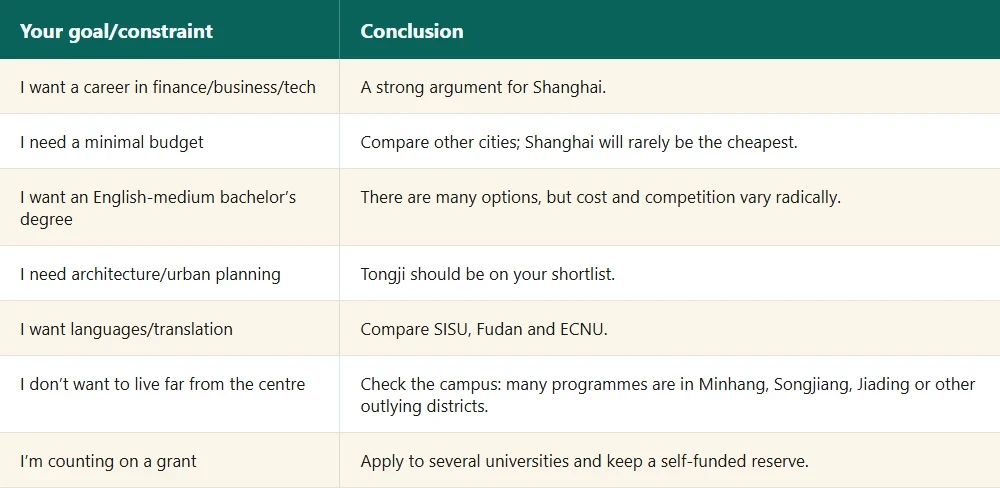
How to know if Shanghai is right for you
FAQ: frequently asked questions about studying in Shanghai
Is it expensive to study in Shanghai?
State programmes can have a moderate tuition fee, but the final budget is often driven up by housing. With a dormitory, expenses are noticeably lower than with a separate rental.
How much money does a student need per month?
With a dormitory, a benchmark is about 3,500–7,000 RMB; renting a room raises it to 7,000–13,000 RMB; a standalone apartment and an active lifestyle may require 15,000 RMB or more.
Which Shanghai university is the best?
There is no single answer. Fudan and SJTU are strong as comprehensive research universities, Tongji in architecture and engineering, SUFE in finance, SISU in languages, Donghua in fashion and textiles.
Can you study in English?
Yes. English-medium programmes exist at Fudan, SJTU, Tongji, ECNU, NYU Shanghai and other universities. Requirements and cost must be checked for the specific programme.
Do you need Chinese?
A Chinese-taught programme needs an HSK. For an English-taught programme, Chinese may not be required for admission, but it greatly eases daily life, internships and career prospects.
Is CSCA required?
Yes, for some international bachelor’s programmes. In 2026 the requirement was published by Fudan, SJTU, SISU, Tongji and other universities.
Does admission guarantee a dormitory place?
No. At a number of universities, booking is done separately and rooms are limited.
Can you work while studying?
An internship or part-time activity is only possible in compliance with visa and university rules. Part-time work should not be treated as a source of guaranteed funding for your studies.
What scholarships are available?
The Shanghai Government Scholarship, the Chinese Government Scholarship, and university merit-based scholarships.
When should you start applying for autumn 2027?
Preparation is best started in summer–autumn 2026, especially if you need HSK, IELTS, CSCA, a portfolio or a scholarship application.
Beijing or Shanghai — which should you choose?
Beijing is chosen more often for an academic and government-institution environment; Shanghai for international business, finance, technology and urban infrastructure. The decision depends on the programme and budget.
Can you apply without an agency?
Yes, but the applicant is fully responsible for the selection, requirements, translations, deadlines, payment, visa documents and housing. For a complex case, support reduces the risk of mistakes.
Applying to Shanghai with GE Agency
In Shanghai it is especially important to compare not just the university’s brand but the real outcome: the programme, campus, tuition, housing, CSCA, the likelihood of a grant and the full budget. GE Agency helps build a balanced application strategy.
- analysing your profile, goals and budget;
- selecting universities and programmes by risk level;
- checking language, CSCA and entrance requirements;
- calculating tuition, dormitory, living expenses and additional fees;
- preparing forms, a study plan, a CV and the document set;
- translations and format checks;
- submitting applications and liaising with universities;
- working on scholarship options;
- obtaining admission documents and the JW202;
- visa, pre-departure and organisational support.
Get a personal shortlist of Shanghai universities for 2027 and a full budget calculation The GE Agency team will match your major, language, grades and financial capacity against the real requirements of the programmes. |