
The cost of studying in China can differ several times over. A language year at a state university often costs 14,000–28,000 CNY, a standard bachelor’s degree roughly 15,000–40,000 CNY a year, while medicine, international and premium English-medium programmes are significantly more expensive. On top of tuition you need to add a dormitory, food, insurance, paperwork, flights and personal expenses.
Information verified on 19 July 2026. Ruble amounts are calculated for reference at the Bank of Russia rate of 1 CNY = 11.5139 ₽ from 17 July 2026. Check your chosen university’s 2027 rate before paying.
The short answer For a budget route, plan for roughly 35,000–60,000 CNY for the first academic year. For most standard programmes in a large regional city — 55,000–90,000 CNY. For medicine, Beijing, Shanghai, Shenzhen, or a premium English-medium programme, the budget may be 90,000–190,000 CNY or higher. |
Table of contents
- The short answer: what budget to plan
- What the cost is made up of
- Converting RMB to rubles
- Language year and Foundation
- Bachelor’s degree
- Master’s and PhD
- Medical education
- Examples of official prices
- Additional university fees
- Dormitory and rent
- Food, transport and communication
- Insurance and paperwork
- One-off expenses
- Cities and budget scenarios
- Grants, payment and saving money
- FAQ
The short answer: what budget to plan
To avoid underestimating costs, count more than just the tuition fee. The full first-year budget includes tuition, accommodation, food, mandatory fees, paperwork, travel and a reserve for unforeseen expenses.
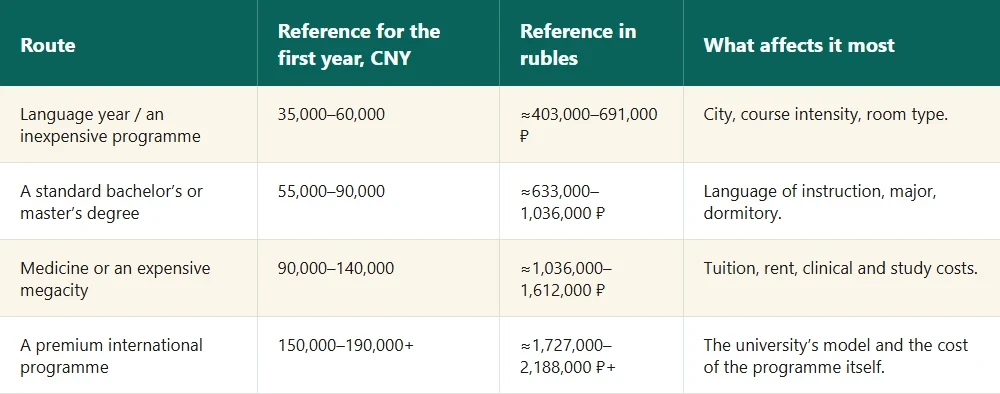
This is not a price list for every university These ranges are for early planning. A specific programme can be cheaper or more expensive. For example, CUHK-Shenzhen has already published tuition of 162,000 CNY a year for the 2027 entry, while regular state universities often charge 18,000–30,000 CNY for a bachelor’s degree. |
What the cost of studying and living is made up of
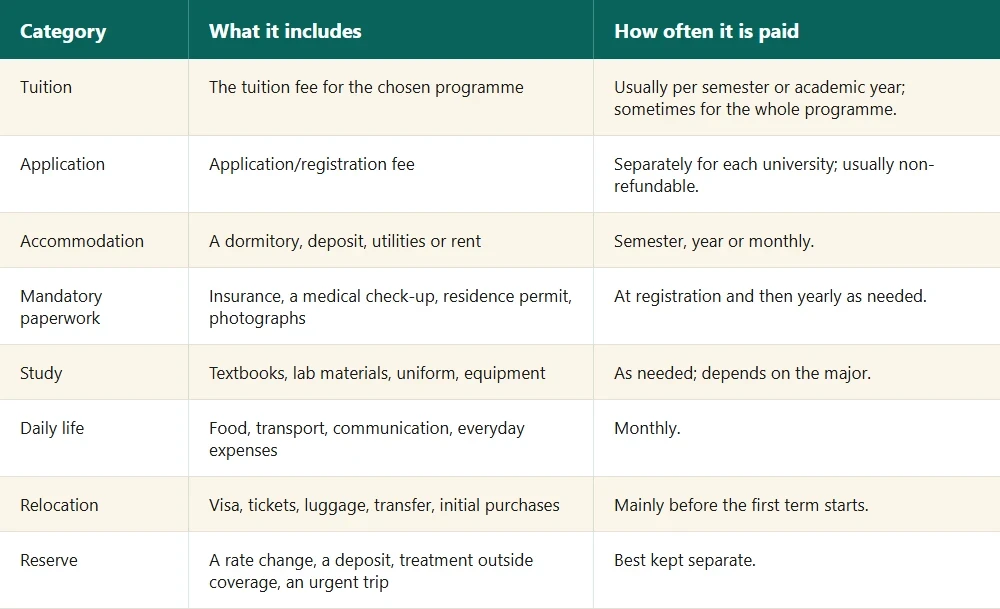
A budget formula First year = tuition + application fees + a dormitory or rent + food and transport + insurance and paperwork + flights + initial purchases + a 10–15% reserve. |
Converting RMB to rubles: how to calculate it correctly
Chinese universities set their rates in RMB. A ruble equivalent helps compare options but should not be treated as a fixed contract price.
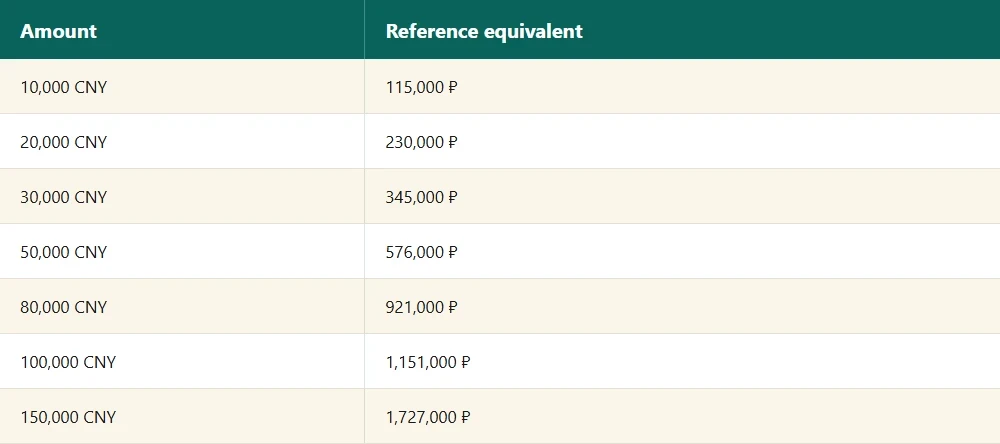
Why the amount you pay may be higher Your bank or payment provider applies its own rate and may withhold a fee. The university must receive the full amount in CNY. If a fee is deducted from the transfer, the student’s account will show a shortfall. |
How much a language year and Foundation cost
Language and preparatory programmes are often the most affordable entry point into Chinese education, though intensive courses in Beijing and Shanghai can cost noticeably more than standard programmes at regional universities.
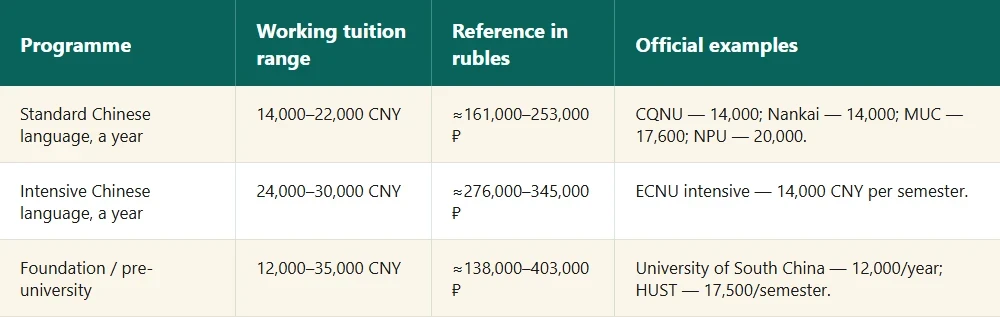
Source: East China Normal University, University of South China, Chongqing Normal University, Nankai University, Minzu University of China, Northwestern Polytechnical University, Huazhong University of Science and Technology
Accommodation, insurance, paperwork and food are added on top of the programme fee. So a language year with a 14,000 CNY tuition fee does not mean the whole year will cost 14,000 CNY.
The cost of a bachelor’s degree in China
At state universities, a Chinese-medium bachelor’s degree is usually cheaper than an English-medium one. Engineering, medicine, architecture, art and programmes with an international degree often cost more than humanities fields.
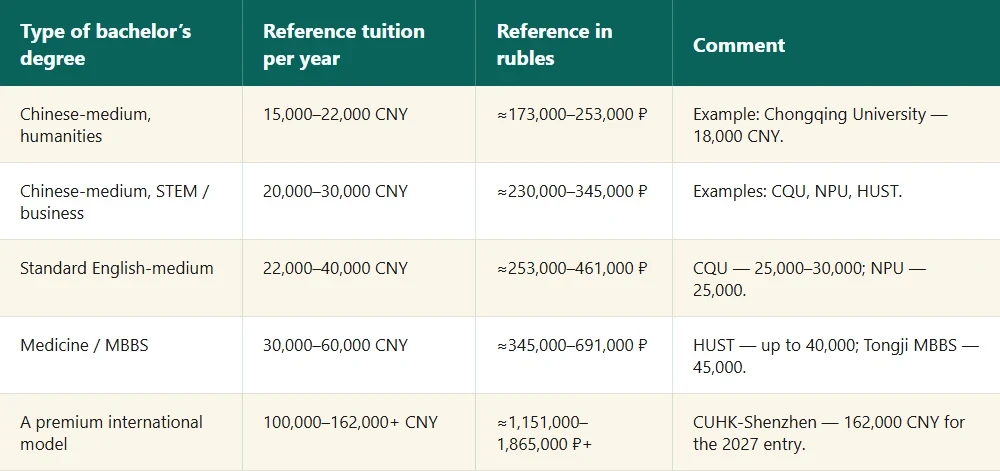
Source: Tongji University, Northwestern Polytechnical University, Huazhong University of Science and Technology, The Chinese University of Hong Kong, Shenzhen
Language of instruction does not always affect the price the same way Do not add a fixed surcharge for English-medium teaching. The difference is set by the university and programme. Sometimes the English-medium version is a few thousand yuan more expensive, sometimes an international programme costs several times more. |
The cost of a master’s degree and PhD
For a master’s or doctoral degree, it is especially important to check whether the price is quoted per academic year or for the entire programme. Professional programmes in finance, management, public policy and engineering may have a separate rate.
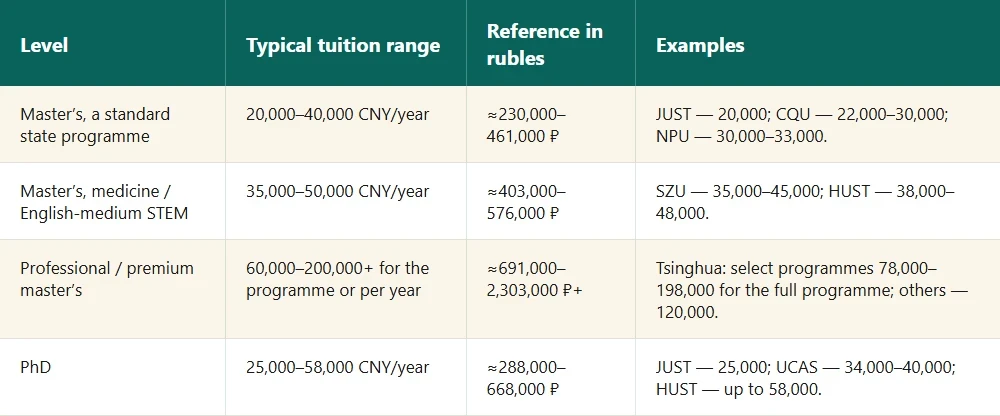
Source: Jiangsu University of Science and Technology, Northwestern Polytechnical University, Shenzhen University, Huazhong University of Science and Technology, University of Chinese Academy of Sciences
The cost of medical education
Medicine requires a separate calculation. Besides higher tuition, there may be costs for uniforms, instruments, lab materials, clinical practice, additional medical checks and travel between campuses or clinical bases.
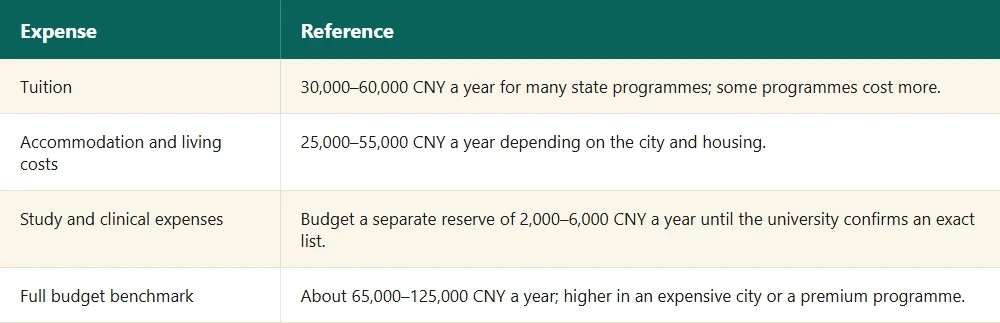
Check programme recognition When choosing medical education, cost should not be the only criterion. You need to check the language of clinical practice, licensing requirements, and diploma recognition in the country where the graduate plans to work. |
Examples of official university prices
The table shows just how different payment models are. These are examples, not a ranking or a list of recommended programmes.
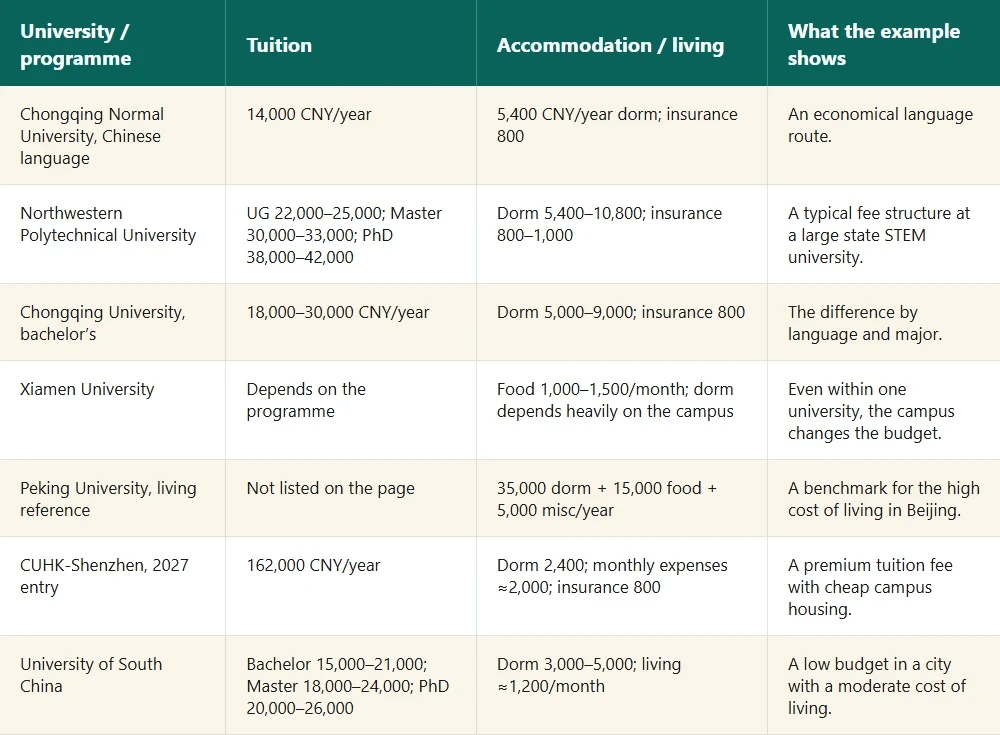
Source: Chongqing Normal University, Northwestern Polytechnical University, Xiamen University, Peking University, University of South China, Peking University, The Chinese University of Hong Kong, Shenzhen
Application, registration and other university fees
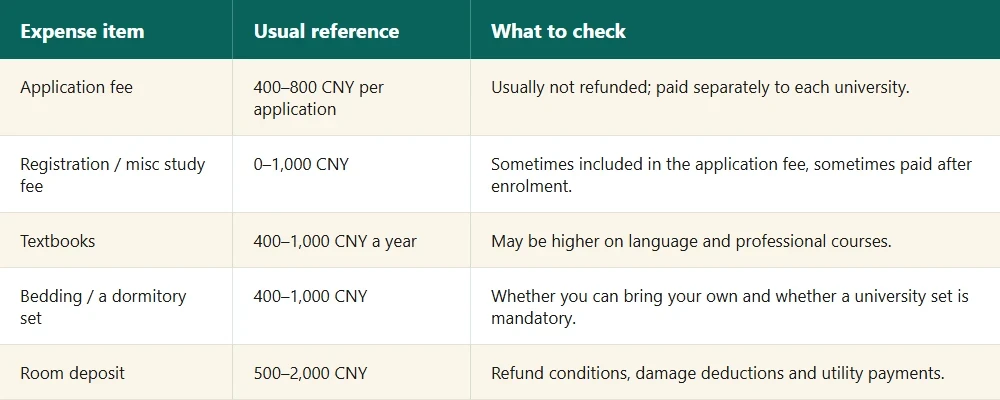
The application fee multiplies with each application If a candidate applies to five universities with a 600 CNY application fee, the applications alone will cost 3,000 CNY. So an application strategy should be broad but not chaotic. |
Dormitory and rent
A dormitory is often the best-value option, but a place is not always guaranteed. The price depends on the campus, number of roommates, bathroom, air conditioning, included utilities and length of stay.
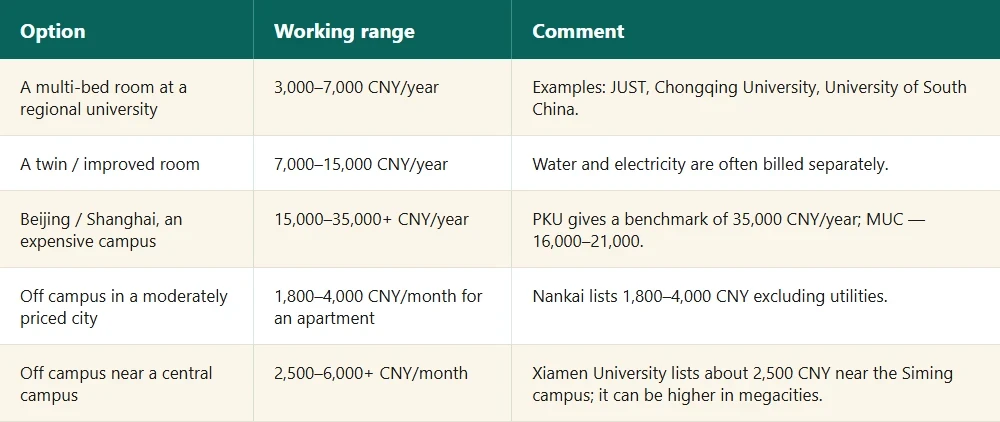
Source: University of South China, Xiamen University, Jiangsu University of Science and Technology, Peking University, Minzu University of China
What is not always included Water, electricity, internet, air conditioning, heating, laundry, bedding and a deposit may be billed separately. Look for the wording "utilities included / excluded" in your offer. |
Food, transport, communication and personal expenses
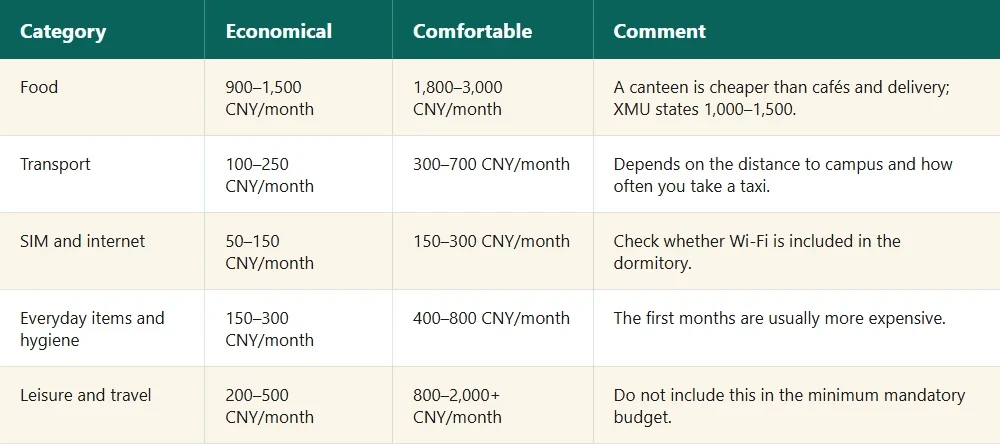
Source: Xiamen University
A realistic day-to-day budget without separate rent usually runs about 1,500–3,500 CNY a month. In Beijing, Shanghai and Shenzhen, with frequent cafés, taxis and outings, it can be higher.
Insurance, medical check-up and residence permit
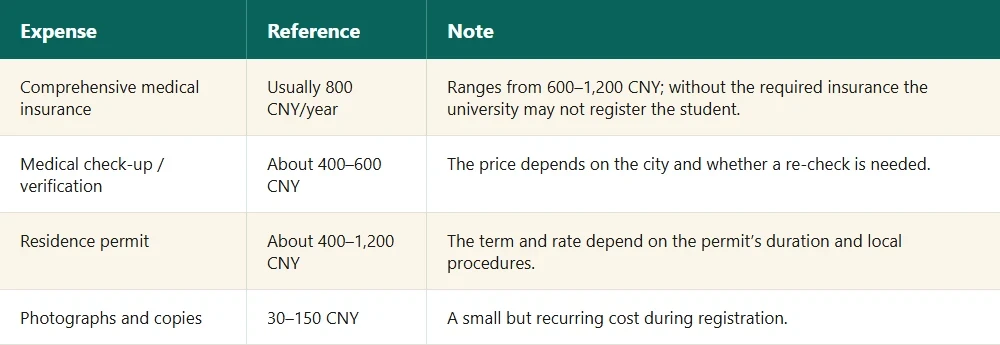
One-off expenses before and after arrival
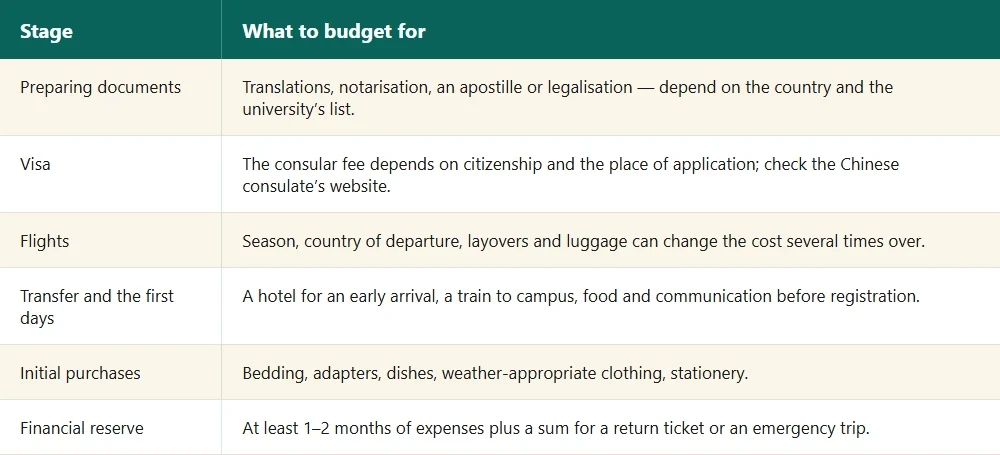
Why the first year is more expensive than the following ones The first year adds application fees, documents, flights, a deposit, a medical check-up, a residence permit and setup costs. From the second year, some of these costs disappear, but tuition, insurance, housing and living expenses remain. |
The cost difference between cities
A city’s name alone does not determine the programme’s price, but it noticeably affects housing, off-campus food, transport and leisure.
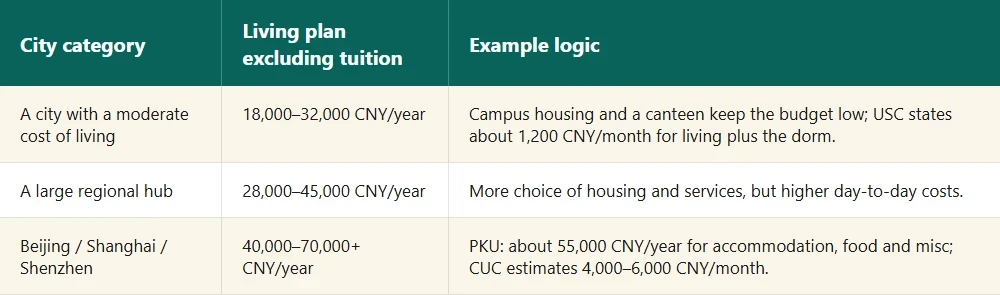
Source: University of South China, Peking University, Communication University of China
An exception: a cheap dormitory in an expensive city A campus subsidy can sharply lower the budget. For example, CUHK-Shenzhen lists a dorm at 2,400 CNY a year alongside a high tuition fee. So compare not "the city in general" but the specific programme + campus + room type. |
Ready-made annual budget scenarios
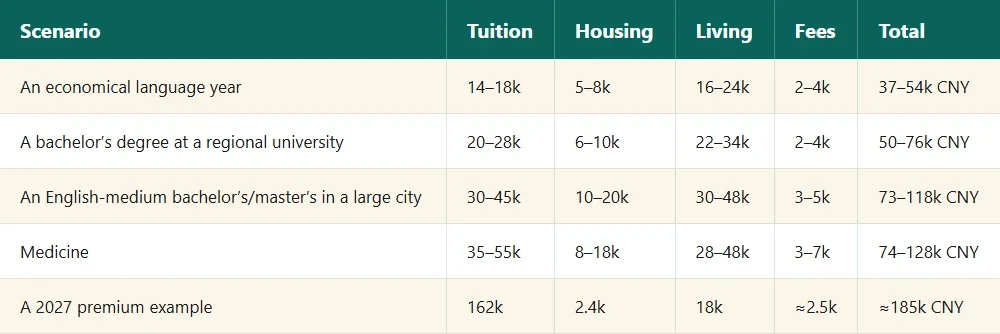
In rubles these scenarios run from roughly 426,000 ₽ for an economical language year to about 2.13 million ₽ for the premium example above. The rate and bank fees need to be recalculated before paying.
How a grant or scholarship changes the budget
The word "grant" does not mean the same coverage in every case. In one case a student gets only a tuition waiver, in another — tuition, accommodation, insurance and a monthly stipend.
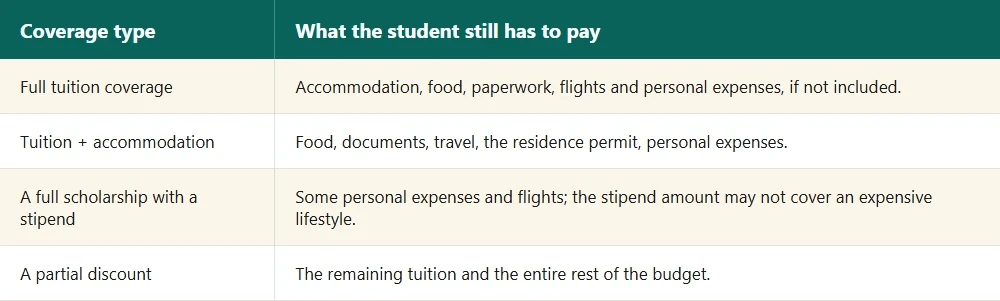
For example, an official CQNU guide states that the International Chinese Language Teachers Scholarship exempts tuition, accommodation and insurance, plus a stipend of 2,500 CNY a month for the yearly and semester programmes. But conditions depend on the category and competition.
Do not build a budget on an unconfirmed grant Until you receive the official scholarship award, your financial plan should assume a self-funded scenario. Also check the scholarship renewal terms: results, attendance and an annual assessment. |
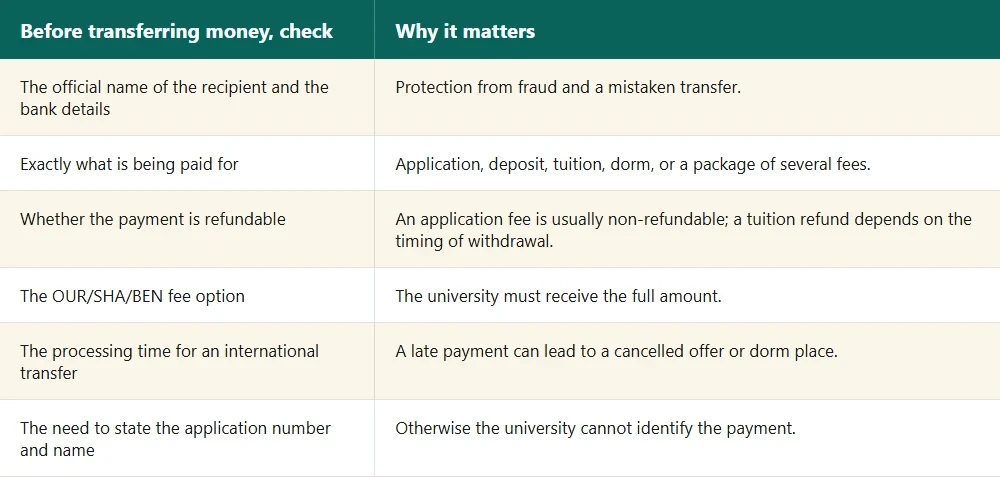
When and how to pay for tuition
Payment order differs. One university asks for tuition before issuing visa documents, another — after the Admission Notice, a third — at registration. Payment can be per semester, per year, or for the full programme.
Hidden costs and common mistakes
- Counting only tuition — the main mistake. In some programmes tuition is less than half the full annual budget.
- Comparing prices without accounting for language and major — a single university may have several rates: Chinese-taught, English-taught, medicine, arts and a premium programme.
- Not confirming the campus — accommodation and cost of living can differ between campuses of the same university.
- Forgetting application fees — five to eight applications create a noticeable separate expense line.
- Using an advertised ruble rate — payment goes through at the bank’s real rate and with a fee.
- Not reading the refund policy — a withdrawal, a visa delay or a postponed intake do not always give the right to a full refund.
- Planning to start earning money right away — do not fund your mandatory budget on an assumed part-time job. The right to work depends on the rules in force and any permits.
- Not keeping a reserve — medical, travel and everyday costs can arise before you open a bank account and gain access to campus services.
How to save without taking risks
- Compare the full annual cost, not just tuition.
- Choose a campus dormitory and apply for a room as soon as booking opens.
- Use university canteens and student transport.
- Apply for suitable state, provincial and university scholarships, but keep a self-funded plan.
- Check whether tuition can be paid by semester without a surcharge.
- Prepare translations and legalisation only after receiving an exact checklist.
- Plan your ticket early and account for the allowed luggage.
- Do not choose an unknown intermediary just because they promise "the lowest price."
Saving money should not worsen the route A very cheap programme may not fit your major, language, level of preparation, diploma recognition or the conditions for progressing after Foundation. Check the academic fit first, then the price. |
Checklist for calculating your personal budget
- Tuition for one year and for the full programme.
- The application fee for each university.
- Dormitory: room, term, deposit, utilities.
- Insurance, a medical check-up and the residence permit.
- Textbooks and any special costs for the programme.
- Food, transport, a SIM card, laundry and everyday purchases.
- Translations, notarisation, an apostille or legalisation.
- A visa, flights, luggage and transfer to campus.
- Bank fees and a reserve for rate changes.
- A reserve of at least 10–15% and 1–2 months of expenses.
- What a confirmed scholarship actually covers.
FAQ: frequently asked questions about the cost of studying in China
How much does the most affordable year of study in China cost?
With tuition around 14,000 CNY and an inexpensive dormitory, a full economical budget can start at roughly 35,000–40,000 CNY a year. This requires a regional city, campus housing and moderate personal expenses.
How much money does a student need per month?
Without a separate expensive rental, it is reasonable to plan 1,500–3,500 CNY for food, transport, communication and daily life. In a megacity or with an active lifestyle — more.
Is a dormitory included in tuition?
Usually not. It is a separate payment unless a scholarship or package explicitly states free accommodation.
Can you study for free?
Yes, full and partial scholarships exist, but they are competitive. Costs cannot be treated as covered until the official award.
Why is an English-medium programme more expensive?
It may have a separate international curriculum, foreign faculty, smaller groups or a partner degree. But the difference depends on the specific university.
Do you have to pay for the whole bachelor’s degree at once?
Tuition is more often charged by year or semester, but some professional programmes publish a price for the entire programme. Check the terms in your offer and fee policy.
How much does medicine cost?
For many state programmes, tuition is around 30,000–60,000 CNY a year. The full budget with housing and living expenses is often in the 65,000–125,000 CNY range and above.
Which is more expensive: a dormitory or an apartment?
A campus dormitory is almost always cheaper. An apartment can require a deposit, a commission, utility bills and residence registration.
Which exchange rate should you use for the calculation?
Plan in CNY and convert to rubles at the current rate with a margin for bank fees. The reference rate in this article should not be treated as a guaranteed price on the payment date.
Can you cover expenses with a part-time job?
You should not build your mandatory budget around future work. The possibility of part-time work depends on the rules, university permission and migration procedures.
Get an exact calculation
An exact budget only appears once the level, major, language, city and several specific programmes have been chosen. For each programme you need to separately check tuition, the dorm, the application fee, scholarship coverage and payment deadlines.
Get a budget calculation and a shortlist of universities GE Agency will review the candidate’s documents and goals, select suitable programmes, and prepare a comparison table: tuition, dormitory, additional fees, possible grants and a full reference cost for the first year. |
For a preliminary calculation you will need: citizenship, age, current education, desired major, language of instruction, expected intake, academic grades and available budget.
This material is for informational purposes. Only the university’s official rates, the Admission Notice, the invoice, the scholarship award and the contract terms on the payment date are final.