
A language year at a Chinese university suits students who want to start Chinese from zero, prepare for the HSK, get used to life in the country, or continue studying in Chinese. This guide covers programme options, the latest officially published prices, deadlines, documents and the full budget.
Information verified on 20 July 2026. Some universities have not yet published final terms for the 2027 autumn intake. The tables show the latest official rates and dates available at the time of checking; re-confirm them before applying.
Table of contents
- What a language year is
- Who it suits
- Can you start from zero
- One semester or a full year
- What you study and the result you can expect
- 2027 intake timing
- Universities and prices
- Choosing a city
- Full budget
- Requirements and documents
- Step-by-step application
- Plans after the language year
- Grants
- Visa and dormitory
- Common mistakes
- FAQ
What a language year in China is
A language year is a full-time, non-degree programme at a Chinese university. The student does not enrol directly into a bachelor’s or master’s programme; instead, over one or two semesters they systematically study Chinese: listening, speaking, reading, writing, grammar and characters.
Classes usually run Monday to Friday. Standard programmes involve about 16–20 academic hours a week, intensive ones up to 29–30 hours. After registration the university runs a placement test and groups students by level. Many universities have groups for absolute beginners.
The essentials A language year is a standalone programme. It does not mean automatic admission to a bachelor’s degree or a scholarship. For the main programme the student submits a separate application and must meet the chosen university’s HSK, academic document, CSCA and other requirements. |
How a language year differs from Foundation and the 1+4 programme
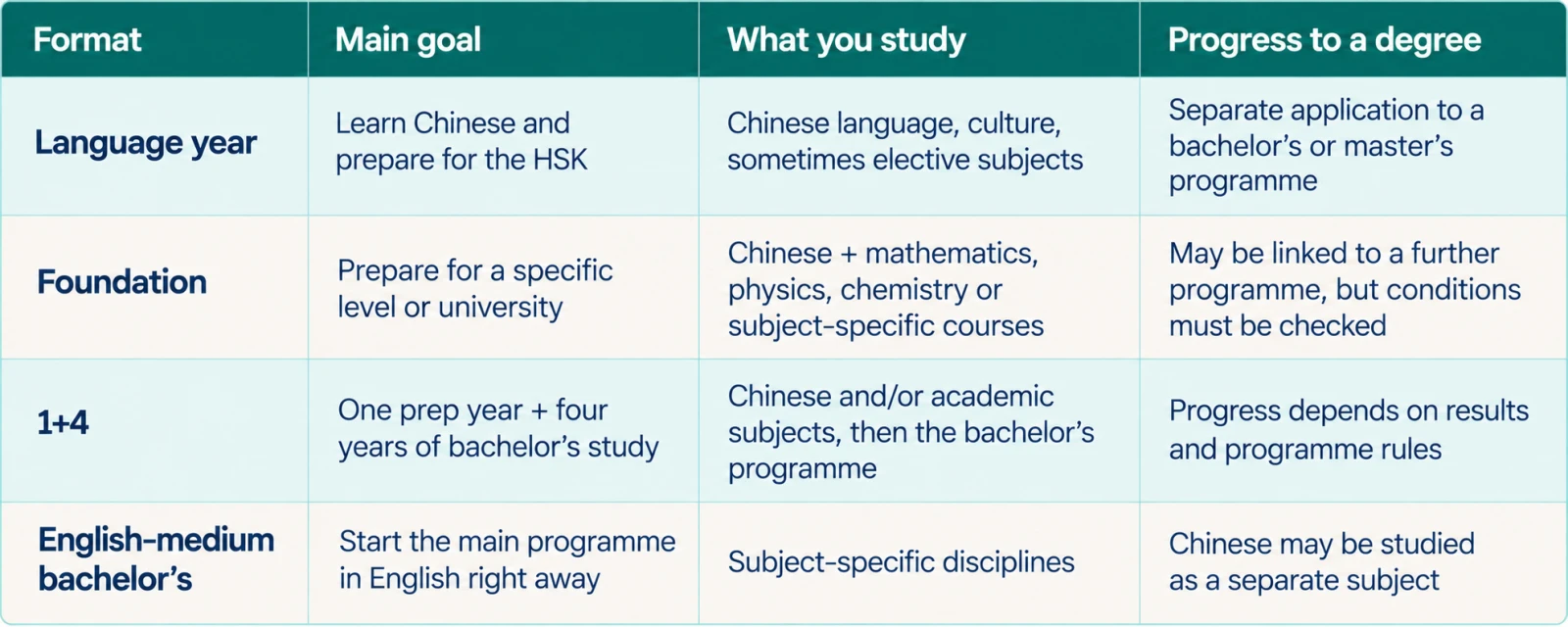
If the main goal is language and freedom to choose a university afterwards, a standard language programme usually fits. If the student also needs preparation in mathematics, natural sciences or CSCA, it is worth comparing a language year with Foundation.
Who a language year suits
- a school graduate who wants to apply to a Chinese-medium bachelor’s programme but does not yet have the required HSK;
- a student starting Chinese from zero;
- a master’s or PhD candidate who needs to strengthen their language before the main programme;
- someone who wants to test whether life and study in China suits them;
- a student who missed the main intake and does not want to lose a year;
- a professional who needs Chinese for business, work or a future career;
- an applicant who wants to learn the language by immersion and use it daily outside the classroom.
A language year is not a universal solution. If a student already has a high HSK and fully meets the requirements of their chosen main programme, direct admission may be faster and cheaper. If the programme will be in English, a separate language year is only needed when the student wants to learn Chinese for life, internships or a future job.
Can you start Chinese from zero
Yes. Many university programmes accept students without an HSK and without prior study of the language. For example, Beijing Normal University directly welcomes candidates at zero or any level, South China Normal University has separate beginner groups for absolute newcomers, and Harbin Institute of Technology splits its long-term programme into beginner, intermediate and advanced levels.
An HSK is usually not mandatory for a language programme. If a certificate already exists, it may be used together with the placement test to determine the group. Having an HSK does not remove the in-house test: the university needs to assess real reading, listening and speaking skills.
One semester or a full language year
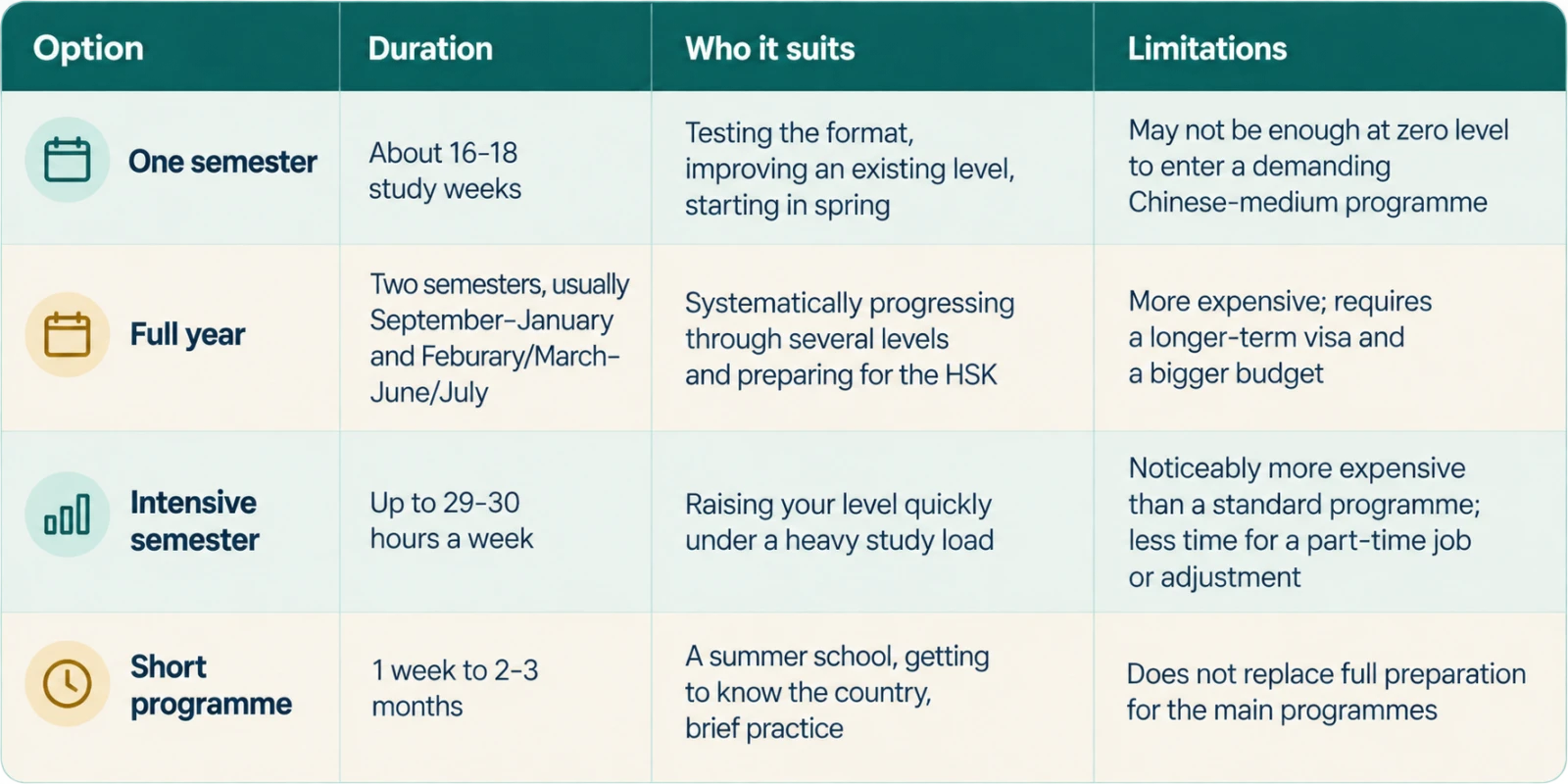
For an absolute beginner planning a Chinese-medium bachelor’s degree, it is safer to consider a full academic year rather than one semester. The final result, however, depends on intensity, attendance, independent work and the required HSK level.
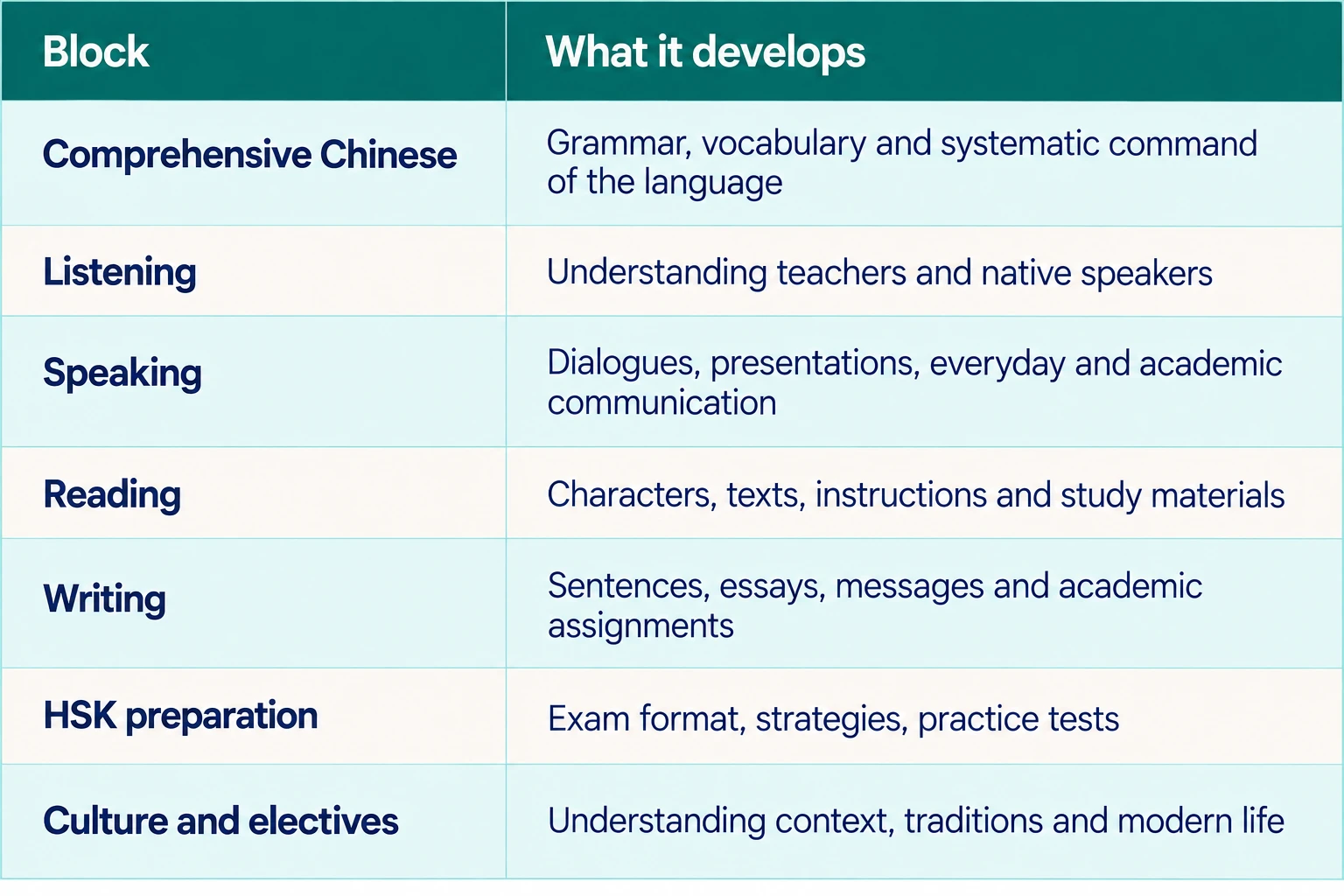
What you study on a language programme
The main programme usually includes comprehensive Chinese, speaking, listening, reading, writing and character practice. Universities may also offer HSK preparation, business Chinese, tourism Chinese, calligraphy, tai chi, Chinese culture and regional courses — for example, basic Cantonese in Guangzhou.
What level you can reach in a year
No university can guarantee a specific HSK result for every student. The outcome depends on the starting level, number of hours, quality of independent work and language practice. Some universities do publish their own benchmarks, though. South China Normal University states that after one semester of intensive study students can typically reach around HSK 3–4, and after two semesters — HSK 5, given successful completion of the programme.
A careful phrasing for publication Do not write: "in a year you will guaranteed get HSK 5." Correct: "an intensive year may help you prepare for HSK 4–5, but the level depends on your starting point, the programme, attendance and independent work." |
When the 2027 language year intake starts in China
Most universities have two possible starts: spring — in February or March, and autumn — in September. The autumn intake usually offers more universities, more dormitory options and more full-academic-year programmes. The spring intake suits those who do not want to wait until September, but the choice may be narrower.
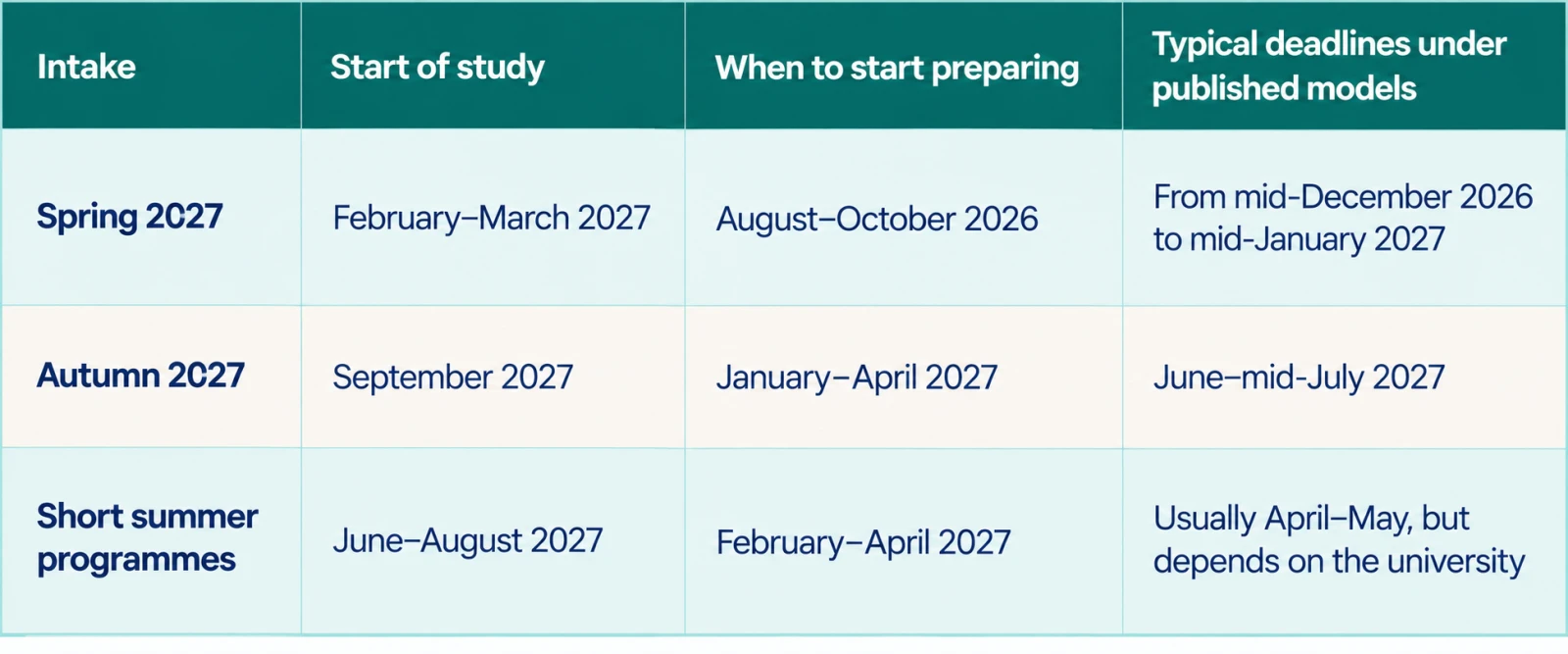
These are reference points, not a single calendar. For example, Shanghai Jiao Tong University gives a 15 September – 15 December application window for its long-term spring course and has already published the 2027 spring semester dates: 1 March to 2 July. South China Normal University states annual deadlines of 15 January for spring and 15 July for autumn. Some universities close intake earlier once places are filled.
Chinese universities with language programmes: official examples
The list below does not cover every Chinese university — it shows examples of programmes for which official rates and terms were available as of 20 July 2026. Prices may change for autumn 2027. Before signing a contract and paying, the university must reconfirm the tuition fee, campus, dormitory and deadline.
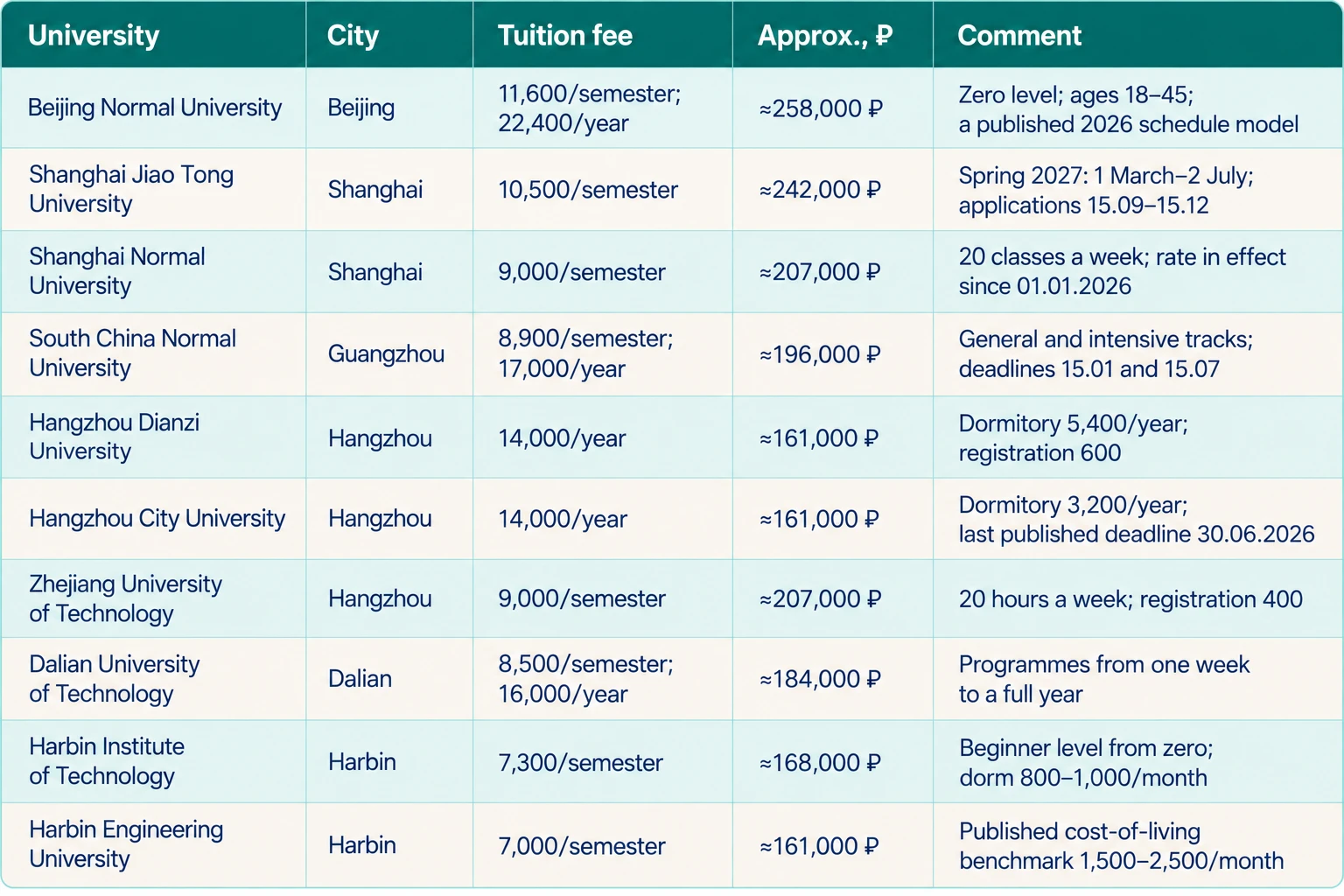
How to read the table Ruble amounts are indicative, calculated at the Bank of Russia rate of 1 CNY = 11.5136 ₽, effective from 16 July 2026. Your bank, payment provider and university may apply a different rate and fees. Update the ruble equivalents before publishing in autumn 2026. |
How to choose a city for a language year
The choice of city affects not only your impressions of China but also the full budget, climate, language environment, transport and further opportunities. The best-known megacity is not always the best option. A student who wants maximum immersion and more moderate costs may prefer a regional university; for an international environment, business and internships — Beijing, Shanghai, Guangzhou or Hangzhou.
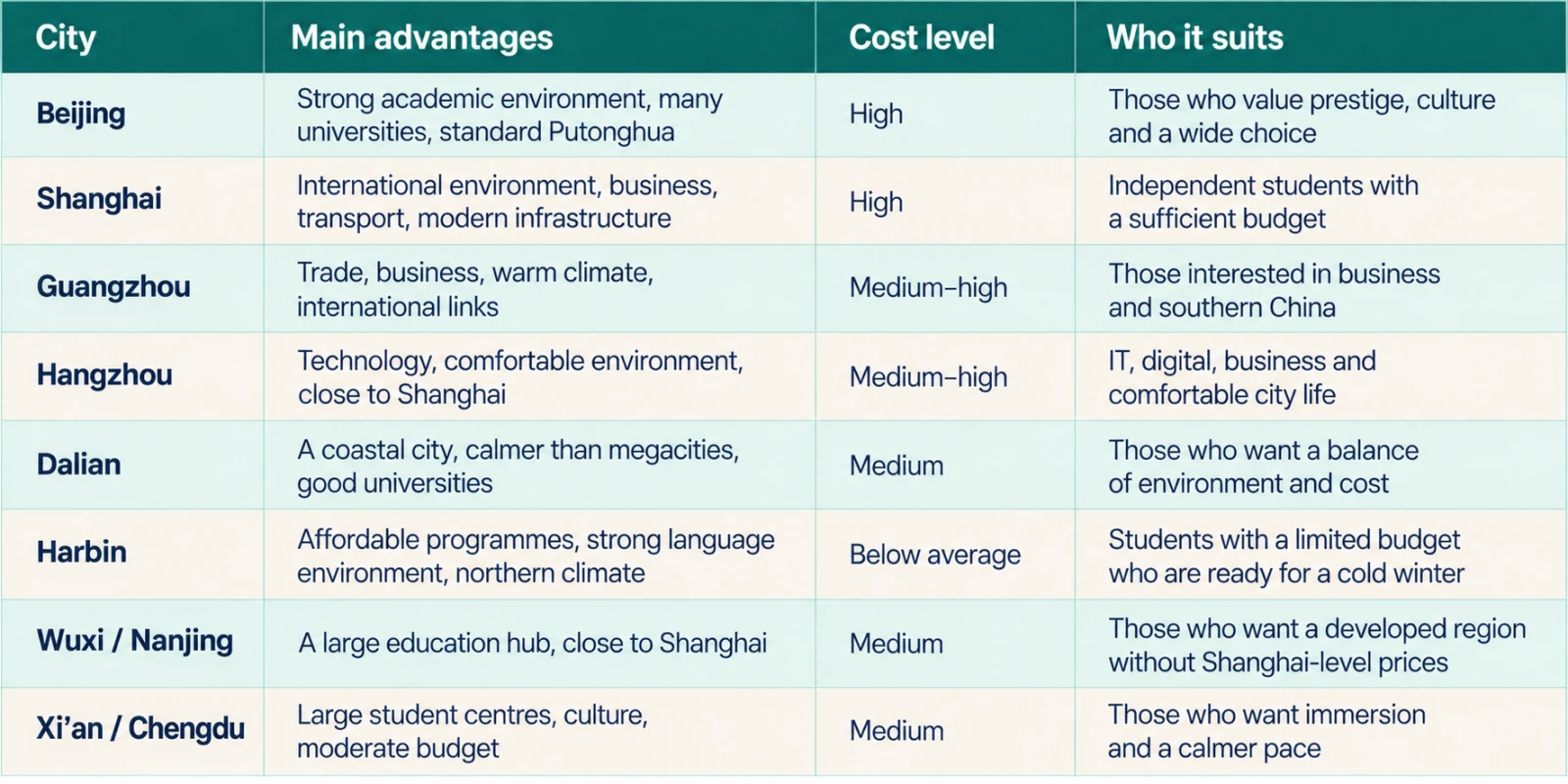
For each city page on ge.agency, at least three available universities, dormitories, cost of living, airports, climate and options to continue studying should be compared separately. A simple copy of the general article with the city name swapped will not give the reader enough value.
How much a language year in China costs in 2027
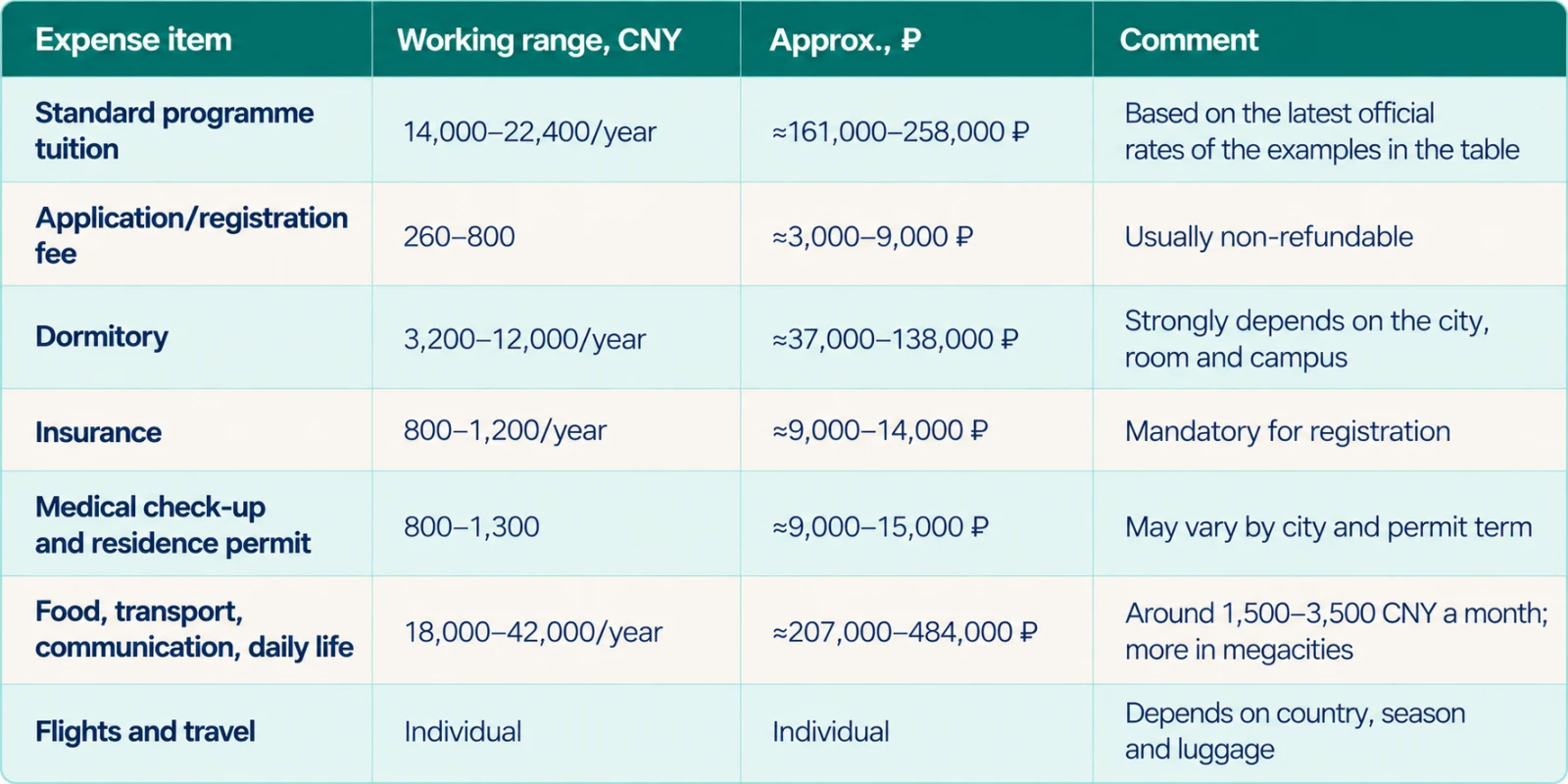
The programme fee is only one part of the budget. Besides the tuition fee, a student pays a registration fee, dormitory, insurance, medical check-up, residence permit, food, transport, communication, flights and personal expenses.
Three full-budget scenarios
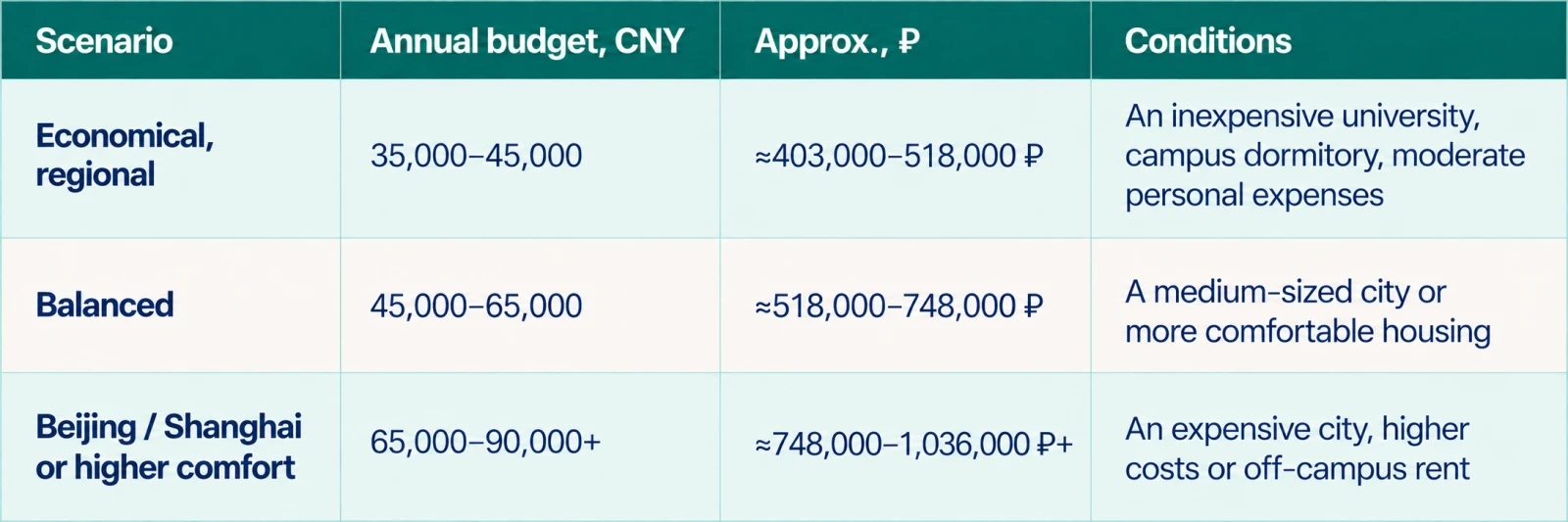
These scenarios are for initial planning, not a fixed price. An exact calculation is only possible once the city, university, campus and room type have been chosen.
Requirements for a language year application
Requirements are usually softer than for a bachelor’s or master’s programme. Most programmes do not require entrance exams or an HSK, but the university checks age, education, health, financial capacity and migration history.
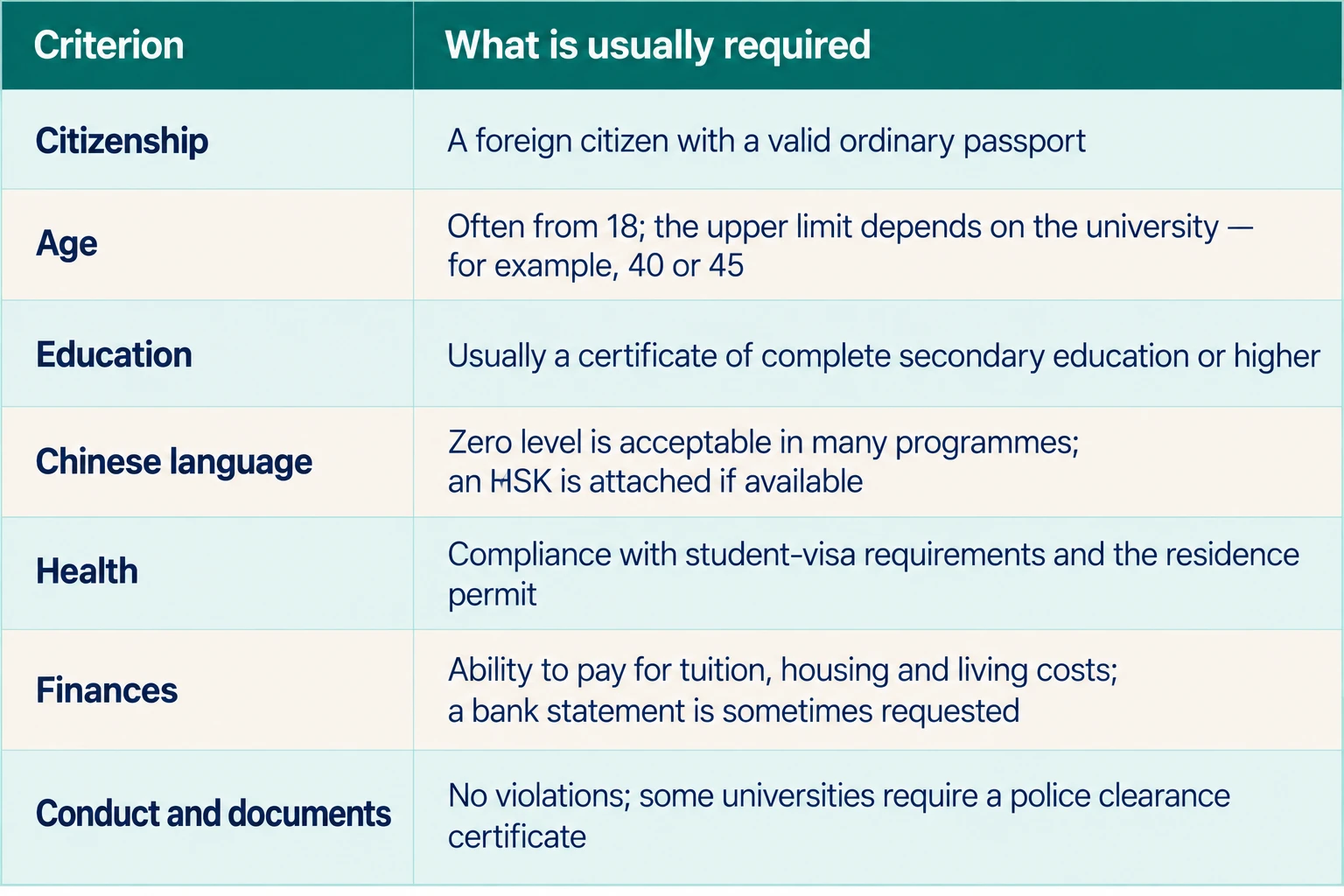
What documents are needed
- a scanned photo page of the international passport;
- the university’s application form;
- a certificate, diploma or transcript of study;
- a transcript or grade record;
- a translation of documents into Chinese or English if the original is in another language;
- a passport-format photo;
- an HSK certificate — if available, though usually not required for a beginner programme;
- a medical form — if required at the application or visa stage;
- a police clearance certificate — if requested by a specific university or country;
- copies of previous Chinese visas and proof of prior study in China — if applicable;
- financial or sponsorship documents — upon the university’s request.
A final list cannot be formed from a single universal checklist. For example, BNU asks for a police clearance certificate, while SCNU notes that additional documents may be requested by email for certain countries. All files must match the format and size required by the specific university’s system.
How to apply: step by step
- Decide on your goal: Chinese for life, HSK, a bachelor’s degree, a master’s degree, or business.
- Choose a spring or autumn 2027 start.
- Compare cities by budget, climate and further programme.
- Shortlist 3–6 universities and check whether there is a beginner group, a dormitory, and the intake you need.
- Prepare your passport, education document, transcript and translations.
- Fill out the online application and pay the registration fee.
- Monitor the system and your email; promptly send additional documents and attend an interview if scheduled.
- Receive the Admission Notice and the JW202 or DQ form, if applicable.
- Pay the tuition fee and other mandatory payments in the order specified by the university.
- Arrange an X1 or X2 visa, buy a ticket, book a dormitory and prepare original documents.
- Complete registration, the placement test, the medical check-up and residence permit paperwork after arrival.
What to do after the language year
After the programme, a student can continue Chinese for another semester, apply to a bachelor’s, master’s or PhD programme, move to an English-medium programme, return home, or use the language for work. The university issues a certificate of completion, but this document does not replace a degree or guarantee admission to the main programme.
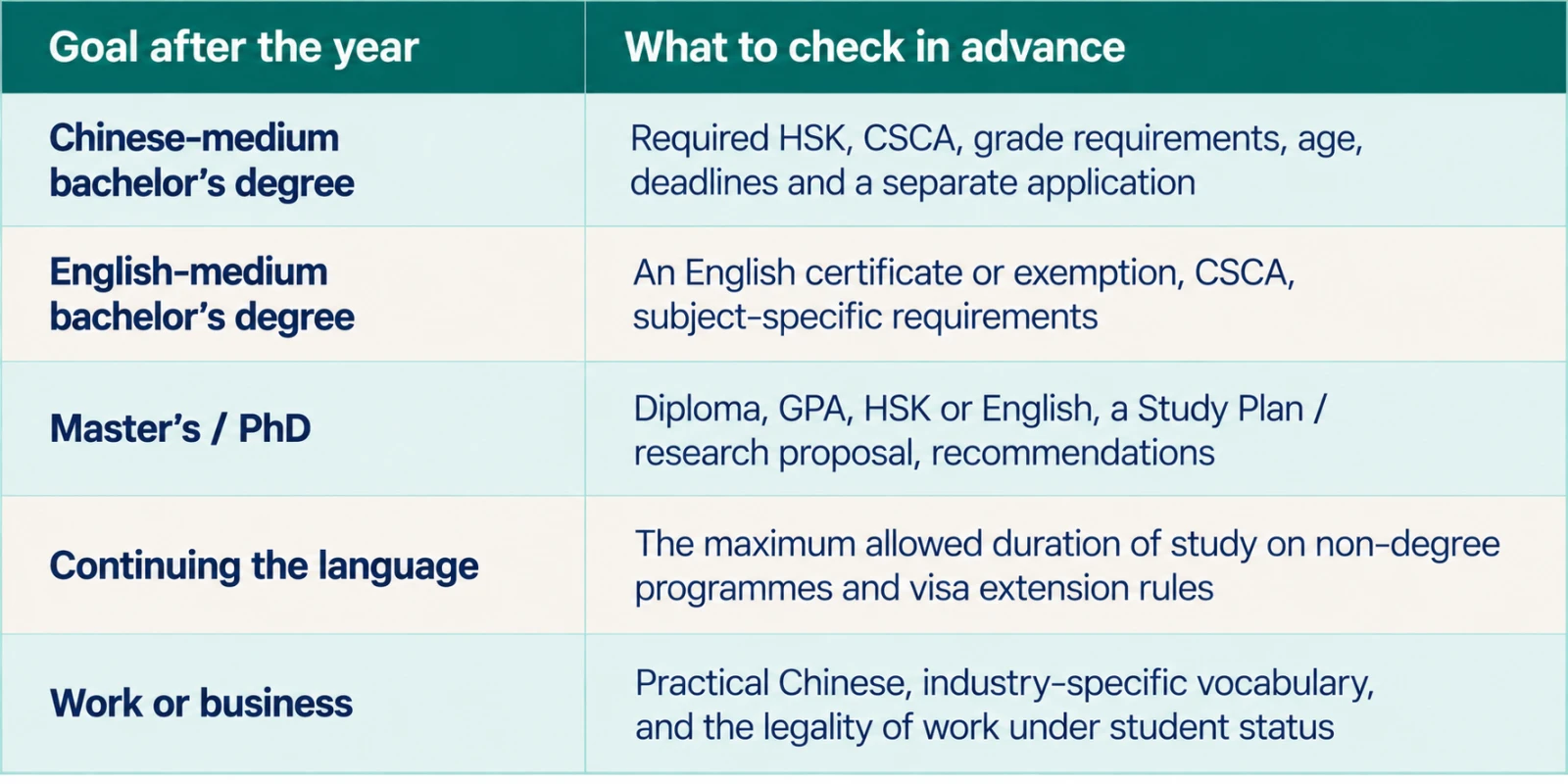
Important for the 2027 bachelor’s intake A language course alone does not exempt you from bachelor’s admission requirements. In 2026 Chinese universities began including CSCA in admission rules for foreign undergraduates. Before choosing a language programme, check whether it prepares you for the required CSCA subjects or whether separate preparation will be needed. |
Can you get a grant for a language year
Yes, some funding options exist, but a standard self-funded language year should not automatically be called a grant programme. The best-known relevant route is the International Chinese Language Teachers Scholarship. In 2026 the official list of host universities included institutions working with scholarship holders on language programmes, though categories, HSK/HSKK, age, recommending organisation and deadlines depend on the specific programme.
For most clients it is safer to plan a base budget as self-funded and separately assess eligibility for a scholarship. A full grant cannot be promised: the decision is made competitively by the organiser and host university.
Which visa you need
For study lasting more than 180 days, an X1 visa is usually issued. For a course of up to 180 days — X2. X1 requires an Admission Letter and a JW201/JW202 form; after entry, an X1 holder must obtain a residence permit within 30 days. X2 usually only requires an Admission Notice and any additional documents specified by the consulate and university.
The exact set depends on the country of application. For example, the Chinese Embassy in the UAE uses online submission and separately reminds applicants to confirm legal residency if applying outside their country of citizenship. Check the embassy or visa centre website at the place of application before applying for the visa.
Dormitory and campus life
A dormitory place is not automatically guaranteed simply by enrolment. At popular universities, rooms are booked after admission and can run out. Clarify the campus, room type, deposit, whether water, electricity and internet are included, whether living off campus is allowed, and whether address registration is required.
- do not transfer dormitory payments to personal accounts without an official instruction;
- keep receipts and payment confirmations;
- check refund rules before paying;
- do not buy a non-refundable ticket before receiving your visa;
- bring original education and medical documents;
- arrange a way to pay in China, a SIM card and a cash reserve in advance.
Common applicant mistakes
- choosing a university only by ranking, without checking the quality and intensity of the language programme;
- assuming the tuition fee equals the full annual budget;
- applying too late, when beginner-group or dormitory places have already run out;
- not checking whether a spring intake is actually available on the chosen campus;
- expecting a guaranteed HSK 5 after one year;
- thinking a language year automatically leads to a bachelor’s degree;
- not accounting for CSCA and the academic requirements of the future programme;
- paying fees before checking the payment details and refund policy;
- submitting unreadable scans or documents without a required translation;
- choosing a city without considering climate, budget and transport access.
Frequently asked questions
Can you apply for a language year without an HSK?
Yes. Many universities accept absolute beginners. An HSK is usually needed for level placement or for a further main programme, not for a beginner course.
Can you start in spring 2027?
Yes, but a spring intake is not available at every university. Under published models, deadlines often fall in December 2026 – January 2027.
How much does a language year cost?
Based on the latest official rates of the state universities reviewed, tuition is about 14,000–22,400 CNY per year. The full budget with housing and living costs is usually in the range of 35,000–90,000 CNY.
Are there age limits?
Yes, and they vary. For example, some programmes state a limit of 40 or 45. A minor may need guardian documents.
Can you apply after grade 9?
Some non-degree or preparatory routes may be available, but most classic university programmes require education equivalent to full secondary school. Each case needs individual assessment.
Will I get HSK 5 in one year?
It is possible with intensive study but not guaranteed. The result depends on your starting level, the programme, attendance and independent work.
Does a language year give automatic admission to a bachelor’s programme?
No. A separate application is submitted for a bachelor’s degree, and the candidate must meet the requirements for HSK, CSCA, grades, age and documents.
Can you get a grant?
There are dedicated scholarships, including the International Chinese Language Teachers Scholarship, but they are competitive and have their own requirements. A standard programme should be planned as self-funded until a scholarship is confirmed.
Which visa do you need?
Usually X1 for study over 180 days and X2 for a period of up to 180 days. The exact set is checked by country of application.
Which city should you choose?
Beijing and Shanghai offer the widest choice but are more expensive. Hangzhou combines technology and comfort, Dalian offers a coastal environment and a mid-range budget, Harbin offers affordable programmes and strong language immersion but a cold climate.
Get matched with language programmes
Want to start a language year in China in 2027? GE Agency will review your age, education, budget, preferred city and future plans, then suggest universities with a suitable start date, tuition fee and dormitory. Once you’ve chosen a programme, we help prepare documents, submit the application, obtain admission, and go through the visa, travel and registration process. |