
Studying in Guangzhou for international students in 2027
Guangzhou is the capital of Guangdong province, a major university and business hub in southern China, and one of the key cities in the Guangdong–Hong Kong–Macao Greater Bay Area. Here education is closely tied to foreign trade, industry, medicine, technology and international communications.
For international students Guangzhou offers a rare combination: strong state universities, a wide choice of medical and engineering programmes, developed international trade, a warm climate and costs that are usually lower than in the central districts of Beijing and Shanghai. By the end of 2025, Guangdong province had more than 20,000 international students, with 105 universities open to foreign applicants.
The city is home to Sun Yat-sen University, South China University of Technology, Jinan University, South China Normal University, Guangdong University of Foreign Studies, Southern Medical University, Guangzhou Medical University, South China Agricultural University, Guangzhou University and Guangdong University of Technology. Research centres and new universities across the Greater Bay Area further strengthen the education ecosystem.
Important for the 2027 intake As of the preparation date — July 2026 — most universities had not yet published their 2027 admission brochures. This document therefore separates confirmed 2026 terms from planning benchmarks for 2027. Final prices, deadlines and CSCA subjects need to be checked before applying. |
Why international students choose Guangzhou
- Strong comprehensive universities — SYSU and SCUT give access to competitive programmes in engineering, computer science, economics, medicine, business, natural sciences and humanities.
- Medicine and a clinical base — SYSU, Southern Medical University and Guangzhou Medical University have strong medical schools with affiliated hospitals. GMU offers an English-medium MBBS.
- International business — the city hosts the Canton Fair and is known for foreign trade, logistics, e-commerce, manufacturing and links to Hong Kong, Macao and Shenzhen.
- Chinese language and international communication — Jinan University, GDUFS and SCNU offer language, preparatory, teacher-training and international programmes.
- A moderate budget — living in a dormitory and using canteens, a student can often keep daily expenses in the range of 2,500–4,500 RMB a month, excluding tuition.
- A warm climate — winter is short and mild, though summer is hot and humid, which suits students who tolerate cold poorly but requires adjusting to rain and air conditioning.
Who studying in Guangzhou suits
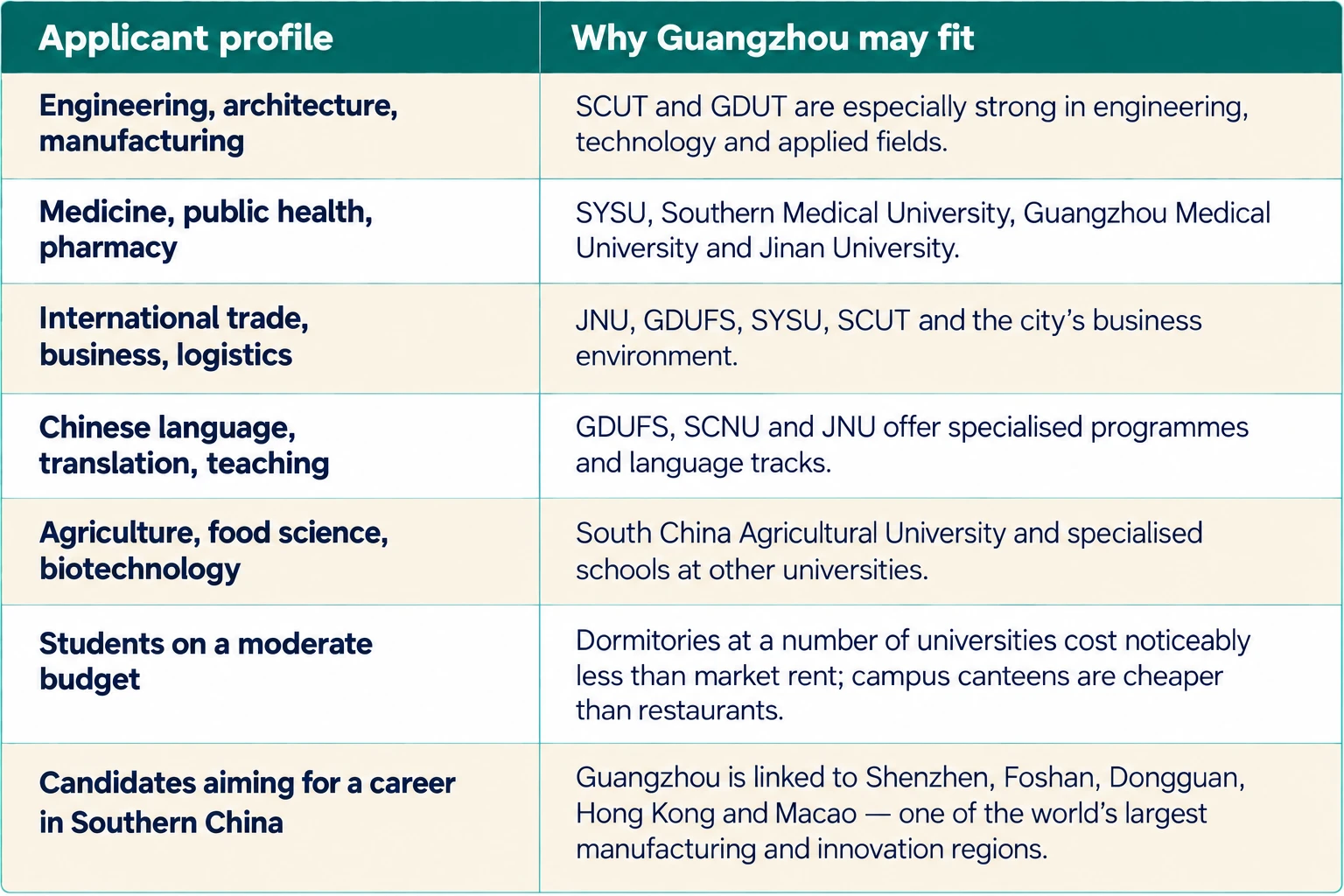
When another city may be better For the highest concentration of national research institutions and a humanities-focused academic environment, Beijing is more often chosen. For global finance and an ultra-international corporate environment — Shanghai. For a cooler climate and a minimal budget you can compare Harbin, Xi’an, Wuhan or Changchun. |
Best universities in Guangzhou for international students
Choosing a university should start not with the overall ranking but with the specific programme, language, campus, tuition fee, CSCA subjects, medical requirements and dormitory availability.
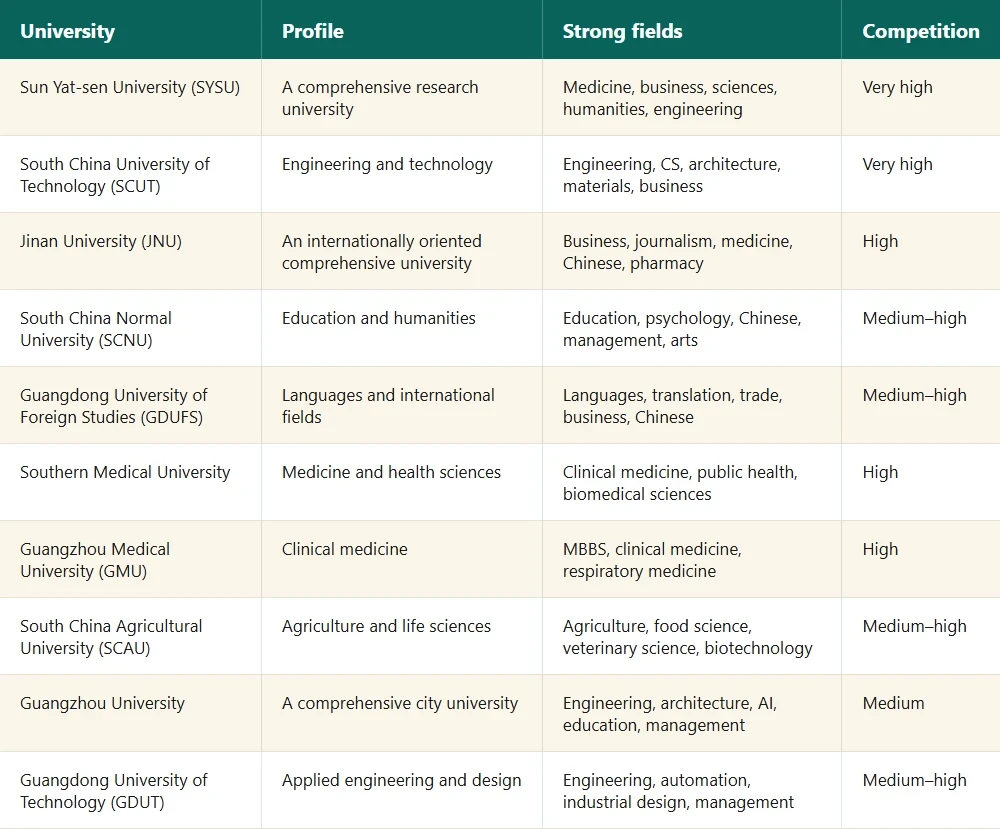
Source: Sun Yat-sen University, University of South China, Jinan University, South China Normal University, Guangzhou University, Southern Medical University, Guangzhou Medical University, South China Agricultural University, Southern Medical University
Sun Yat-sen University (中山大学)
One of the most competitive universities in Southern China. For the 2026 bachelor’s intake the university ran two application rounds: 1 January–28 February and 1 March–30 April. Most bachelor’s programmes required CSCA. Tuition was 26,000 RMB for humanities, 33,800 RMB for natural sciences/engineering/agriculture, and 48,000 RMB for medicine.
Who it suits Suits strong candidates with high grades, a solid academic base, and readiness to complete CSCA in advance. Campuses are not only in Guangzhou, so the specific programme’s address should be checked. |
South China University of Technology (华南理工大学)
A key engineering university in the region. The official 2026 prospectus offered Chinese- and English-medium programmes; published programme pages showed tuition roughly from 18,200 RMB for a Chinese/language track up to 26,000–34,000 RMB for select English-medium business and engineering programmes. Dormitories are allocated on a first-come, first-served basis.
Who it suits One of the best options for engineering, computer science, materials, architecture, automation and manufacturing. Confirm the language and campus in advance. |
Jinan University (暨南大学)
One of China’s most internationally oriented universities. In 2026 tuition for international students was 19,000 RMB for humanities/economics/management, 22,000 RMB for science/engineering/languages, 25,000 RMB for medicine/pharmacy, and 28,000–40,000 RMB at the International School. Dormitories on the Guangzhou campuses cost about 975–6,000 RMB a year.
Who it suits A strong choice for business, journalism, Chinese language, pharmacy and medicine. The university has several campuses, so costs and logistics vary significantly. |
South China Normal University (华南师范大学)
A specialised university for education, psychology, Chinese, humanities and management. In 2026 bachelor’s tuition was 21,000 RMB for humanities/social sciences, 22,000 RMB for science/engineering, and 24,000 RMB for music/fine arts. Dormitory for degree students was stated at about 12,000 RMB a year for a shared room.
Who it suits Suits future teachers, psychologists, Chinese-language specialists and humanities students. Some programmes operate under a 1+3 model. |
Guangdong University of Foreign Studies (广东外语外贸大学)
A specialised international university, especially strong in languages, translation, international trade and business. The 2026 Chinese language programme cost 17,200 RMB a year; Foundation was 18,000–23,000 RMB. A double room was about 4,800 RMB per semester, and a four-bed room 2,400 RMB per semester.
Who it suits A good option for a language year, Foundation, translation, international trade, and applicants who need a gentler adjustment to the Chinese system. |
Southern Medical University (南方医科大学)
A large medical university with clinical and research fields. Conditions for foreigners and the list of programmes can change from intake to intake; check English-medium availability, licensing recognition and clinical internship rules for your specific country.
Who it suits Recommended for candidates aiming for medicine, public health, nursing and biomedical sciences, but requires especially thorough checking of diploma recognition and the language of clinical practice. |
Guangzhou Medical University (广州医科大学)
GMU offers a six-year English-medium MBBS. In 2026 tuition was 40,000 RMB a year, with a dormitory of 4,000 RMB on the Yuexiu campus or 6,000 RMB on the Panyu campus. Strong school results, proof of English, and CSCA in Mathematics and Chemistry were required.
Who it suits Suits applicants who need an English-medium medical programme. Before applying, check the rules for recognising the qualification in your home country. |
South China Agricultural University (华南农业大学)
A specialised university with strong fields in agriculture, food science, veterinary medicine, environmental sciences and biotechnology. Terms for international programmes should be checked against the annual admission guide.
Who it suits Especially interesting for students focused on food technology, agribusiness, ecology and life sciences. |
Guangzhou University (广州大学)
A large city university with civil engineering, architecture, computer science, AI, education, business and arts. Competition is usually lower than at SYSU and SCUT, but the programme and language need separate checking.
Who it suits Suits candidates who value a balance of an applied programme, city infrastructure and a more realistic chance of admission. |
Guangdong University of Technology (广东工业大学)
One of the province’s strong applied engineering universities. Profile: automation, mechanical engineering, industrial design, materials, computer science and management.
Who it suits A good alternative to SCUT for candidates focused on engineering practice, manufacturing and Greater Bay Area tech companies. |
Which majors are especially strong in Guangzhou
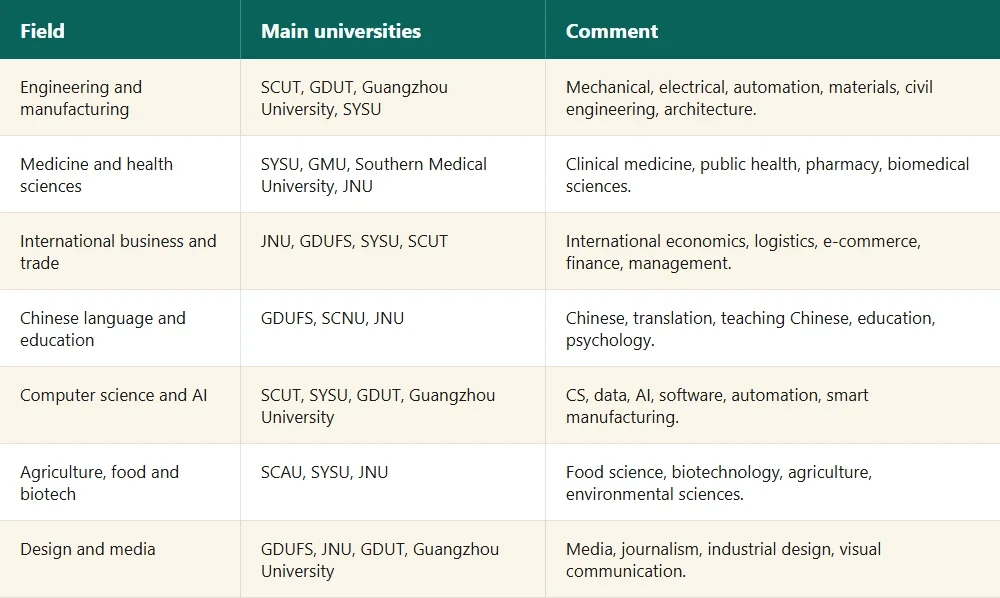
Source: Guangzhou University, Southern Medical University, Sun Yat-sen University, Guangdong University of Technology, Jinan University, Southern Medical University
Language of instruction, HSK, IELTS and CSCA
Chinese-medium programmes
Universities usually require HSK 4 or HSK 5 for bachelor’s admission, but the exact level depends on the field. Humanities, medicine and programmes with heavy academic Chinese may require a higher result. Holding an HSK does not rule out a possible interview, an internal assessment or CSCA.
English-medium programmes
English-medium programmes are available at SCUT, JNU, GMU, SYSU and other universities, but the list changes yearly. IELTS, TOEFL, Duolingo or official confirmation of English-medium schooling are usually accepted. Requirements for medicine are usually stricter.
CSCA for bachelor’s admission
In 2026 CSCA was used by SYSU, SCNU, GMU, GDUFS and a number of other universities. Required subjects depend on the major: Mathematics is the most common, while medicine and engineering may add Chemistry, Physics or other subjects. It is sensible to start 2027 preparation early, without waiting for the university application to open.
A practical rule First choose the programme and university, then check HSK/IELTS/CSCA specifically for that programme. There is no universal exam set for all of Guangzhou. |
Tuition costs in Guangzhou in 2027
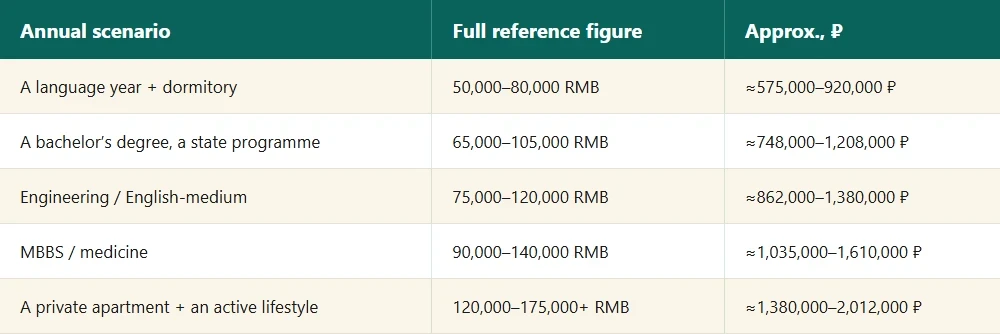
Guangzhou offers a wide price range. Basic state programmes are usually cheaper than premium English-medium, medicine or International School programmes. Ruble figures are a calculated benchmark at a conditional rate of 1 RMB = ≈11.5 ₽; update the rate before publishing.
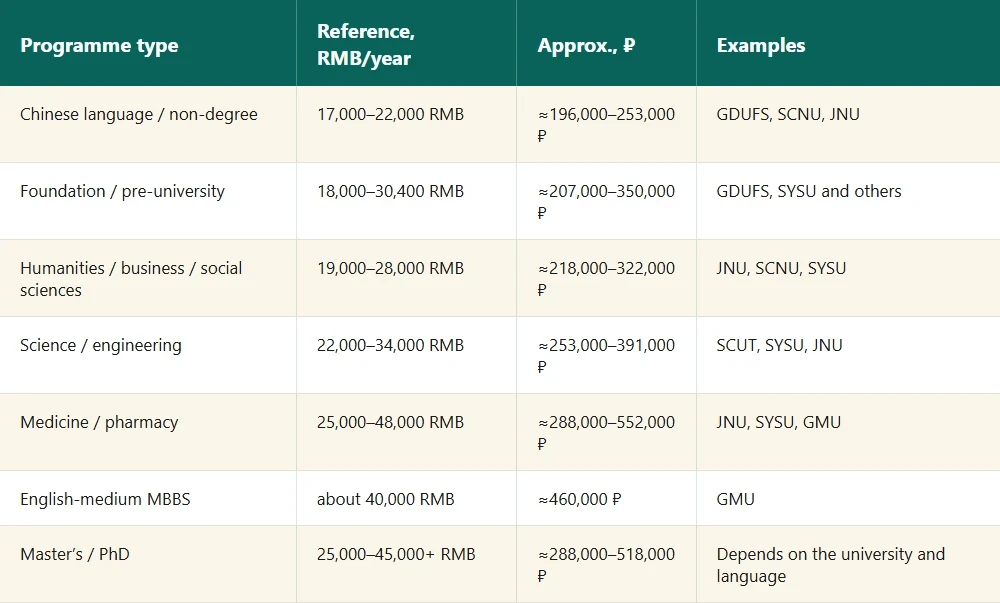
Source: Sun Yat-sen University, Jinan University, Guangdong University of Foreign Studies, Guangdong University of Technology
What is not included in tuition Application fee, insurance, textbooks, accommodation, utilities, residence permit, health check, translations, legalisation, flights and personal expenses are paid separately unless a scholarship explicitly covers them. |
Dormitory and rent in Guangzhou
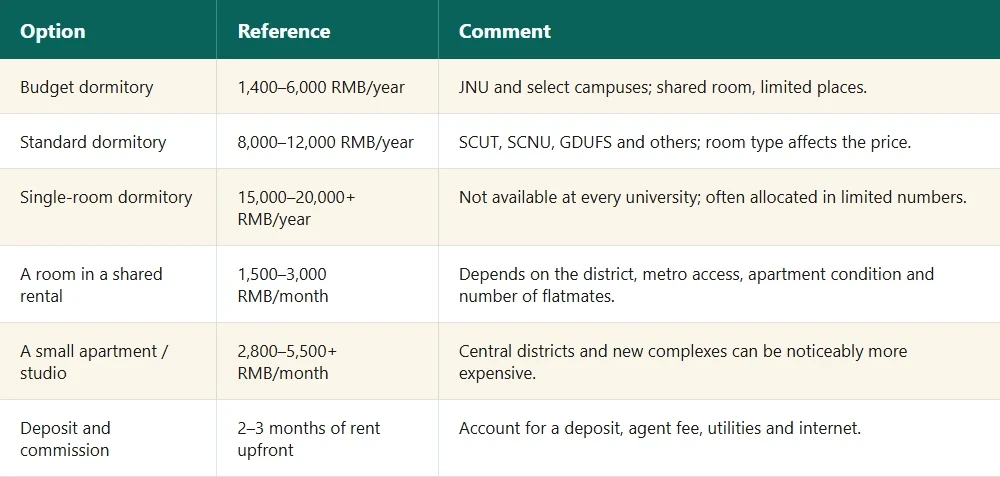
Housing prices depend on the campus more than on the city’s name. University Town in Panyu, Shipai/Tianhe, Haizhu, Baiyun and Yuexiu differ in transport access and market rent.
Source: Jinan University, Sun Yat-sen University, Guangdong University of Technology
The main risk Even if a university lists a dormitory, this does not always mean a guaranteed place. SCUT and other universities openly use a first-come, first-served basis. Budget an off-campus reserve in advance. |
Cost of student living in Guangzhou
SCUT estimates a student’s daily expenses at roughly 20,000–30,000 RMB a year, excluding tuition and accommodation. JNU states 1,000–1,500 RMB a month for food alone. In practice the budget depends on housing, campus, restaurants, travel and how often you order delivery.
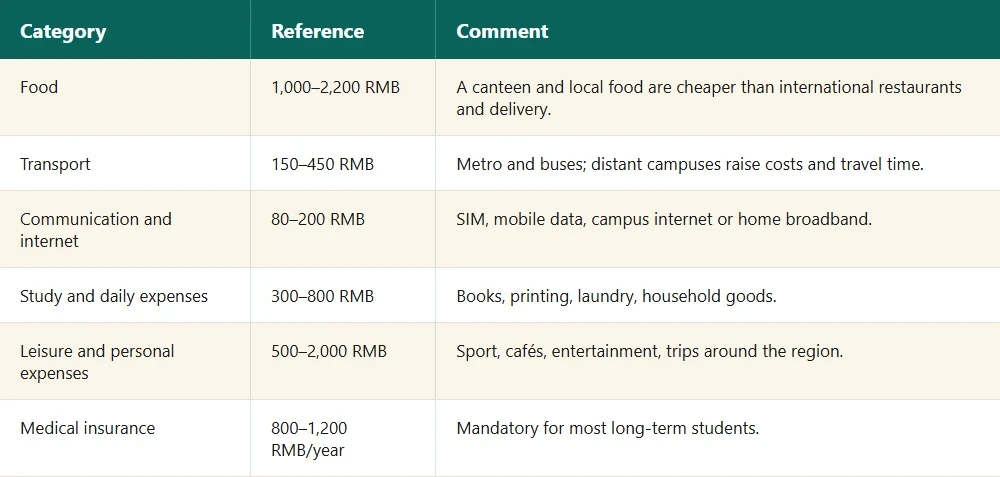
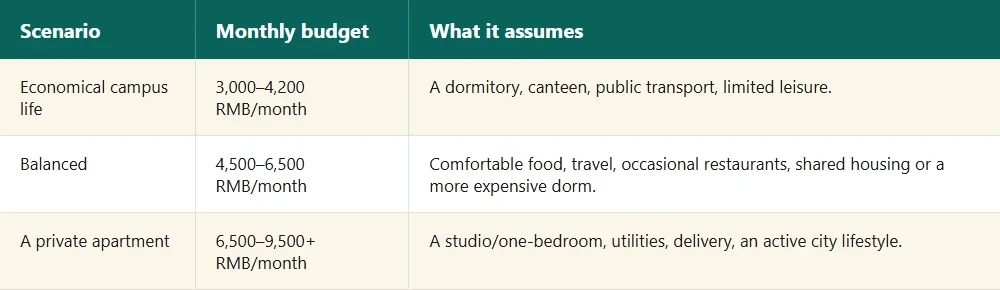
A financial reserve for the first month Beyond the annual budget, it is advisable to have 8,000–20,000 RMB for a deposit, temporary housing, a SIM card, a health check, a residence permit, bedding, household goods and unforeseen payments. |
Transport, districts, climate and daily life
Campuses and distances
In Guangzhou a single university can have campuses in Tianhe, Haizhu, Panyu, Baiyun, Yuexiu, Zhuhai or even Shenzhen. A university’s name does not guarantee that the programme runs in central Guangzhou. Check the campus address and travel time to the metro before paying.
Districts for students
Tianhe is convenient for business and the city centre, but rent is higher. Haizhu combines universities with access to central districts. Panyu and University Town offer a campus environment but require more travel time. Baiyun is often cheaper, but distances depend on the metro line. Yuexiu is a central historic district with dense development.
Food
Cantonese cuisine is known for its variety and mild taste. University canteens offer inexpensive meals, but international students should check halal, vegetarian and allergy-friendly options in advance. International groceries and familiar products raise the budget.
Climate
Guangzhou has a subtropical monsoon climate: summer is long, hot and humid; the rainy season is intense; typhoons and heavy rain are possible. Winter is short and usually mild, though buildings can feel cool due to a lack of central heating.
Safety and digital adaptation
The main everyday risks relate not to street crime but to rental scams, breaching visa terms, illegal work, incorrect address registration and losing access to payment apps. A working WeChat/Alipay, a Chinese SIM card and backup copies of documents are needed.
Scholarships and grants for studying in Guangzhou
Chinese Government Scholarship (CSC)
CSC can cover tuition, accommodation or an accommodation subsidy, a stipend and insurance, depending on the programme category. For Type A the application usually goes through an authorised body or the Chinese representation; for Type B — through the university. Deadlines often come earlier than self-funded applications.
Guangdong Government Outstanding International Student Scholarship
A provincial scholarship usually given as a one-time award. For example, SCNU stated 10,000 RMB for undergraduates, and GMU 20,000 RMB for master’s and 30,000 RMB for doctoral freshmen. The recipient often pays the fees themselves first, and the award is transferred after registration.
University scholarships
SYSU, SCUT, JNU, SCNU, GDUFS and other universities offer their own scholarship programmes. Coverage can range from a one-time discount or a partial tuition waiver to a full package. A scholarship should not be treated as guaranteed until the official award notice is received.
An application strategy A strong strategy includes 1–2 ambitious universities, 2–4 realistic options and 1–2 financially safe programmes. Grant and contract applications should be planned in parallel. |
How to apply to a Guangzhou university in 2027
- Determine your level: language, Foundation, bachelor’s, master’s, PhD or medicine.
- Choose a major, language and the full budget you can afford.
- Build a shortlist accounting for the campus and scholarship options.
- Check HSK, IELTS/TOEFL, CSCA, GPA, age and subject prerequisites.
- Prepare your passport, diploma/certificate, transcript and notarised translations.
- Prepare a study plan, CV, recommendations, portfolio or research proposal.
- Take CSCA and language exams before early deadlines.
- Submit the university application and a separate scholarship application if required.
- Take an interview or additional assessment.
- Get the admission result, confirm your place and meet payment requirements.
- Obtain the Admission Notice and an electronic JW202/JW201.
- Apply for an X1/X2 visa, arrange housing, insurance and your arrival route.
- After arrival, complete registration, a health check and residence permit procedures.
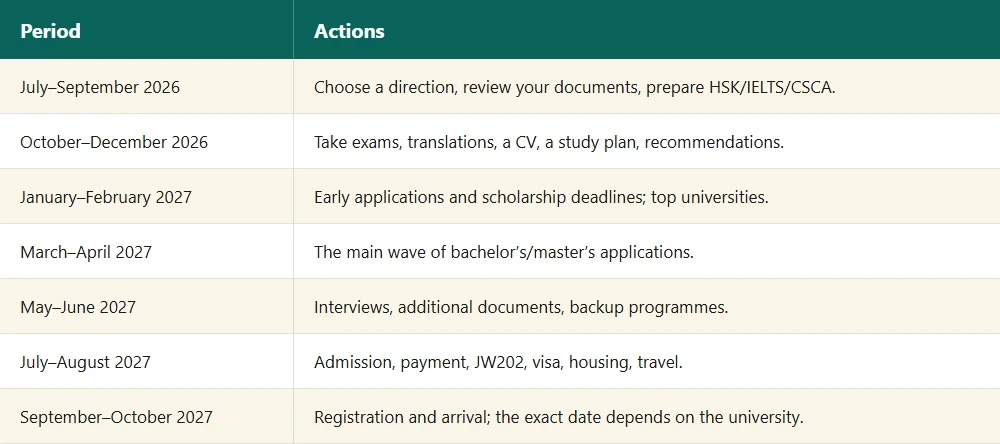
Recommended preparation calendar
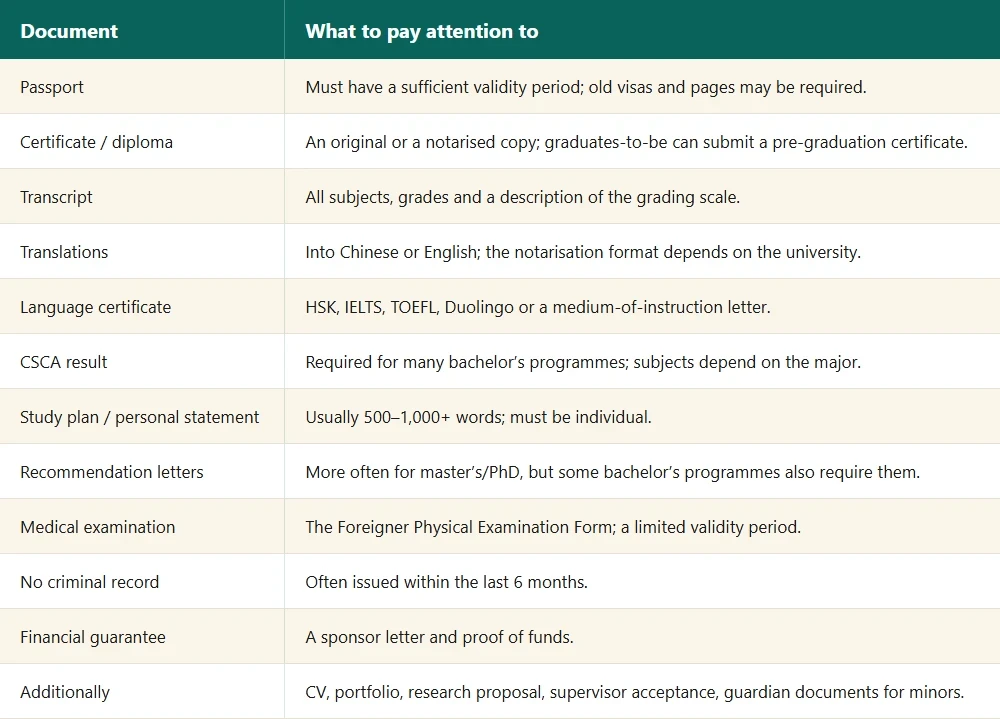
Application documents
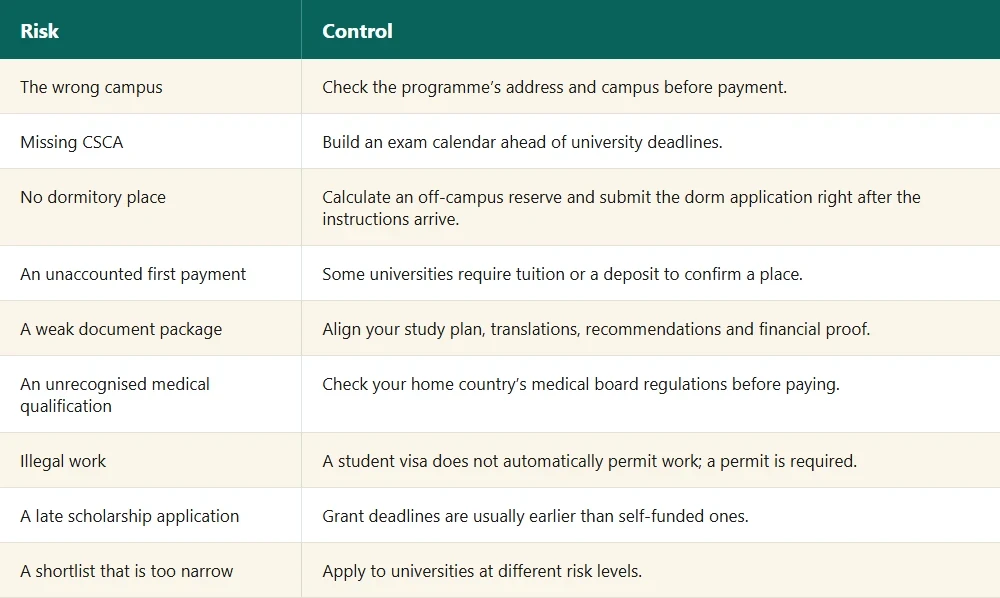
Main risks and how to manage them
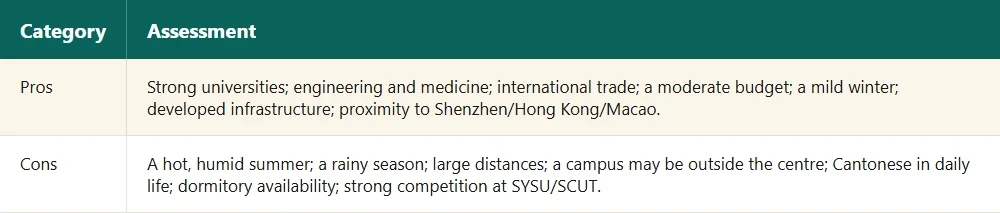
Pros and cons of studying in Guangzhou
How to know if Guangzhou is right for you
- Is your major strong at one of the city’s universities?
- Are you ready for a hot, humid climate?
- Does your budget account for an off-campus housing reserve?
- Are you ready to take CSCA and a language exam in advance?
- Are you interested in business, technology, medicine or a career in the Greater Bay Area?
- Have you checked the specific campus and transport?
- Are you ready to learn Chinese even on an English-medium programme?
A quick conclusion Guangzhou especially suits candidates who want a strong university in an economically active region but are not ready to pay Shanghai-level rent. The best choice depends on the major: SYSU for comprehensive and medical fields, SCUT for engineering, JNU for an international profile, GDUFS for languages/trade, GMU for English-medium MBBS. |
FAQ: frequently asked questions about studying in Guangzhou
Are Guangzhou and Canton the same city?
Yes. Guangzhou is the Chinese pinyin spelling; the older Western name is Canton — in Chinese, 广州 (Guǎngzhōu).
Is Guangzhou more expensive than Beijing and Shanghai?
Housing and daily expenses are usually lower, especially with a dormitory, but central rent and an international lifestyle can be expensive.
Which Guangzhou universities are the strongest?
Sun Yat-sen University and South China University of Technology are the most competitive comprehensive options. GDUFS is important for languages, and SYSU, GMU and Southern Medical University for medicine.
Can you study in English?
Yes, but the list of English-taught programmes is limited and changes yearly. A well-known example is the MBBS at Guangzhou Medical University.
Do you need Chinese?
Chinese-taught programmes require an HSK. Even on an English-medium programme, Chinese matters for daily life, internships and clinical practice.
Is CSCA required?
Yes, for many 2026 bachelor’s programmes. Subjects depend on the major and university.
How much does a dormitory cost?
A reference range is 1,400 to 12,000 RMB a year for a shared room, though some options cost more. A place is not always guaranteed.
What budget do you need for a year?
For a state programme with a dormitory, a reasonable benchmark is 65,000–105,000 RMB. Medicine or a private apartment can raise the budget to 120,000–175,000 RMB and above.
What scholarships are available?
The Chinese Government Scholarship, the Guangdong Government Outstanding International Student Scholarship, and university scholarships.
When should you start applying for autumn 2027?
It’s best to start preparing in summer–autumn 2026, especially if CSCA, HSK, IELTS or a scholarship application is needed.
Can you apply without an agency?
Yes, but the applicant is fully responsible for the shortlist, translations, exam schedule, application systems, payment, visa documents and housing.
Beijing, Shanghai or Guangzhou?
Beijing offers an academic and government-institution environment; Shanghai offers finance and international business; Guangzhou offers engineering, medicine, trade and a more moderate budget. The decision depends on the programme.
Applying to Guangzhou with GE Agency
In Guangzhou it is important to compare not just the ranking but the programme language, campus, CSCA, tuition, dormitory, scholarship coverage and career goal. GE Agency helps build a balanced admission strategy.
- analysing your profile, major and budget;
- selecting universities and programmes at different risk levels;
- checking HSK, IELTS/TOEFL, CSCA and subject requirements;
- calculating tuition, accommodation, living expenses and additional fees;
- preparing forms, a CV, a study plan, recommendations and research documents;
- translations and format checks;
- submitting applications and liaising with universities;
- working with CSC, the Guangdong scholarship and university awards;
- obtaining the Admission Notice and JW202;
- visa, pre-departure and organisational support.
Get a personal shortlist of Guangzhou universities for 2027 and a full budget calculation The GE Agency team will match your major, language, grades and financial capacity against the real requirements of the programmes. |