After grade 9 you cannot enrol directly into a standard bachelor’s programme at a Chinese university: higher education in China begins after completing upper-secondary education, and universities require a senior high school diploma or a recognised equivalent.
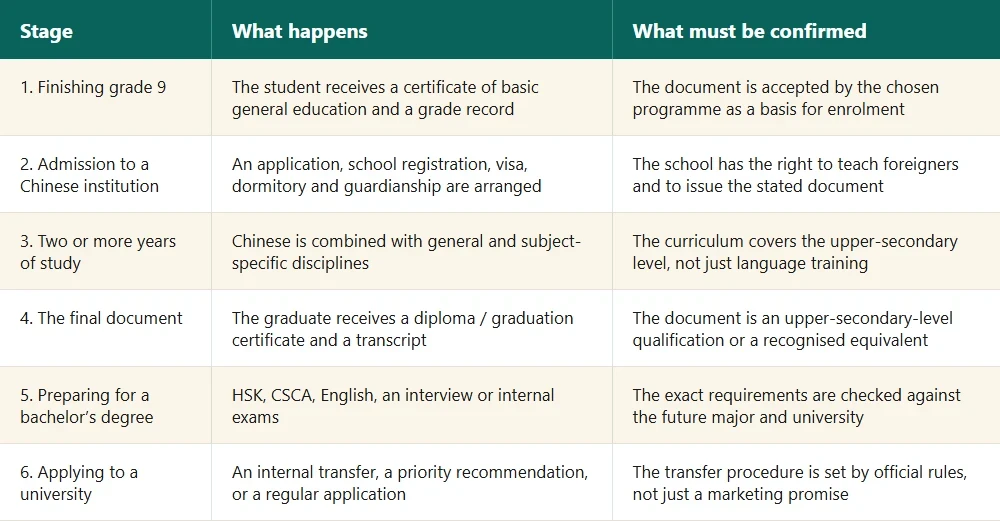
At the same time, another route exists for some international school students: after finishing grade 9, a teenager enrols in a Chinese secondary vocational or pre-university-level institution, studies Chinese, general and subject-specific disciplines, receives a final upper-secondary-level document, and then applies to a bachelor’s programme.
This route can genuinely replace the usual grades 10–11, but only under one condition: the chosen programme must be an official educational programme, not language courses or a commercial Foundation without the right to issue an education document. For a future bachelor’s degree, what matters is not the length of study but the legal status of the final document.
The main takeaway The route "grade 9 → a programme in China → a bachelor’s degree" is possible but not universal. Before paying, you need written confirmation of: who issues the diploma, where the student is registered, what level of qualification it is, which universities accept the document, and whether HSK, CSCA or an internal exam is additionally required. |
Can you go to China to study after grade 9
Yes. Chinese rules allow foreign nationals to study at secondary education institutions. Admission procedures are set not only by national rules but also by the norms of the specific province, city and school. So a single universal list of conditions for the whole country cannot be drawn up.
In practice, secondary vocational institutions, international senior high schools, specialised schools and special programmes combining upper-secondary level with language and pre-university preparation can all be considered after grade 9. Admission of foreigners is only possible where an institution has the corresponding right and can arrange legal student status.
Why you cannot enrol directly into a bachelor’s degree
Chinese law defines higher education as education delivered after completing upper-secondary education. To obtain bachelor’s student status, you must have finished senior high school or have an equivalent level of preparation.
- A certificate after grade 9 confirms completion of basic general education, not full secondary school.
- An HSK language certificate shows knowledge of Chinese but does not replace a school diploma.
- A standard language year issues a certificate of completing a course, not an upper-secondary education document.
- Most university Foundation and Pre-University programmes are already designed for graduates of full secondary school. For example, Peking University’s programme accepts high-school graduates.
- For a bachelor’s degree in 2027, a university may additionally require CSCA, HSK/IELTS, an interview, a portfolio or subject-specific grades.
How the route after grade 9 is structured
Source: Ministry of Education of the People’s Republic of China
Can the programme really last two years
Here it is especially important not to turn a private product into a general rule. The official standard duration of full-time secondary vocational education for junior-middle-school graduates in China is usually three years. Under a credit system, early graduation is allowed, but usually no more than one year earlier than the base term.
Consequently, a two-year route can be legitimate if it is, for example, an accelerated credit-based programme, a special international track, an upper-secondary-level programme, or another approved model. But the claim that "any Chinese college after grade 9 lasts two years" is incorrect.
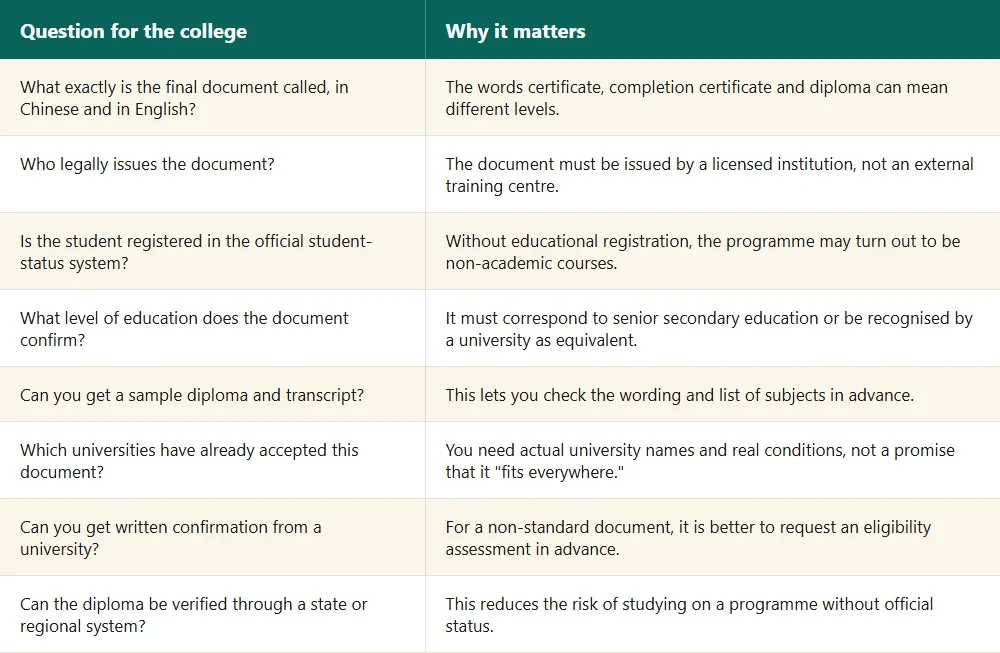
What to ask the college for A written basis for the two-year term: an approved curriculum, credit-system rules, a licence or authorisation for the programme, the student registration procedure, and a sample of the final document. If the school cannot provide this, parents should not rely solely on a presentation or an intermediary’s word. |
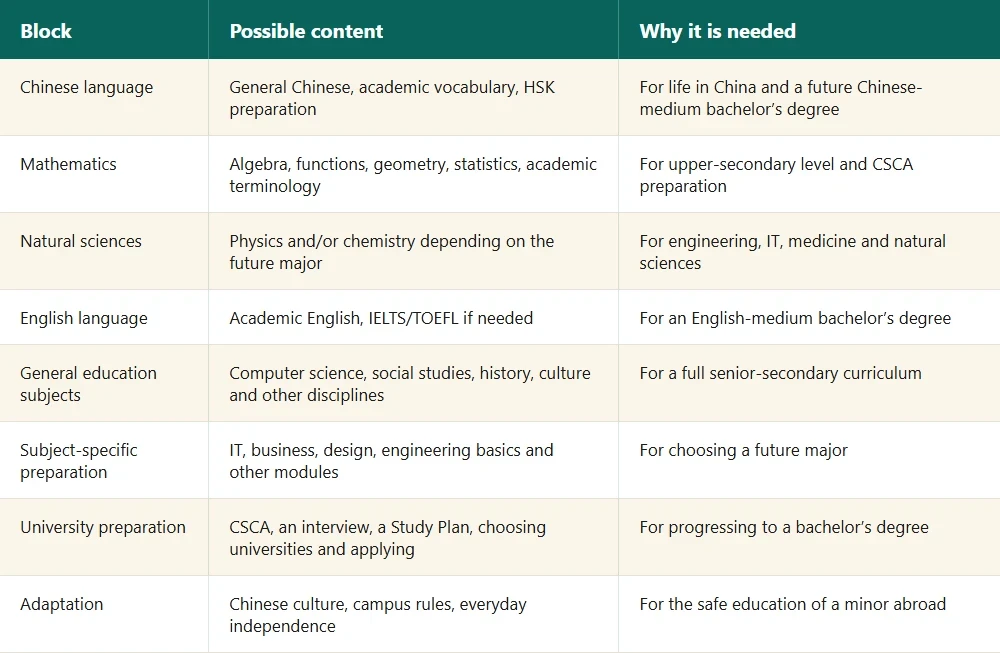
What the child studies during the programme
Content depends on the specific model. A strong programme should combine language and academic preparation. The possible components below are not a universal state programme for all colleges.
Source: Ministry of Education of the People’s Republic of China, Ministry of Education of the People’s Republic of China
What document should the graduate receive
This is the central question of the entire education path. Chinese law distinguishes between education with an official qualification and informal courses. A graduate of an accredited secondary vocational programme can receive a secondary vocational education diploma; this level belongs to upper-secondary education. China’s Ministry of Education confirms that graduates of official secondary vocational schools who have completed the programme receive the corresponding diploma and can apply for further higher education if admission conditions are met.
Source: Ministry of Education of the People’s Republic of China
The key point For a future bachelor’s degree, what matters is not the length of study itself but the legal status of the final document. |
Is progression to a bachelor’s degree guaranteed
The word "guaranteed" is only acceptable when the transfer conditions are set out in official documents and the student has met all the criteria. In practice, three models exist.
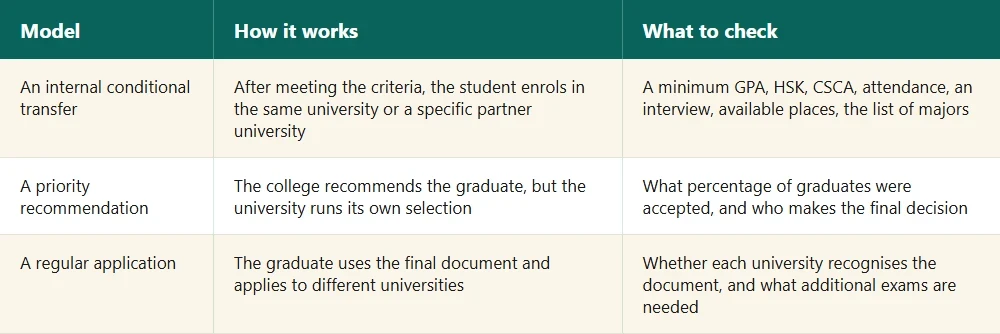
Even strong Chinese-university pre-university programmes usually describe progression as depending on an exam, academic performance and meeting standards, rather than as an unconditional automatic enrolment.
Who can apply
- Graduates of grade 9 or an equivalent level of education in another country.
- Usually teenagers around 15–17 years old; the exact age limits are set by the programme.
- Candidates with satisfactory or good school grades.
- Students with no knowledge of Chinese, if the programme officially includes teaching from zero.
- Teenagers ready to follow a strict campus routine, study in a foreign language, and live away from family.
- Minors for whom a legal guardian in China has been arranged along with a complete set of parental documents.
Can you apply without Chinese
Yes, if the specific programme accepts beginners and the curriculum includes intensive Chinese. However, parents need to check how many hours of language study are scheduled per week and what level the student should reach by the end of the first and second year.
For a future Chinese-medium bachelor’s degree, the HSK level set by the university will usually be required. For an English-medium bachelor’s degree, Chinese may not be a formal admission requirement, but it remains important for life, adaptation and some professional programmes.
Important The phrase "no HSK for college admission" does not mean "HSK will never be needed." The requirement can appear two years later when applying to a bachelor’s programme. |
CSCA after a two-year programme
CSCA is a new standardised exam for international bachelor’s applicants. Completing a two-year programme does not automatically exempt you from it. A university may require Mathematics, Professional Chinese, Physics or Chemistry depending on the major and language of instruction.
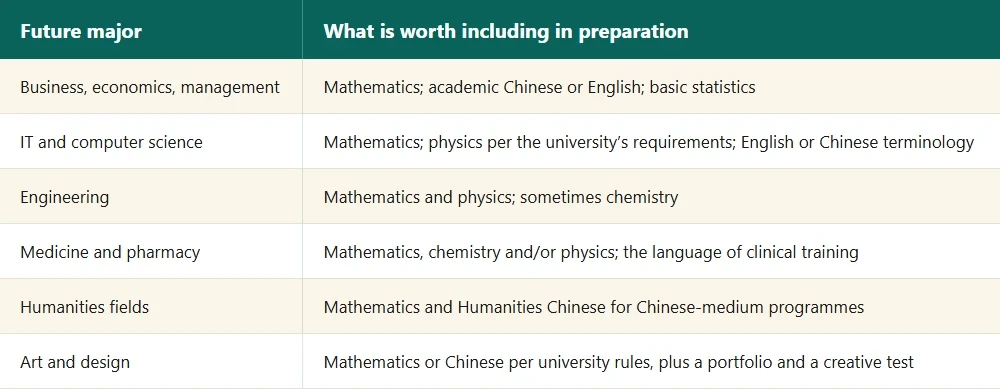
Source: Ministry of Education of the People’s Republic of China
A minor student: what parents should check
If the student is under 18 and the parents do not live in China, the school is required to arrange an officially appointed guardian — a Chinese citizen or a foreigner permanently residing in China — along with supporting documents. International students are also required to have medical insurance.
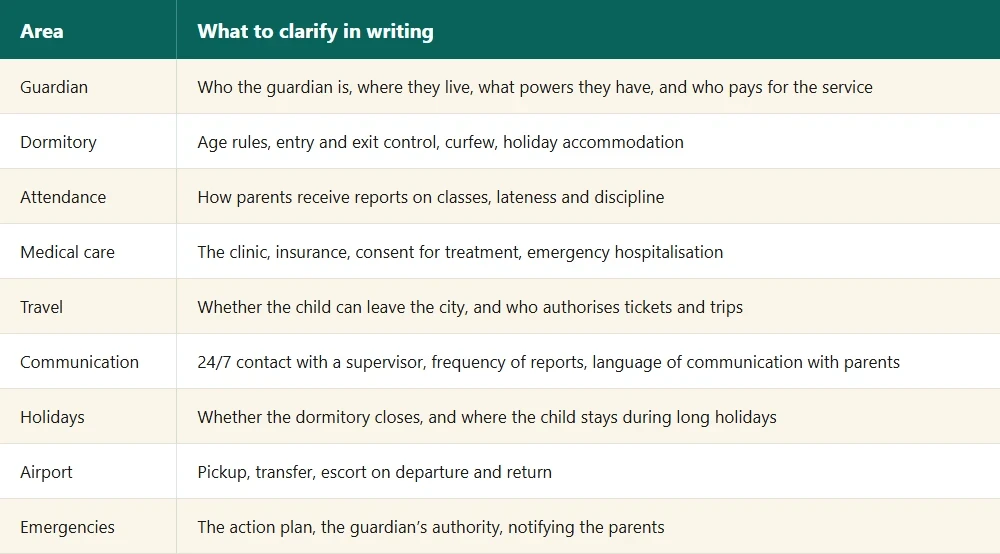
Source: Beijing Municipal Government, Ministry of Education of the People’s Republic of China
Documents needed to apply after grade 9
The final list is set by the college and local authorities, but the family usually prepares:
- the child’s valid international passport;
- a certificate of completing grade 9;
- a full grade record;
- a notarised translation of documents into Chinese or English;
- a birth certificate;
- the parents’ passports;
- the parents’ notarised consent for study and residence abroad;
- a power of attorney and the Chinese guardian’s documents;
- a medical form and examination results;
- a police clearance certificate — if required by age and programme rules;
- a financial guarantee or sponsor letter;
- passport-format photos;
- a motivation letter or a form;
- a language certificate — if required;
- additional school and migration forms.
Documents from one country cannot automatically be used for every programme. Translation, notarisation and legalisation requirements are checked by country of issue, the college, and the future university.
How much the route after grade 9 costs
The full budget must be calculated for both stages at once: the programme after grade 9 and the future bachelor’s degree. Publishing a single "average China-wide price" without specific programmes is risky, since cost depends on the institution’s status, the city, the dormitory, guardianship, and included services.
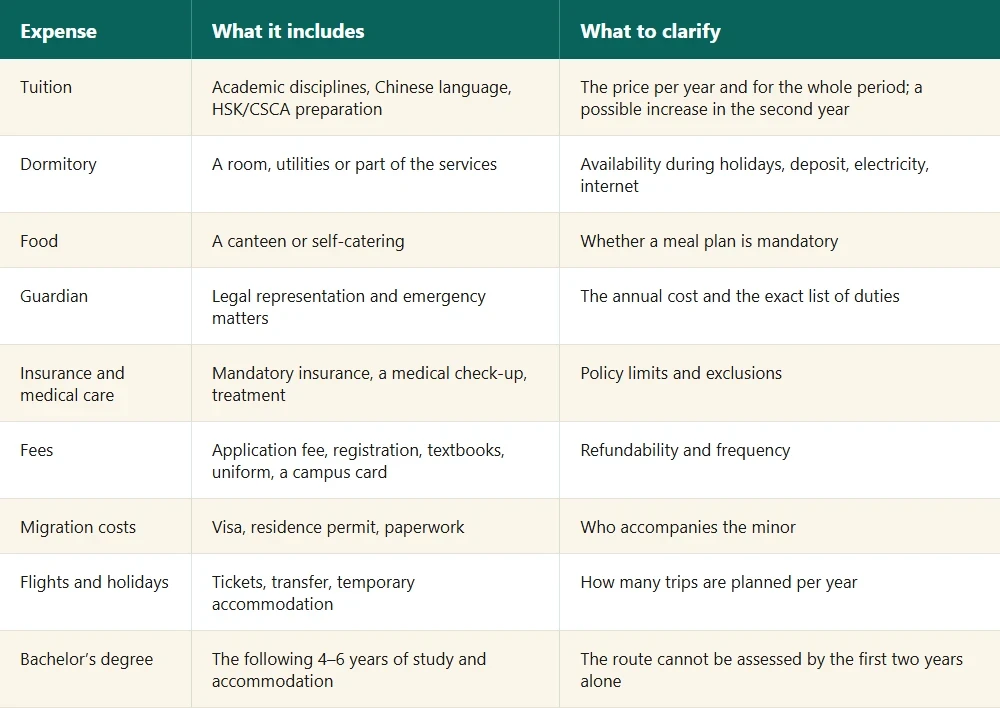
Source: Beijing Municipal Government, East China University of Science and Technology
An illustrative example, not a universal rate In one of the partner programmes GE Agency reviewed in summer 2026, tuition was 19,800 CNY a year. This example cannot be applied to every college: before publishing it or offering it to a client, the programme’s length, dormitory, guardianship, final document and progression conditions must be confirmed. |
What happens after completing the programme
- Admission to a Chinese-medium bachelor’s degree after reaching the required HSK and CSCA results.
- Admission to an English-medium bachelor’s degree with IELTS/TOEFL or another proof of English.
- A conditional internal transfer to a partner university, if set out in the programme’s rules.
- A regular application to several Chinese universities with the final diploma and transcript.
- Continuing vocational education in China.
- Returning home and continuing education — after checking document recognition in advance.
Advantages of the route for the family
- Two years are used for language and academic immersion, rather than just waiting for school to end.
- The teenager adapts to the Chinese system before the more demanding bachelor’s stage.
- You can prepare for HSK, CSCA and subject-specific exams in advance.
- The child gains experience of independent living under the supervision of the school and guardian.
- The family understands earlier whether China suits them for long-term education.
- With a strong programme, a consistent trajectory forms: secondary education → bachelor’s degree.
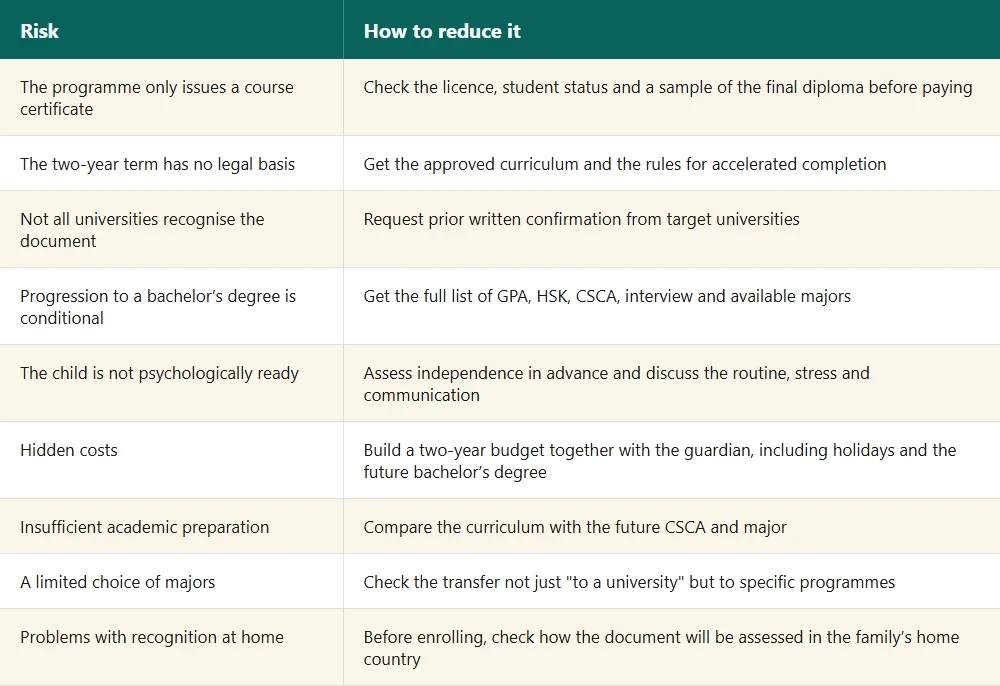
Risks that cannot be ignored
Source: Ministry of Education of the People’s Republic of China
How GE Agency checks a two-year programme
- We verify the institution’s legal name and status.
- We request confirmation of the right to admit international minors.
- We check the academic registration and the type of educational programme.
- We obtain a sample of the final document and transcript.
- We clarify the basis for the two-year term.
- We check the list of universities and majors for further admission.
- We record the GPA, HSK, CSCA and internal-test requirements.
- We check the guardian, the dormitory and support for the minor.
- We calculate the full budget for the two years and the subsequent bachelor’s degree.
- We put together a written route without promising unconditional admission.
Want to check a route for your child? GE Agency will check the two-year programmes available after grade 9, the status of the final document, the conditions for progressing to a bachelor’s degree, the language of instruction, CSCA requirements, guardianship and the full budget of the route. |
Frequently asked questions
Can you enrol in a bachelor’s degree right after grade 9?
No. A bachelor’s degree requires completed upper-secondary education or a recognised equivalent.
Can you study for two years in China instead of grades 10–11?
Yes, if the chosen programme officially covers the senior-secondary level and issues a recognised document. Standard language courses do not do this.
Do all Chinese colleges accept foreigners after grade 9?
No. You need to check the institution’s right to admit international students and the rules of the specific region.
Why can a standard programme be three years, not two?
For secondary vocational education after junior middle school, the official base term is usually three years. A two-year option requires a legal basis: an accelerated credit model or a special programme.
Is Chinese needed on admission?
Some programmes may accept a beginner, but the future Chinese-medium bachelor’s degree will require an HSK at the level set by the university.
Is CSCA required?
Not always for the current programme after grade 9. But when later applying to a bachelor’s degree, the university may require CSCA.
Is a guardian required?
If the child is under 18 and the parents do not live in China permanently, an officially appointed guardian in China is required.
Is progression to university guaranteed?
Only if it is set out in official conditions and the student meets all the criteria. More often the transfer is conditional or happens through a regular application.
Can you enrol in any university after the programme?
No. Each university independently assesses the document and academic preparation.
What is most important to check before paying?
The licence and status of the programme, student registration, the final diploma, the universities that accept it, the transfer rules, and the full budget.
Conclusion
Studying in China after grade 9 can be a real alternative to grades 10–11 and give a teenager language, academic and cultural preparation for a bachelor’s degree. But this route should not be chosen just for an attractive name like "2+4," "Foundation" or "two years at a college."
The right programme should give the child an official educational track and a document that is recognised for bachelor’s admission. That is exactly why, before paying, you need to check not the promise of admission but the licence, the academic registration, the curriculum, the final diploma, the university’s requirements and the guardianship system.