A master's degree in China is open to international graduates: with a bachelor's degree you can join an English- or Chinese-taught programme, study for 2–3 years and earn a degree from a major research university. Below are real requirements from university admission guides, tuition fees, scholarships, documents and deadlines for the 2027 intake. For the overall admission process at every level, see our guide How to Apply to Study in China in 2027.
Key facts • You need a bachelor's degree (or an expected-graduation certificate) and are usually under 35. • Language: HSK 4–5 for Chinese-taught programmes, IELTS 6.0–6.5 or TOEFL around 80 for English-taught ones. • Self-funded tuition is roughly RMB 22,000–34,000 (about USD 3,000–4,800) per year. • The Chinese Government Scholarship covers tuition and housing and pays master's students RMB 3,000 a month. • Many universities open applications for autumn 2027 in October–November 2026. |
Do Chinese universities offer master's degrees to international students?
Yes. The master's degree (硕士) is the second level of higher education in China, and most major universities admit international students to it. Study is full-time, usually starting in September, with a spring start at some universities.
There are two kinds of programmes. Academic master's degrees focus on research and usually last 3 years. Professional master's degrees (MBA, engineering and applied programmes) are shorter — often 2 years — and include practical training.
How long is a master's degree in China?
A master's in China takes 2–3 years depending on the programme. For example, Harbin Institute of Technology lists 2–3 years, while master's programmes at Peking University's School of Electronic and Computer Engineering are 3 years of full-time study.
If you choose a Chinese-taught programme but your Chinese is still weak, add a preparatory language year. For Chinese Government Scholarship holders this extra year is often covered as well.
English-taught or Chinese-taught: which master's to choose
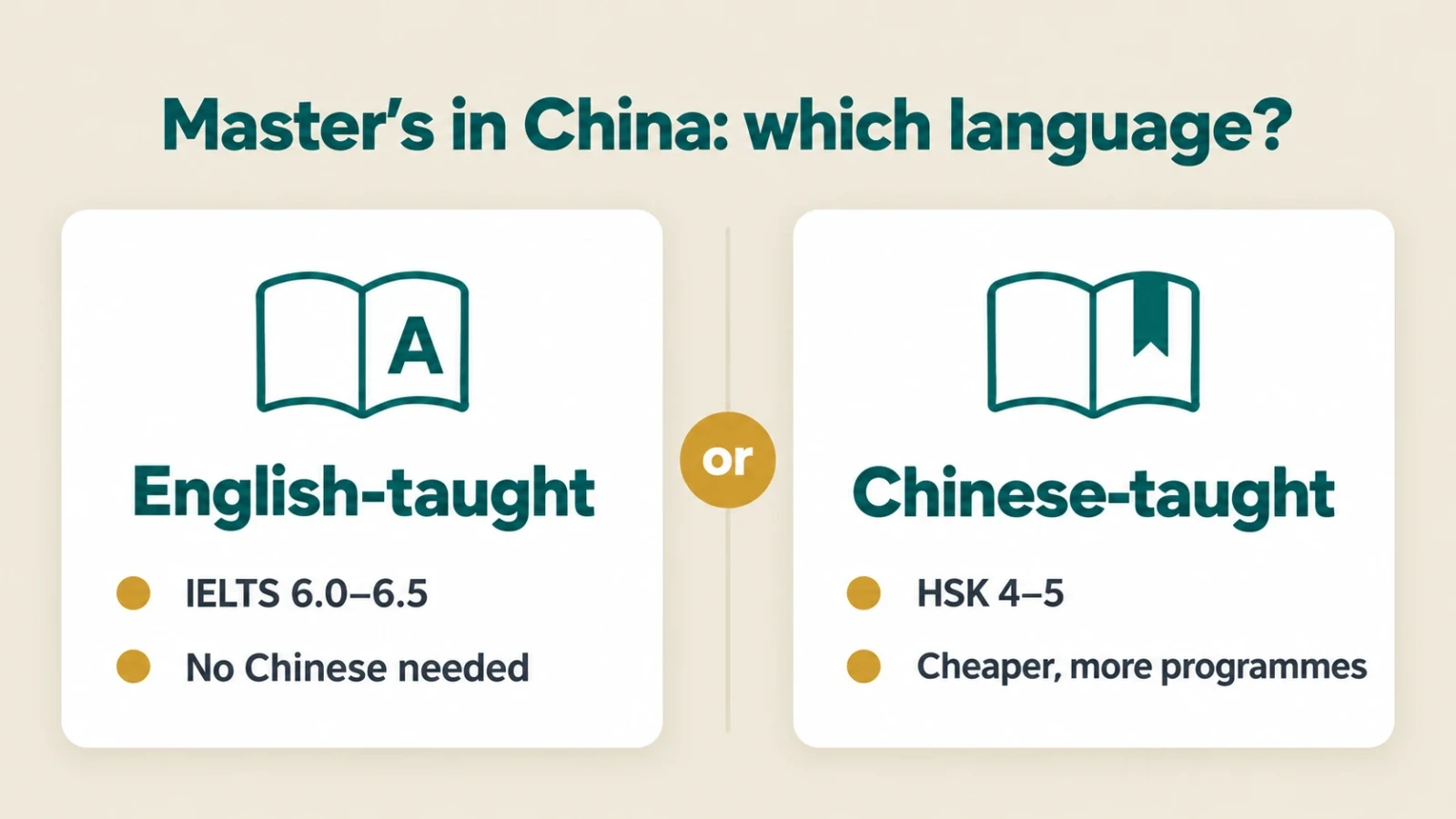
English-taught programmes let you start without Chinese; Chinese-taught programmes are cheaper and cover more subjects. The right choice depends on your language level, your field and your career plans.
Parameter | English-taught | Chinese-taught |
Language on entry | IELTS 6.0–6.5 or TOEFL around 80 | HSK 4 (210+) or HSK 5 (180+) |
Tuition | Higher: e.g. RMB 34,000/year at HIT | Lower: e.g. RMB 28,000/year at HIT |
Choice of subjects | Limited: engineering, IT, business, economics | Almost every field the university offers |
Best for | No Chinese yet, want to start fast | Have HSK or ready for a language year |
Source: Harbin Institute of Technology
Even on an English-taught programme, everyday Chinese helps in the city, at the bank and in the dorm. More on starting without the language: How to Apply to China Without Knowing Chinese.
Master's subjects and fields in China
Chinese universities are strongest in engineering, IT, natural sciences, economics and Chinese studies, but you can find almost any field at master's level. Each university publishes its own list — for example, the master's programmes of China University of Petroleum (Beijing) include petroleum engineering, management science and teaching Chinese to speakers of other languages.
- Engineering and IT — the widest choice, including many English-taught options.
- Chemical engineering, energy, materials — specialised technical universities and labs.
- Biology and life sciences — research programmes; find a supervisor early.
- Economics, management, MBA — many English-taught programmes.
- Design and arts — a portfolio is usually required, sometimes with a creative interview.
- Chinese language, international relations, education — usually taught in Chinese.
For research programmes, many universities expect a letter from your future supervisor. Harbin Institute of Technology, for example, encourages applicants to contact HIT professors before submitting.
Entry requirements for a master's in China
Basic requirements are similar at most universities: a bachelor's degree, age under 35, proof of language level and good grades. Details differ, so always compare the requirements of your specific programme.
Requirement | Harbin Institute of Technology | Zhejiang Normal University |
Chinese-taught programmes | HSK 4, 210+ (valid for two years) | Valid HSK certificate |
English-taught programmes | TOEFL 80+ or IELTS 6.0+ (no band below 5.5) | TOEFL, IELTS or Duolingo |
Funds in your account | At least RMB 30,000 | At least RMB 30,000 |
Application period (2026) | Until 31 May 2026 | 1 March – 15 July 2026 |
Source: Harbin Institute of Technology, Zhejiang Normal University
If your previous degree was taught in English or Chinese, some universities waive the language certificate — HIT does this, for example. You will need a letter from your university confirming the language of instruction.
Documents for a master's application in China
The document set is nearly the same everywhere: passport, diploma and transcripts, language certificate, recommendations, study plan, medical form, police certificate and proof of funds.
1. Passport scan (photo page). Zhejiang Normal University, for example, requires a passport valid beyond 28 February 2027.
2. Bachelor's diploma, or a certificate of expected graduation if you are still studying.
3. Transcripts for all semesters.
4. Notarised copies or translations of your diploma and transcripts in English or Chinese.
5. HSK, IELTS or TOEFL certificate.
6. Two recommendation letters from associate professors or above.
7. A study and research plan — at Zhejiang Normal University, at least 1,000 words.
8. Foreigner Physical Examination Form.
9. Police clearance certificate, usually issued within the last 6 months.
10. Bank statement showing the required funds.
How much does a master's in China cost?
Self-funded tuition is roughly RMB 22,000–34,000 (about USD 3,000–4,800) per year. Add accommodation, insurance and the application fee on top.
University | Chinese-taught, RMB/year | English-taught, RMB/year | Housing, RMB/month | Insurance, RMB/year |
Zhejiang Normal University | 22,000 | 24,000 (MBA 26,000) | 450–600 | 1,000 |
Harbin Institute of Technology | 28,000 | 34,000 | 800–1,000 | 800 |
Peking University, ECE (Shenzhen) | 33,000 | — | — | — |
Source: Zhejiang Normal University, Harbin Institute of Technology, Peking University
The application fee is RMB 400–600 and non-refundable. Zhejiang Normal University estimates meals at about RMB 1,000 per month; big cities cost more. For a full yearly budget, see How Much It Costs to Study and Live in China.
These fees come from the universities' 2026 guides. Fees for 2027 are published in autumn–winter and usually change only slightly. USD figures are approximate and depend on the exchange rate.
Can you study for a master's in China for free?
Yes, with a scholarship. The best-known is the Chinese Government Scholarship (CSC): it covers tuition, accommodation and comprehensive medical insurance and pays master's students RMB 3,000 per month.
CSC conditions, as published by China University of Petroleum (Beijing):
- master's applicants must hold a bachelor's degree and be under 35;
- a monthly allowance of RMB 3,000 for master's students;
- comprehensive medical insurance of RMB 800 per year is paid by the scholarship.
There are two routes. Type A goes through the Chinese embassy in your country; Type B goes directly through the university.
Universities also run their own scholarships. Harbin Institute of Technology, for example, offers tuition waivers of 100%, 50%, 30% or 20%, with a deadline of 31 May 2026; you cannot apply for two scholarship types at HIT at once.
Important A scholarship is never guaranteed, even for strong candidates — it is a competition. Apply for a scholarship and a self-funded place in parallel so you don't lose a year. |
How to apply for a master's in China: step by step
Getting into a master's programme in China takes 6–10 months from choosing a programme to arrival.
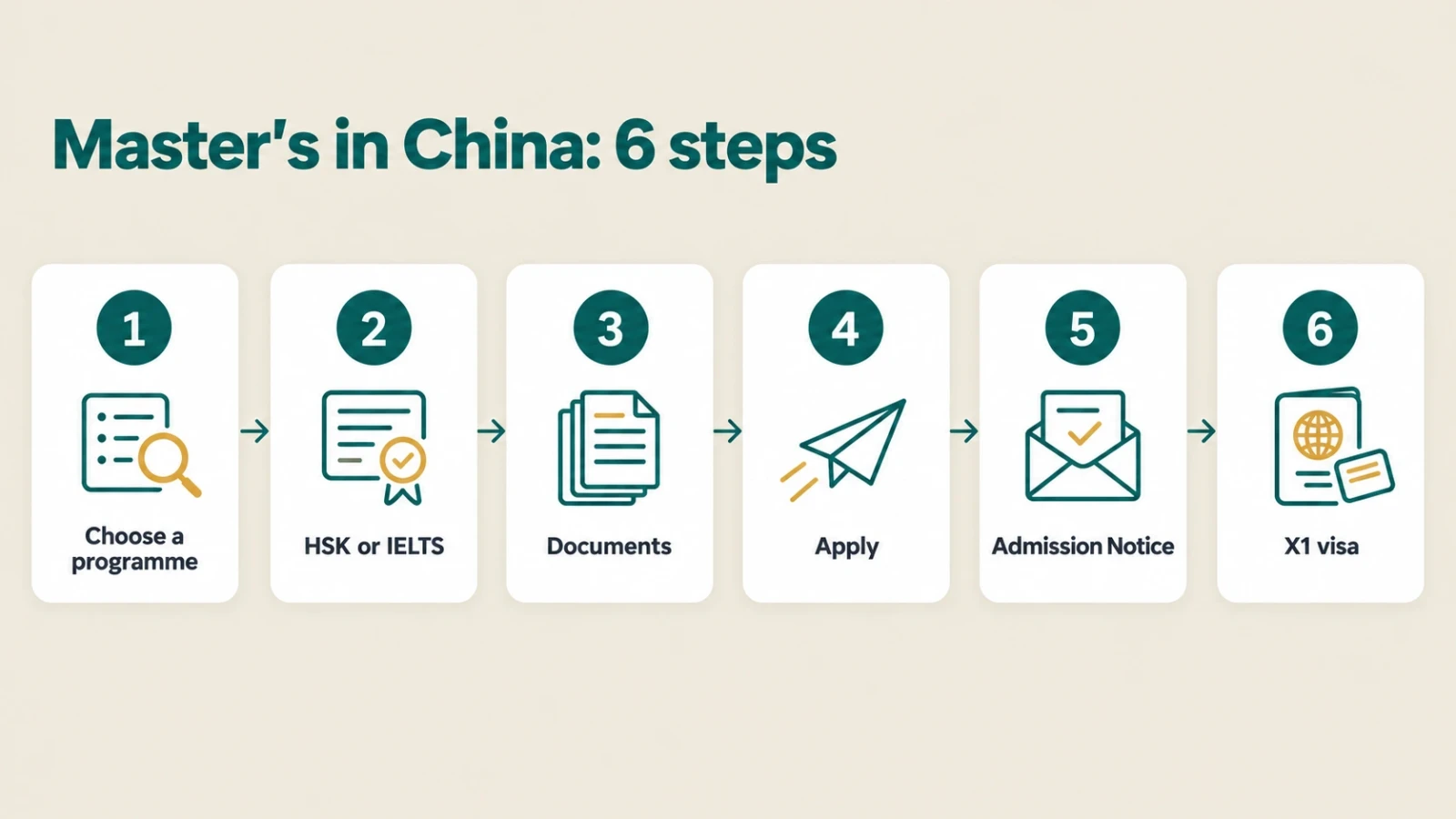
1. Choose a programme and 3–5 universities. Compare the language of instruction, cost, requirements and deadlines.
2. Take a language test. HSK for Chinese-taught programmes, IELTS or TOEFL for English-taught ones.
3. Prepare your documents. Start with translations and recommendation letters — they take the longest.
4. Apply. Usually through the university's online system, plus the scholarship portal if you apply for CSC.
5. Get a decision. Once admitted, the university sends an Admission Notice and a JW201 or JW202 form for the visa.
6. Get an X1 visa. Apply at the Chinese embassy or a Chinese Visa Application Service Center.
After arrival, the X1 visa is converted into a student residence permit with help from the university's international office — see, for example, how China University of Petroleum (Beijing) handles it.
Application deadlines for autumn 2027
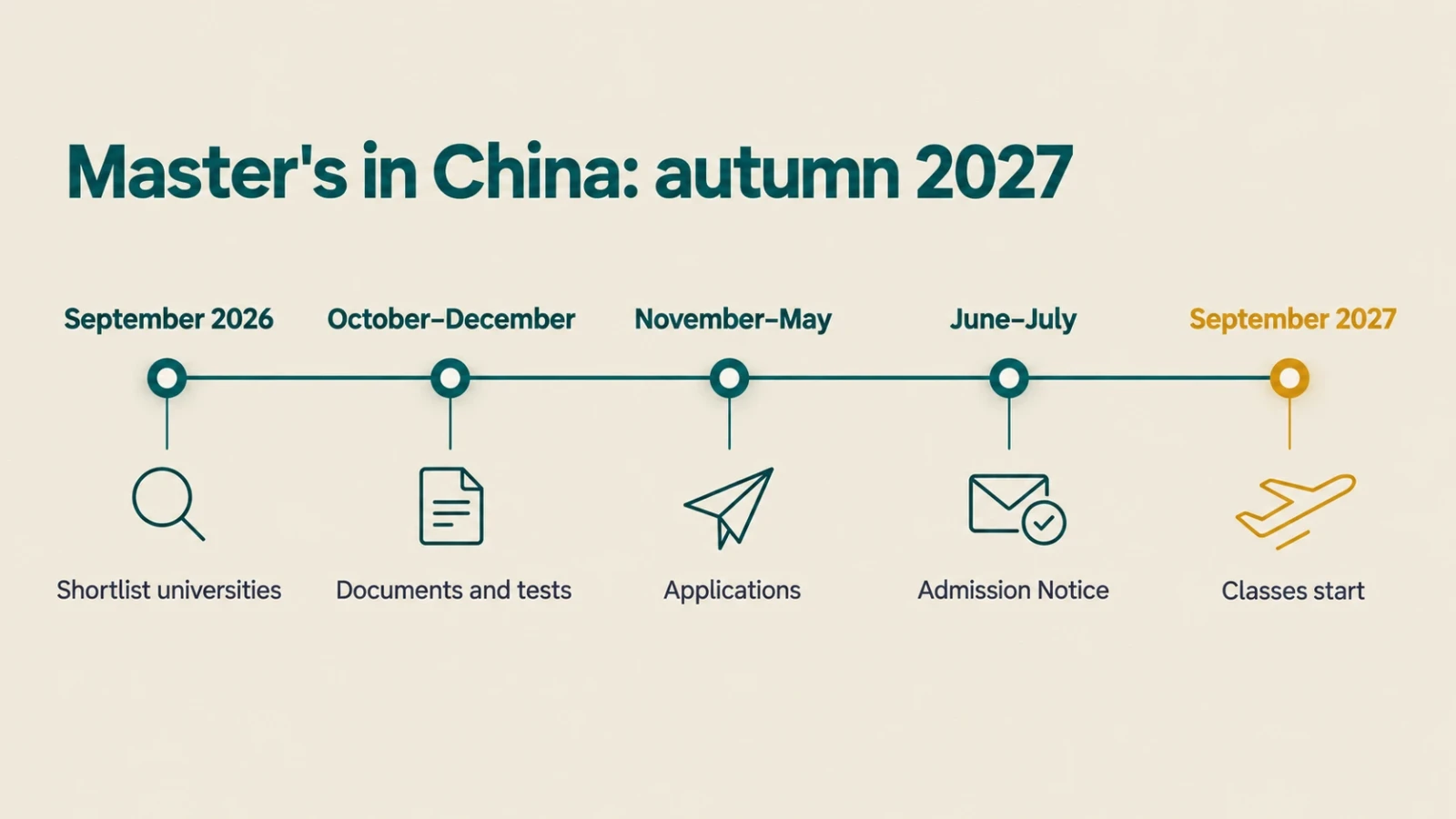
Most universities admit master's students once a year, for September. Application windows vary: some close in January, others accept applications until summer.
University | 2026 application window | What to expect for 2027 |
Peking University, ECE | Mid-October 2025 – mid-January 2026 | Applications in autumn–winter 2026 |
Harbin Institute of Technology | Until 31 May 2026 | A similar deadline in May 2027 |
Zhejiang Normal University | 1 March – 15 July 2026 | A similar window in spring–summer 2027 |
Source: Peking University, Harbin Institute of Technology, Zhejiang Normal University
Top universities and scholarships close earlier. If you are aiming for a leading university or a CSC scholarship, start preparing in summer–autumn 2026.
Can you do a master's in China online or part-time?
Full online or part-time master's degrees for international students are practically unavailable at Chinese universities: programmes are full-time, and the X1 student visa is issued for study in China. Peking University, for example, states full-time study, and Harbin Institute of Technology admits master's students for September only.
If you cannot relocate yet, look at double-degree programmes between a university in your country and a Chinese partner, where part of the study takes place at home.
How to choose a university for your master's
Choose by the strength of the specific programme, not just the overall ranking. Check five things:
- Programme: curriculum, labs, supervisors, language of compulsory courses.
- Requirements: HSK or IELTS, GPA, age, whether you need a supervisor before applying.
- Cost: tuition, housing, insurance, fees, funds required for the application.
- Scholarships: CSC and university scholarships, and their deadlines.
- City: cost of living, climate, internships. For example, read about universities and life in Harbin in our Harbin study guide.
Common mistakes when applying for a master's in China
1. Applying to only one university and only for a scholarship, with no backup.
2. Leaving the language test too late — HSK and IELTS results take time.
3. Not contacting a supervisor where a supervisor's letter is required.
4. Submitting translations without notarisation where the university requires it.
5. Writing a generic study plan instead of one tailored to the programme.
6. Relying on last year's deadlines without checking the new admission guide.
Frequently asked questions
Can I apply for a master's in China with a foreign bachelor's degree?
Yes. Chinese universities accept foreign bachelor's degrees with copies or translations in English or Chinese, notarised as the university requires. If you are still studying, a certificate of expected graduation is usually accepted.
How many years is a master's in China?
Usually 2–3 years. Academic programmes are often 3 years, professional ones 2 years. Add a language year if you go for a Chinese-taught programme without the required HSK.
How much does a master's in China cost?
Without a scholarship, roughly RMB 22,000–34,000 per year in tuition, according to universities' 2026 guides. Housing costs RMB 450–1,000 per month, plus insurance and food.
Are there English-taught master's programmes in China?
Yes, at many major universities, especially in engineering, IT, business and economics. You usually need IELTS 6.0–6.5 or TOEFL around 80.
Can I get a master's in China for free?
Yes, with a scholarship. The full Chinese Government Scholarship covers tuition, housing and insurance and pays RMB 3,000 a month. University scholarships range from a 20% discount to a full tuition waiver.
Is a Chinese master's degree recognised in my country?
It depends on your country's rules and agreements with China. Check with your national recognition authority before you apply, especially for regulated professions.
Quick action plan
1. Choose your field and language of instruction.
2. Shortlist 3–5 universities and check their 2027 admission guides.
3. Take HSK or IELTS before the end of 2026.
4. Prepare translations, recommendations and your study plan.
5. Apply for a scholarship and a self-funded place at several universities.
6. Once admitted, get your X1 visa and book a dorm.
We'll help you get into a master's in China GE Agency will shortlist programmes for your degree and budget, help you prepare documents and scholarship applications, and support you through to your visa. Book a consultation — we'll assess your profile and chances. |
Information checked on 3 October 2026. Requirements, fees and deadlines vary by university and may change — always check the university's official website before applying.