Applying to China without knowing Chinese is realistic. You can first learn the language at a university, complete Foundation or a 1+4 programme, or go straight for a bachelor’s, master’s, PhD or medical programme in English. But "without Chinese" does not mean "without requirements": the university checks education, grades, English, age, documents and, for many bachelor’s programmes, CSCA results.
Information verified on 19 July 2026. 2027 conditions need to be re-checked against the official page of the chosen programme.
The short answer If you know no Chinese at all, three routes are the clearest: start with a language programme; enrol in Foundation/1+4 and transfer to a bachelor’s degree once the required HSK is reached; or choose a fully English-medium programme. There is no one-size-fits-all option — the route depends on your education, major, English level and budget. |
Table of contents
- Can you apply without Chinese
- The difference between not knowing Chinese and not having an HSK
- Route 1. A language year from zero
- Route 2. Foundation and the 1+4 programme
- Route 3. An English-medium bachelor’s degree
- Route 4. A master’s degree and PhD in English
- Route 5. Medicine and MBBS
- Direct admission in Chinese
- Confirming your English
- CSCA
- Routes after grade 9 and grade 11
- Documents and cost
- Grants
- 2027 deadlines
- Chinese during your studies
- A step-by-step plan
- Mistakes and choosing a route
- FAQ
The short answer: can you apply without Chinese
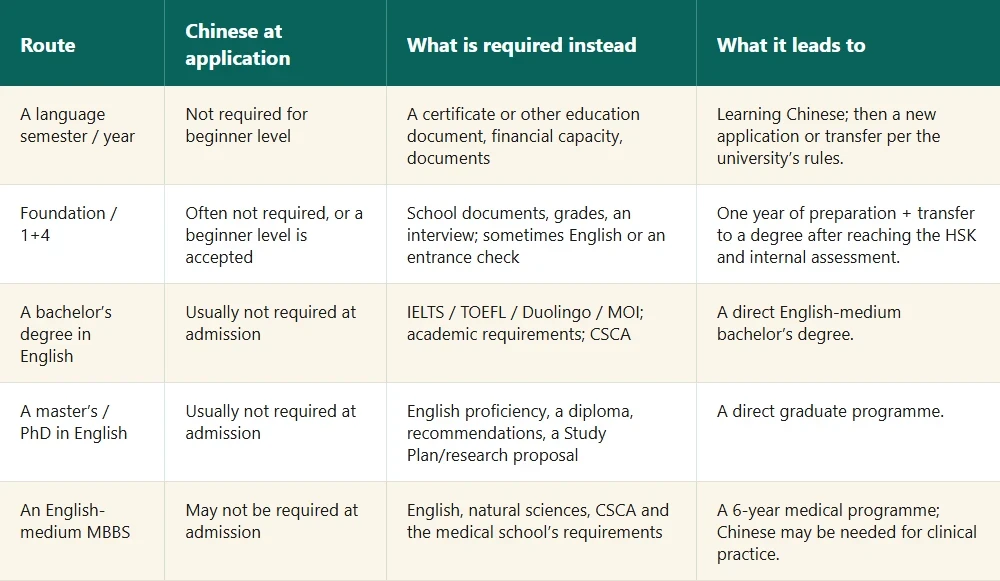
Yes. Chinese universities accept international students who have not studied Chinese, but you need to choose a programme designed for that profile. In practice this is not one scheme but several different educational routes.
Important Having an English-medium programme does not mean automatic admission. A university may require a high average grade, mathematics and natural sciences, an interview, a portfolio, recommendations or standardised test results. |
What "without Chinese" and "without an HSK" mean
Chinese language ability is a real skill in understanding and using the language. HSK is a standardised certificate a university uses to confirm the level. Several situations are possible:
- The student does not know Chinese and has never taken the HSK.
- The student speaks a little Chinese but has no HSK certificate.
- The student studied in Chinese and can request an HSK exemption if the university allows it.
- The student chooses a fully English-medium programme, so an HSK is not needed at admission.
- The student is admitted in English but must reach a certain HSK level by the time of practice or graduation.
So when choosing a programme, you should ask not only "do I need an HSK" but also clarify the language of instruction, the language of exams, graduation requirements, and clinical or on-the-job practice rules.
Route 1. A language semester or year from zero
This is the most direct option for someone who wants to learn Chinese in a university setting before choosing a degree programme. Many universities open groups for absolute beginners and place students by level after a placement test.
For example, Beijing Normal University explicitly states that its Chinese language programme accepts students at zero or any level, South China Normal University treats an HSK as a document "submit if available" and forms a Beginner I group for absolute newcomers, and Shanghai International Studies University also offers a beginner level for those who have never studied Chinese before.
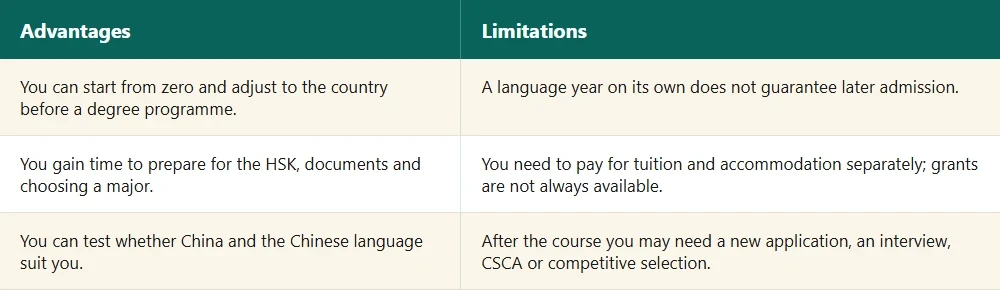
Who it suits Applicants who want to study in Chinese but are not yet ready for academic subjects in that language; students who missed the main degree intake; those who need a gentle start and time to adjust. |
Route 2. Foundation and the 1+4 programme
Foundation is a preparatory stage before the main programme. In the Chinese context you will find "1+4" schemes: one year of Chinese and academic preparation, then four years of a bachelor’s degree. The name does not guarantee an automatic transfer: each university’s conditions need to be read separately.
Nanjing University of Finance & Economics describes its Chinese Foundation Program as a year of intensive Chinese before a bachelor’s or master’s degree. During the year students study Chinese and preparatory subjects, then go through a comprehensive selection process considering HSK, grades, attendance, conduct and an interview. Qualified graduates move on to degree programmes.
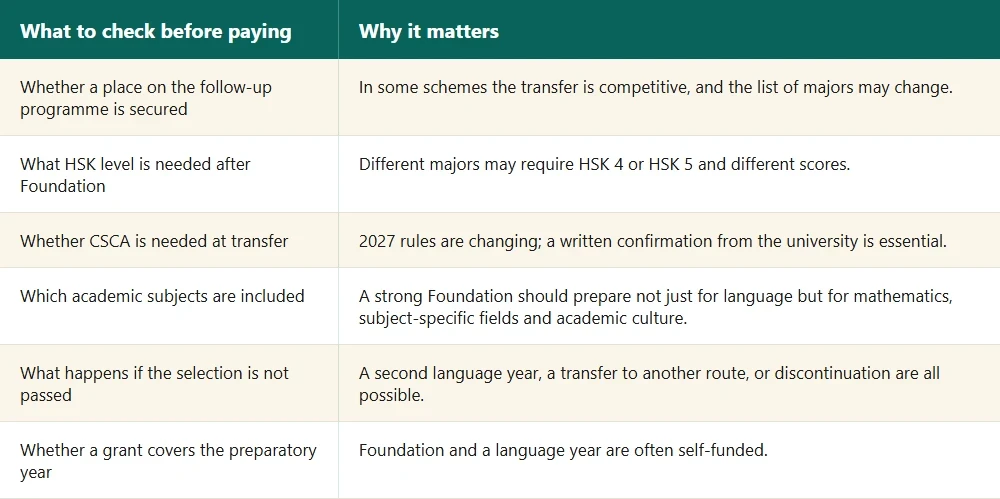
Do not promise an automatic transfer The term "1+4" should not be presented as an unconditional guarantee of a bachelor’s degree. A transfer is only possible after meeting language, academic and internal requirements. |
Route 3. An English-medium bachelor’s degree
A student can apply directly to a bachelor’s programme where the main subjects are taught in English. A Chinese certificate is usually not needed for admission, but you will need to prove you can study in English.
Official requirements vary. Shanghai University requires IELTS 6.5 or TOEFL iBT 90 for English-medium programmes and allows an exemption for native English speakers and graduates of fully English-medium programmes. Jiangsu University usually requires IELTS above 6.0, TOEFL above 80, or Duolingo above 100. Central South University requires IELTS 6.0 or TOEFL 85 and also allows an exemption for a first/official English language or prior English-medium education.
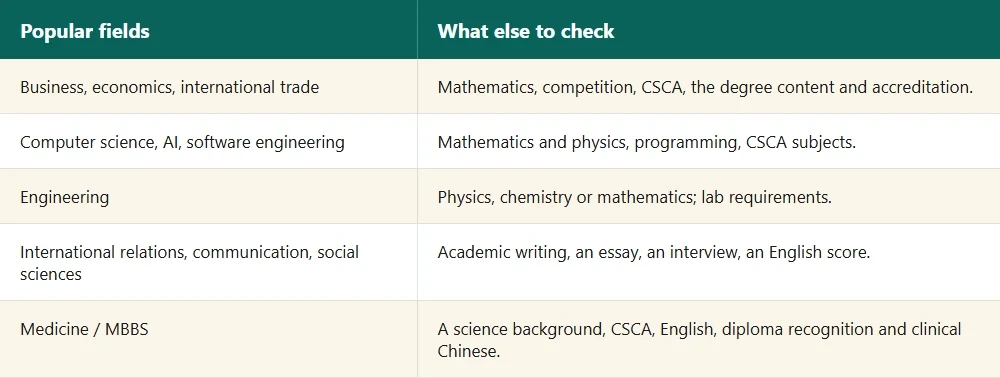
The programme’s language is verified through the curriculum Do not rely just on the word "English" in the catalogue. Confirm the language of mandatory subjects, exams, the thesis, practice, and whether the programme is actually open to international students. |
Route 4. A master’s degree and PhD in English
After a bachelor’s degree, the choice of English-medium programmes is usually wider. Universities offer master’s and doctoral programmes in engineering, computer science, business, economics, medicine, public health, international relations and other fields.
For graduate admission, instead of an HSK, universities usually assess a diploma, transcript, match with your prior major, English, recommendations, a Study Plan or research proposal. Some programmes require prior consent from a supervisor, publications, a portfolio, GRE/GMAT or an interview.
Xiamen University accepts TOEFL 80, IELTS 6.0, an English-medium certificate or an equivalent document for English-medium programmes. Shanghai University uses a higher threshold for some graduate programmes and allows confirmation of prior education entirely in English.
Chinese is still useful Even with a fully English-medium master’s programme, Chinese eases daily life, internships, communication with administration, and finding a job. Some universities introduce mandatory Chinese courses or a graduation minimum. |
Route 5. Medicine and MBBS in English
An English-medium MBBS lets you start medical education without an HSK at universities where the programme is officially taught in English. But this route requires especially thorough checking.
Xiamen University’s MBBS FAQ states that an HSK is not required for admission, the programme is taught entirely in English, and English is confirmed by IELTS 6.0, TOEFL 80, Duolingo 100 or an official English-medium certificate. At the same time, CSCA is required for the bachelor’s degree.
No HSK at admission does not mean Chinese will not be needed. For example, Huazhong University of Science and Technology requires English-medium MBBS students to pass HSK 4 before starting clinical internship. This makes sense: in a hospital you need to communicate with patients and staff.
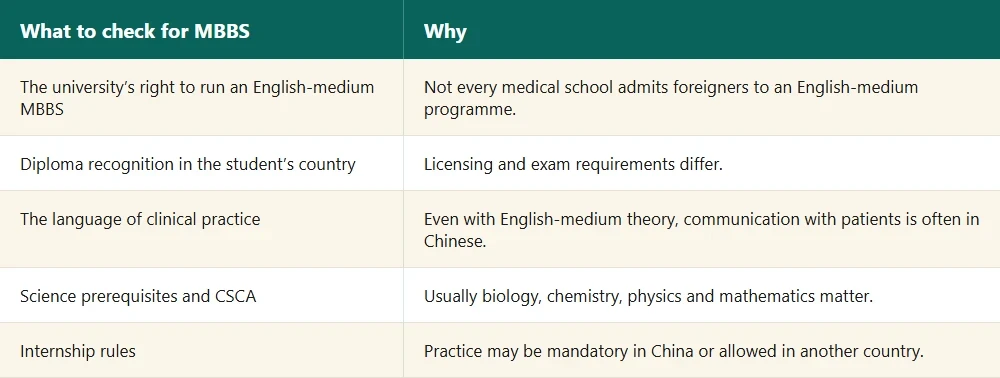
A medical caveat MBBS should not be recommended based only on price and language of instruction. Before applying, check diploma recognition, licensing, clinical practice and the requirements of the country where the graduate plans to work. |
Can you enrol directly in a Chinese-medium programme without an HSK
A Chinese-medium bachelor’s, master’s or PhD programme usually requires a valid HSK. The level depends on the major and university: science and engineering often only need HSK 4, while humanities, economics, law or literature may require HSK 5 or higher.
Exemptions are possible if prior education was entirely in Chinese and the university accepts a certificate of Chinese-medium instruction, or if the university runs its own check. For example, Shanghai University lists an exemption for native Chinese speakers and graduates of a prior fully Chinese-medium programme.
A practical conclusion If a student does not know Chinese and wants a Chinese-medium degree, it is safer to plan a language year or Foundation rather than count on an HSK exemption. |
How to confirm your English
An English-medium programme replaces the Chinese requirement with an English one. A university may accept one or several options:
- IELTS Academic;
- TOEFL iBT;
- the Duolingo English Test — not accepted by every university;
- SAT, ACT, IB, A-Level or other exams with an English component — only if listed by the university;
- an English-medium instruction certificate from a school or university;
- an exemption for citizens of countries where English is official or a native language;
- an internal test or interview — only if explicitly required by the admission guide.
For example, CUHK-Shenzhen has already published requirements for 2027 entry: IELTS 6.5, TOEFL iBT 80 and a number of alternative qualifications; some categories of candidates are exempt from the test. Wenzhou-Kean University accepts TOEFL, IELTS and Duolingo. Chongqing University allows IELTS/TOEFL, confirmation of prior education in English, or study in an English-speaking country for more than a year.
No IELTS does not mean no English A Medium of Instruction letter can replace IELTS only where the university explicitly allows it. Do not decide on your own that your school-level English is sufficient. |
Do you need CSCA if the programme is in English
Yes, for many international bachelor’s applicants CSCA remains mandatory even on a fully English-medium programme. English-medium admission exempts you from the Professional Chinese component, but not necessarily from mathematics and subject-specific subjects.
The official CSCA notice states that from the 2026/2027 academic year, bachelor’s applicants must complete the assessment before applying. Shanghai Government clarifications note that CSCA is mandatory for most undergraduate applicants, and that English-taught applicants are exempt from Professional Chinese, but the fundamental subjects are set by the major.
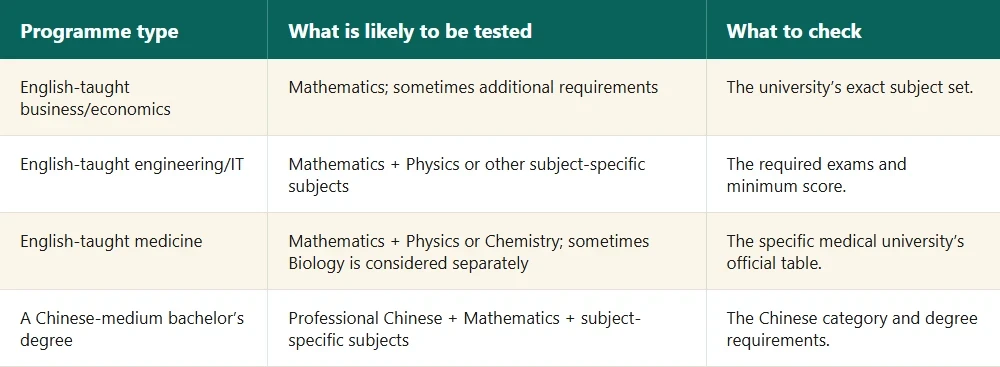
Do not mix up CSCA and a language certificate CSCA assesses academic readiness and, for Chinese-medium programmes, professional Chinese. IELTS/TOEFL confirm English, and HSK confirms general Chinese. One document does not always replace another. |
Which route suits you after grade 9
A direct bachelor’s degree is usually unavailable after grade 9, since a degree programme requires completed secondary education or a recognised equivalent. Colleges, secondary vocational routes, and some Foundation or language programmes are possible, but age, guardianship and further document recognition need to be checked separately.
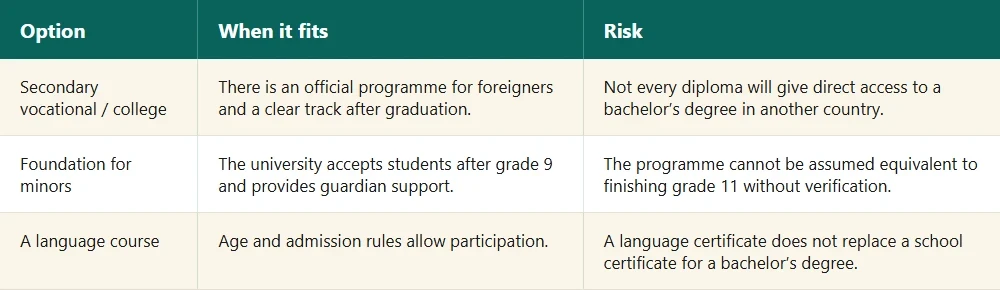
For minors Check the minimum age, the requirements for a legal representative in China, dormitory, visa, medical consent and parental documents. |
Which route suits you after grade 11 or college
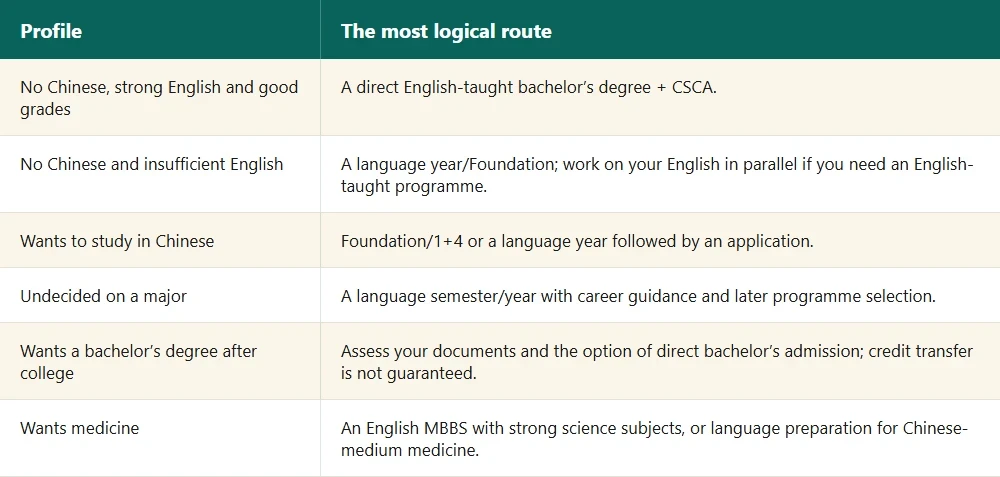
What documents will be needed
The exact list depends on the programme, but a university usually requests:
- a passport with a sufficient validity period;
- a certificate, diploma or expected-graduation certificate;
- a transcript or grade appendix;
- a translation of documents into Chinese or English, certified per university rules;
- a photo;
- the Foreigner Physical Examination Form;
- a police clearance certificate, if required;
- a motivation letter, Study Plan or personal statement;
- recommendations for graduate programmes;
- proof of English for an English-taught programme;
- an HSK — if you have one, or if it’s needed for a specific route;
- a CSCA transcript for undergraduate admission, if required;
- a financial statement or sponsor letter;
- guardian documents for minors.
How much studying without Chinese costs
Cost is determined not by the absence of Chinese but by the chosen route. A language year and Foundation add a preparatory year to the total budget. English-medium degree programmes are often more expensive than Chinese-medium ones, but this depends on the university.
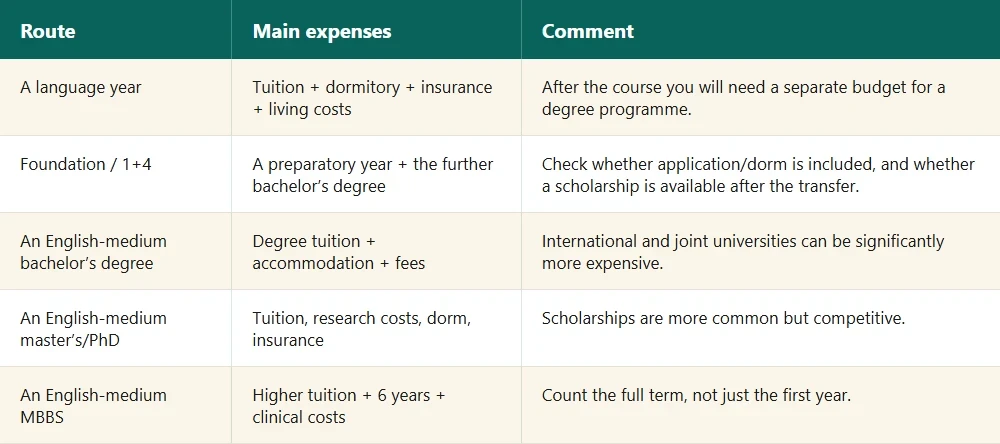
Can you get a grant without an HSK
Sometimes yes, especially for an English-medium master’s or PhD programme, where English and your academic profile are assessed instead of an HSK. But for Chinese-medium grants, an HSK is often an important part of the application, and Foundation or a language year may not be covered by funding.
At NUFE, for example, a new Chinese Foundation Program student pays for the language stage themselves, and can apply for a performance-based scholarship for the first degree year after a comprehensive selection process.
A grant is not an admission route First determine an achievable programme and meet the admission requirements. Then check the specific scholarship conditions. Do not build your whole plan around expecting a guaranteed full grant. |
2027 application deadlines
For the autumn 2027 intake, it is best to start preparing in summer–autumn 2026. For the spring 2027 intake, the choice of programmes is narrower, and documents are often submitted in autumn 2026 – early winter. Exact dates are published by each university.
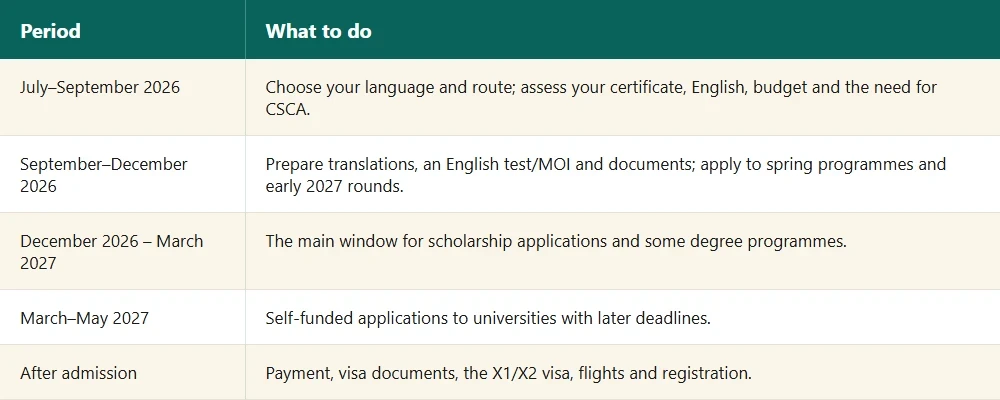
An early start matters most Without Chinese, you may need Foundation, a language certificate or CSCA preparation. So it is risky to delay your choice until summer 2027. |
Chinese during your studies and after admission
Even if admission is fully English-medium, a university may include Chinese in the curriculum. In daily life, Chinese helps with the bank, the hospital, the dormitory, transport and government services.
For some programmes, an HSK becomes a graduation or practical requirement. HUST requires HSK 4 before clinical internship for English-medium MBBS students. Wenzhou University reports HSK 4 as a graduation requirement for international undergraduates in English-taught programmes.
The right way to think about it You can apply without Chinese, but studying and living in China for several years without learning it is usually impractical. The goal is to remove the language barrier at admission, not to give up on the language altogether. |
A step-by-step application plan
- Determine your level: after grade 9/11, college, a bachelor’s or master’s degree.
- Choose a major — do not start by searching for "any university without an HSK."
- Assess your English: IELTS/TOEFL/Duolingo, MOI, or the need for preparation.
- Choose a route: language, Foundation/1+4, an English-medium bachelor’s/master’s/PhD/MBBS.
- Check CSCA: subjects, dates, format and university requirements.
- Build a shortlist of only programmes open to international students and matching your profile.
- Prepare documents: translations, certification, a personal statement, recommendations, a health form.
- Submit several applications, split into dream, realistic and safe options.
- Compare admission offers: tuition, dorm, scholarship, refund, language and progression conditions.
- Get your visa and prepare: the Admission Notice, a visa document, insurance, arrival and registration.
Common mistakes
- Assuming an English-medium programme does not require proof of English.
- Choosing "1+4" without a written understanding of the transfer conditions to a bachelor’s degree.
- Not accounting for CSCA on an English-taught bachelor’s degree.
- Applying for MBBS without checking diploma recognition and clinical Chinese.
- Treating a language year as a guarantee of degree admission.
- Submitting a Medium of Instruction letter instead of IELTS without checking whether the university accepts it.
- Choosing a university only for a low price or ranking.
- Expecting a guaranteed full grant for Foundation.
- Not checking age and guardian requirements for minors.
- Starting document and exam preparation too late.
How to choose a route
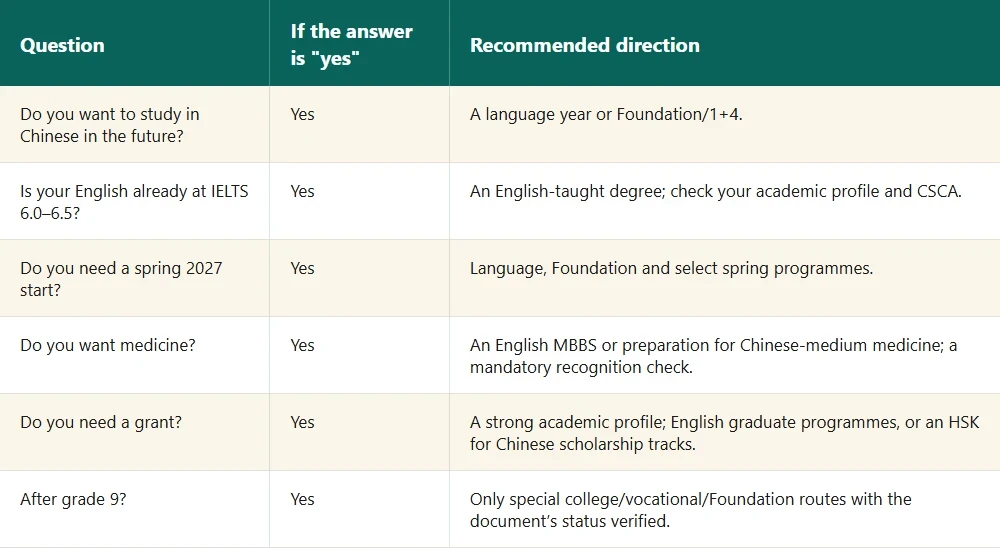
FAQ
Can you apply to China if you know no Chinese at all?
Yes. You can start with a beginner Chinese programme, Foundation/1+4, or choose a degree programme in English.
Can you apply without an HSK?
Yes, if the chosen route does not require one. English-taught programmes usually need English, while an HSK may not be mandatory for a language programme/Foundation at application.
Can you apply without IELTS?
Sometimes a university accepts TOEFL, Duolingo, another exam, a Medium of Instruction letter, or an exemption. This must be confirmed against the admission guide.
Is CSCA required for an English-medium programme?
For many undergraduate applicants — yes. English-taught applicants may be exempt from Professional Chinese, but they take mathematics and subject-specific subjects per the programme’s requirements.
Which is better: a language year or Foundation?
A language year focuses more on language. Foundation usually combines language with academic preparation and may have a transfer track, but the conditions need to be checked.
Does the 1+4 programme guarantee bachelor’s admission?
Not always. A transfer can depend on HSK, grades, attendance, an interview, CSCA and internal selection.
Can you study medicine without Chinese?
On some English-medium MBBS programmes, an HSK is not needed at admission, but Chinese may be required for clinical practice and communicating with patients.
Can you get a grant without an HSK?
Yes, for some English-medium programmes, especially at graduate level, but scholarship requirements differ. Foundation is often self-funded.
Can you apply after grade 9?
Only through special routes for minors; a direct bachelor’s degree usually requires completed secondary education.
When should you start applying for 2027?
Ideally in summer–autumn 2026, especially if you need to take an English test or CSCA, arrange translations, or choose Foundation.
Get matched with programmes that don’t require an HSK GE Agency will help identify a suitable route, check university requirements, prepare documents, and select programmes for spring or autumn 2027. For a preliminary assessment, share your citizenship, age, education, major, English level, budget and desired start date. |