
Studying in Harbin for international students in 2027
Harbin is the capital of Heilongjiang province and a major science and university hub in Northeast China. For international students the city combines three advantages: strong technical and medical universities, a relatively low cost of living, and developed ties with Russia and other Eurasian countries.
The city’s main academic brand is Harbin Institute of Technology, one of China’s leading engineering universities. Nearby are Harbin Engineering University, Northeast Forestry University, Northeast Agricultural University, Harbin Medical University, Heilongjiang University and other state institutions. This gives a rare choice between aerospace, mechanical engineering, computer science, shipbuilding, nuclear engineering, medicine, agriculture, forestry, business and Chinese language, all in one city.
Harbin is noticeably cheaper than Beijing, Shanghai, Shenzhen and Hangzhou. Official university materials list dormitories from 400–500 RMB a month, and basic tuition for many Chinese-medium bachelor’s programmes is roughly 15,500–20,000 RMB a year. English-medium programmes, medicine and joint programmes remain more expensive.
Important for the 2027 intake Do not automatically carry over 2026 terms to the next intake. Since 2026 a number of universities have required CSCA for the international bachelor’s programme. In 2027 the list of exams, English-medium programmes, deadlines and scholarship quotas may change. |
Why international students choose Harbin
- A strong engineering school — HIT and HEU are known for aerospace, robotics, AI, shipbuilding, marine engineering, nuclear technology and applied engineering.
- An affordable budget — tuition and dormitories at many state universities are noticeably cheaper than in China’s largest megacities.
- Medicine and life sciences — Harbin Medical University offers MBBS and postgraduate medical tracks, while the agricultural and forestry universities are strong in biotechnology and food science.
- Ties with Eurasia — the region has developed Russian-Chinese education links, with special scholarship programmes for a number of Eurasian countries.
- A good language environment — Heilongjiang University, Harbin Normal University, NEFU and HIT offer Chinese language programmes, and everyday life helps adapt Chinese faster.
- A genuine university atmosphere — large campuses, student districts and a relatively calm pace make the city convenient for a long period of study.
Who studying in Harbin suits
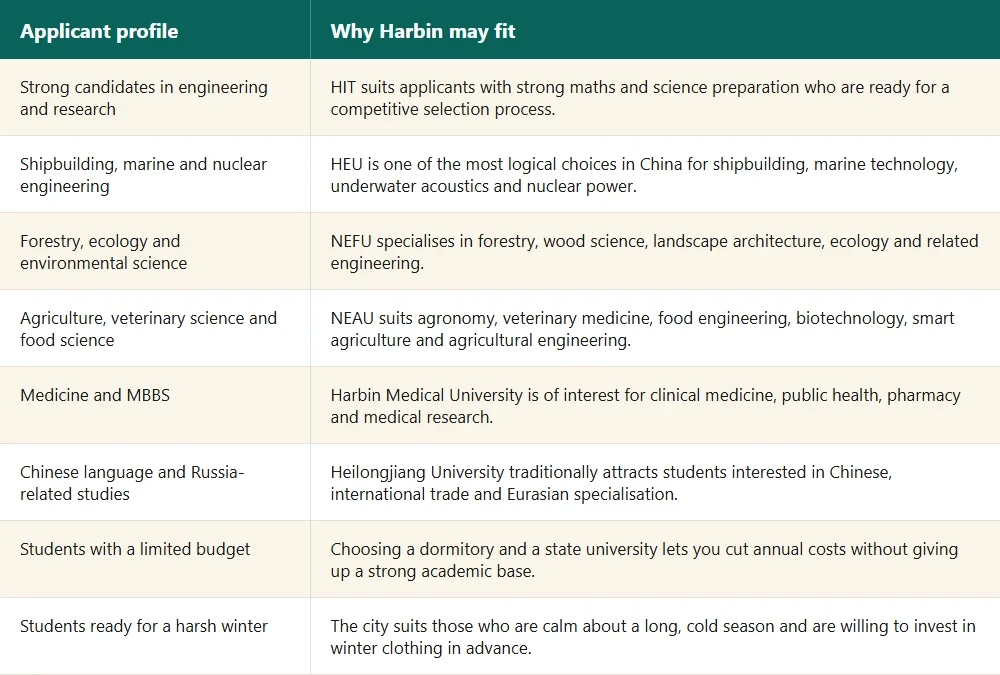
Source: Harbin Medical University, Heilongjiang University, Harbin Institute of Technology, Harbin Engineering University, Northeast Forestry University, Northeast Agricultural University
When another city may be better For international finance and global corporations, Shanghai is more often chosen. For startups and a hardware ecosystem — Shenzhen. For a milder climate — Guangzhou or Hangzhou. For humanities, diplomacy and the highest concentration of top universities — Beijing. |
Best universities in Harbin for international students
When choosing a university, look not just at the overall ranking but at the specific major, language of instruction, campus, scholarship eligibility and entrance tests. In Harbin the difference is especially large between research-intensive engineering universities and more affordable specialised state institutions.
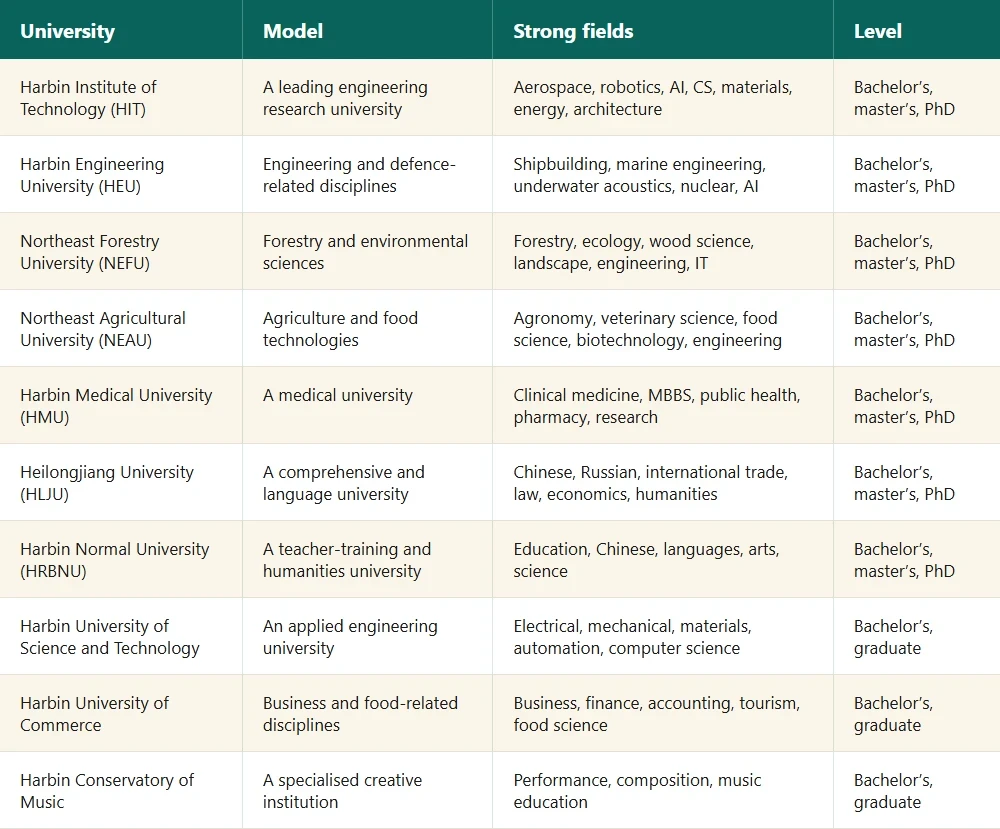
Source: Harbin Engineering University, Northeast Forestry University, Northeast Agricultural University, Harbin Medical University, Heilongjiang University, Harbin Institute of Technology, Northeast Forestry University, Northeast Agricultural University
University profiles
Harbin Institute of Technology — 哈尔滨工业大学
HIT is Harbin’s main international academic brand and one of China’s strongest engineering universities. For the 2026 bachelor’s intake, the university accepted applications until 15 July. Tuition was 20,000 RMB a year for Chinese-medium and 26,000 RMB for English-medium programmes; the dormitory was 800–1,000 RMB a month. The university publishes a separate list of majors and CSCA subjects.
Who it suits Suits strong candidates in aerospace, mechanical engineering, robotics, AI, computer science, materials, energy, architecture and management. Competition is higher than at most other universities in the city. |
Harbin Engineering University — 哈尔滨工程大学
HEU is especially known for shipbuilding, marine engineering, underwater acoustics, nuclear science, automation and intelligent systems. In 2026 Chinese-medium bachelor’s programmes cost 16,000–17,000 RMB a year, English-medium AI — 22,000 RMB, and a Civil Engineering double degree — 45,000 RMB. Dormitories had a wide range of 400–2,600 RMB a month.
Who it suits Optimal for shipbuilding, marine engineering, power engineering, nuclear engineering, robotics, AI and computer science. 2026 requirements included CSCA, HSK 4, or IELTS 6.0/TOEFL 90. |
Northeast Forestry University — 东北林业大学
NEFU is a specialised state university in forestry, ecology, wood science and landscape architecture, but also offers computer science, AI, automation, business and International Economics and Trade. In 2026 tuition was 16,500 RMB for Chinese-medium and 21,500 RMB for English-medium bachelor’s programmes; the dormitory was 500 RMB for a twin room and 1,000 RMB for a single room per month.
Who it suits Suits forestry, environmental science, landscape architecture, ecology, wildlife, materials, civil engineering and applied IT. A Presidential Scholarship and a Eurasian scholarship programme are available. |
Northeast Agricultural University — 东北农业大学
NEAU is a strong 211/Double First Class university in agronomy, veterinary medicine, food science, biotechnology, smart agriculture and agricultural engineering. For the 2026 bachelor’s intake, tuition was 16,000 RMB, and a twin room was 500 RMB a month. HSK 4 and CSCA were required; applications closed at the end of May 2026.
Who it suits Logical for agriculture, veterinary science, food quality, dairy engineering, biotechnology, water conservancy and rural economy. A separate full-scholarship programme is available for some students from Eurasia. |
Harbin Medical University — 哈尔滨医科大学
HMU is one of the leading medical universities in Northeast China. For 2026 the university published a separate English-taught MBBS brochure and a postgraduate admission guide. Exact tuition, internship, clinical placement and dormitory terms must be confirmed against the current PDF for the 2027 intake.
Who it suits Suits candidates aiming for clinical medicine, MBBS, public health, pharmacy, nursing and biomedical research. Before paying, it is important to verify recognition of the diploma in your future country of practice and the language of the clinical internship. |
Heilongjiang University — 黑龙江大学
HLJU is a comprehensive university with strong language, humanities, law, economics and Russian studies. The published fee schedule shows 13,000 RMB a year for Chinese language and 15,500 RMB a year for bachelor’s programmes; long-term dormitory stay costs roughly 21–39 RMB a day for a double room.
Who it suits Especially suited for Chinese language, Russian-Chinese studies, international economics, trade, law and humanities. One of the most affordable options in the city. |
Harbin Normal University — 哈尔滨师范大学
HRBNU is a large teacher-training and humanities university. Strong fields include education, Chinese language, foreign languages, arts, history, geography and natural sciences. The university participates in CSC and other scholarship programmes; exact self-financed fees for 2027 must be checked separately.
Who it suits Suits future teachers, philologists, and students of Chinese language, arts and humanities. HSK, academic results and the correct programme type matter for scholarship applications. |
Harbin University of Science and Technology — 哈尔滨理工大学
An applied engineering university with electrical engineering, mechanical engineering, materials, automation, computer science and management. The international programme and the list of English-medium majors may change year to year.
Who it suits Suits candidates who value applied engineering and more moderate competition than at HIT. Request the 2027 brochure and confirm the language of instruction before applying. |
Harbin University of Commerce — 哈尔滨商业大学
A specialised option for business, finance, accounting, tourism, logistics, food science and commerce-related programmes. Costs are usually within the affordable range for state universities, but the 2027 rates must be confirmed against the admission guide.
Who it suits Suits students looking for business or food technology in an affordable northern city, without focusing on a top-ranking research university. |
Harbin Conservatory of Music — 哈尔滨音乐学院
A specialised creative university for performance, composition, conducting and music education. Admission involves a creative selection process, recordings of performances, a portfolio or exams.
Who it suits Only suits candidates with strong professional training. International intake, audition format and the language of instruction must be confirmed before applying. |
Popular fields of study in Harbin
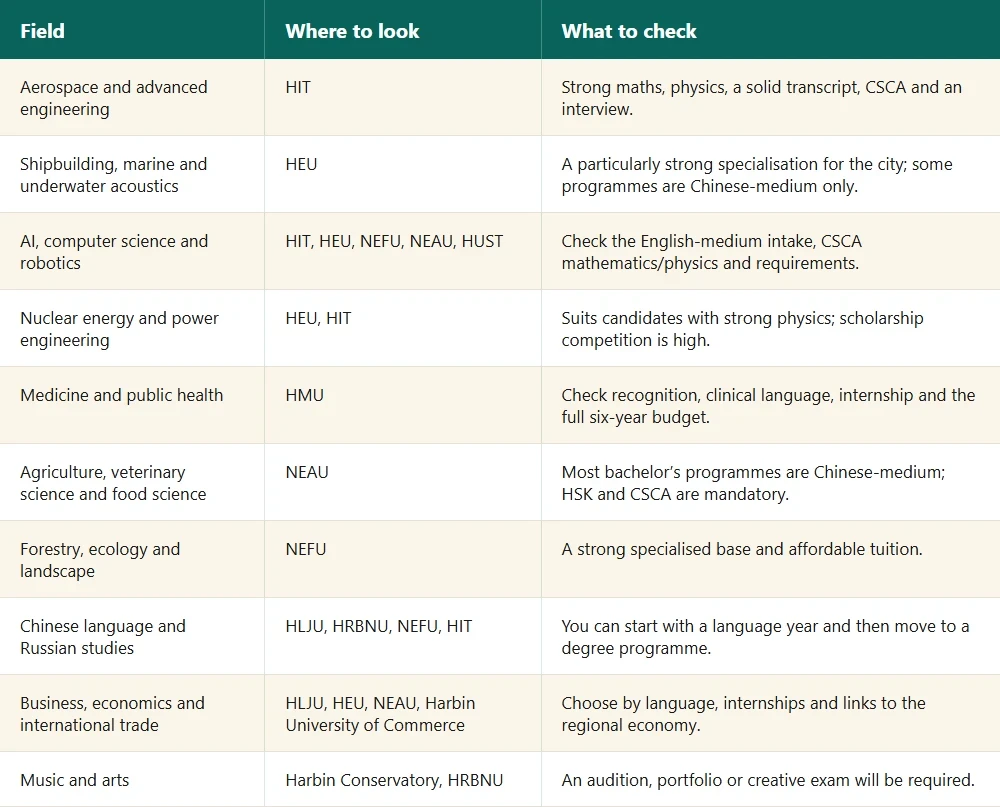
Source: Harbin Institute of Technology, Harbin Engineering University, Northeast Forestry University, Northeast Agricultural University, Harbin Medical University, Heilongjiang University
Tuition costs in Harbin in 2027
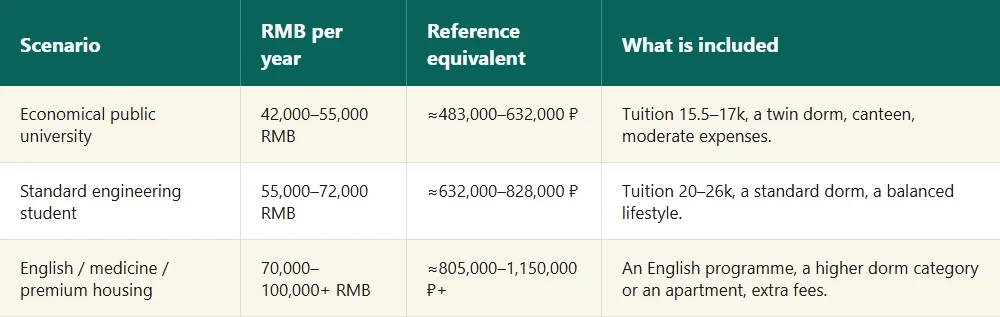
Below are official 2026 rates and careful planning benchmarks for 2027. The final cost depends on the programme, language, level of study, scholarship and special fees. Ruble figures are calculated at a conditional rate of 11.5 ₽ per 1 RMB and are not a currency quote.
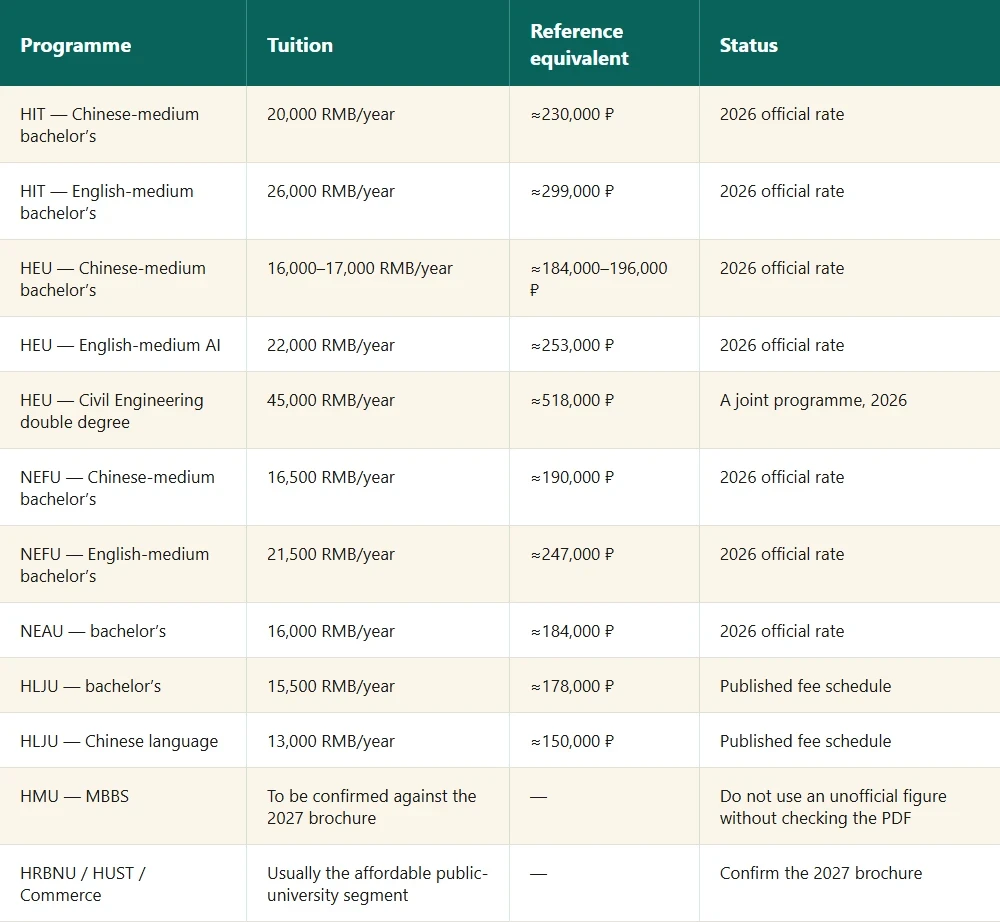
Source: Harbin Institute of Technology, Harbin Engineering University, Northeast Forestry University, Northeast Agricultural University, Heilongjiang University
How to read the prices A low tuition fee does not mean a low total cost. Add the application fee, insurance, residence permit, a medical check-up, a dormitory, a deposit, food, winter clothing and initial expenses after arrival. |
Dormitory, rent and cost of living
Harbin’s main financial advantage is affordable university housing. Official guides list twin rooms from 400–500 RMB a month. HIT, however, usually states 800–1,000 RMB, and HEU offers categories up to 2,600 RMB. A room is not automatically guaranteed: booking and campus assignment need to be confirmed after admission.
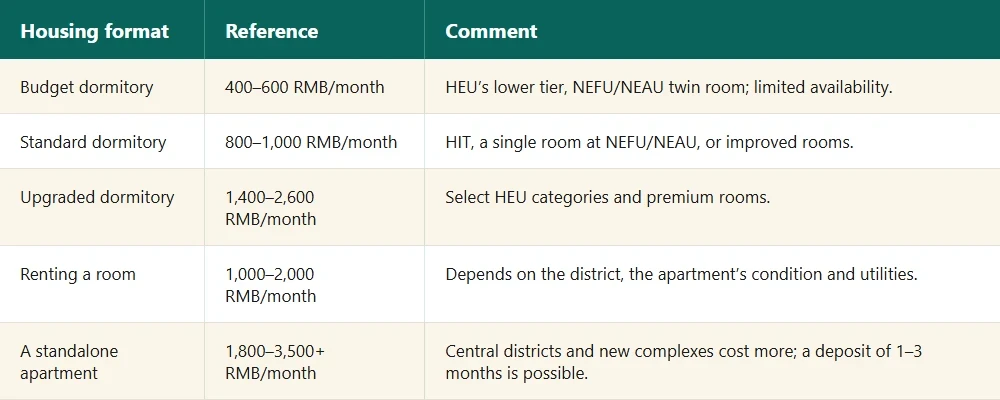
Source: Northeast Agricultural University, Harbin Medical University, Harbin Engineering University, Heilongjiang University
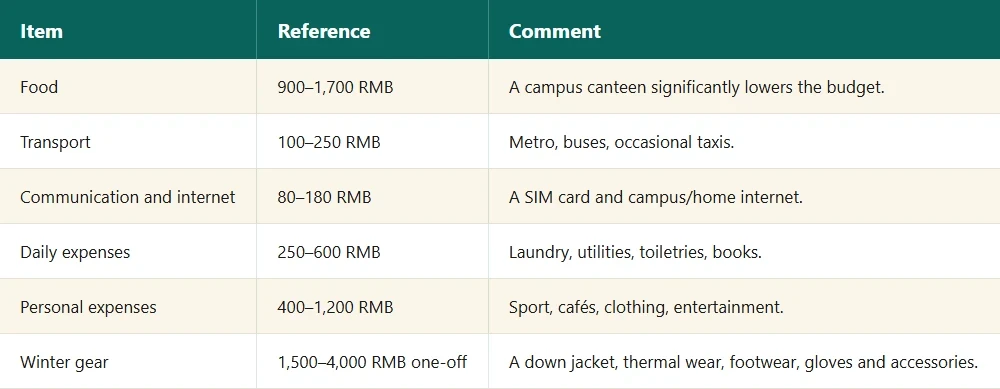
Three annual budget scenarios
First-month reserve Plan an extra 5,000–10,000 RMB for a deposit, bedding, a SIM card, a residence permit, a medical examination, winter clothing and unexpected expenses. |
Language of instruction, HSK, IELTS and entrance tests
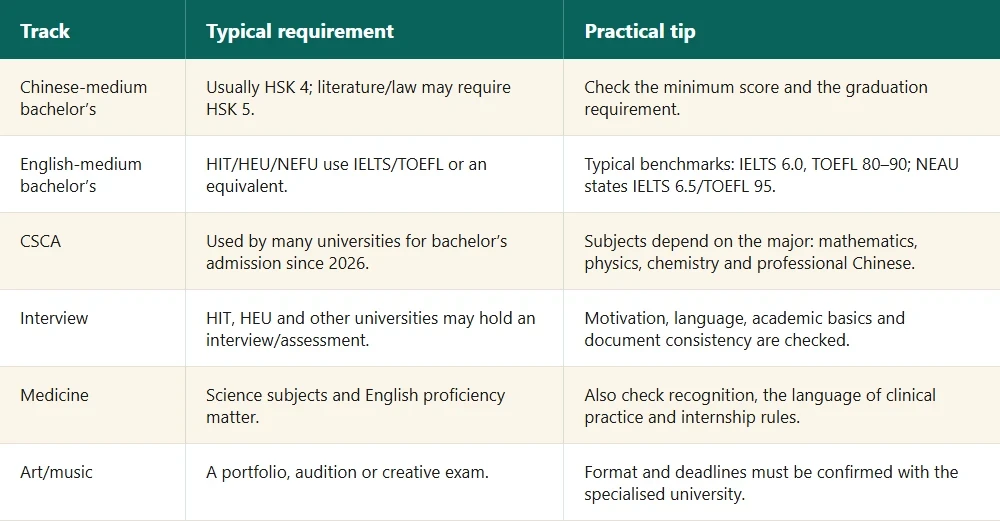
Source: Heilongjiang University, Harbin Institute of Technology, Harbin Engineering University, Northeast Forestry University, Northeast Agricultural University, Harbin Medical University
Do not confuse admission and graduation language Even an English-medium programme may include mandatory Chinese and require a specific HSK level by graduation or before clinical practice. |
Scholarships in Harbin
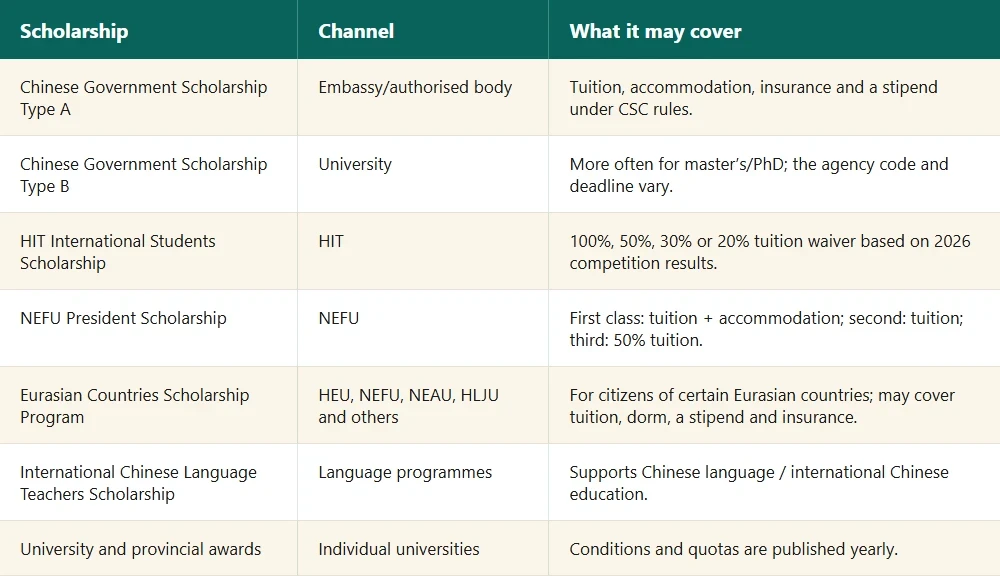
Source: Harbin Institute of Technology, Northeast Forestry University, Northeast Agricultural University, Heilongjiang University
A feature specific to Harbin For students from Russia, Belarus, Kazakhstan, Uzbekistan, Kyrgyzstan and a number of other Eurasian countries, it is especially important to check the Ministry–Province Eurasian Scholarship 2026–2029 programme. The list of countries, levels and deadlines depends on the specific university. |
How to apply to a Harbin university in 2027
- August–October 2026: determine your level, major, language and affordable budget.
- September–December: prepare HSK/IELTS/TOEFL and register for CSCA if required.
- October–January: shortlist 3–6 programmes and check scholarship channels.
- November–March: submit early scholarship applications; many full awards close earlier than the self-funded intake.
- January–May: submit main university applications and complete an interview/assessment.
- May–July: receive an admission decision, confirm your place and meet financial requirements.
- June–August: obtain the Admission Notice and JW201/JW202, and apply for an X1 visa.
- August–September: arrive, register your address, complete medical verification and obtain the residence permit.
Application documents
- a passport with a sufficient validity period;
- a certificate/diploma and transcript;
- notarised translations into Chinese or English;
- HSK, IELTS, TOEFL or other proof of language;
- a CSCA score report for applicable bachelor’s programmes;
- a study plan/motivation letter;
- a CV for graduate programmes;
- two recommendation letters for master’s/PhD;
- the Foreigner Physical Examination Form;
- a certificate of no criminal record;
- a financial guarantee/sponsor documents;
- a portfolio, audition recordings or a research proposal if needed;
- guardian documents for minors;
- proof of application fee payment.
A critical check Full name, date of birth, passport number and transliteration must match across all documents. Even a one-letter mismatch can delay admission, the JW202 or the visa. |
Districts, transport, climate and student life
Campuses are spread across Nangang, Xiangfang, Songbei and other districts. HIT, HEU, HLJU, HMU, NEFU and NEAU are in different parts of the city, so when choosing housing you need to focus on the specific campus, not just the university’s name.
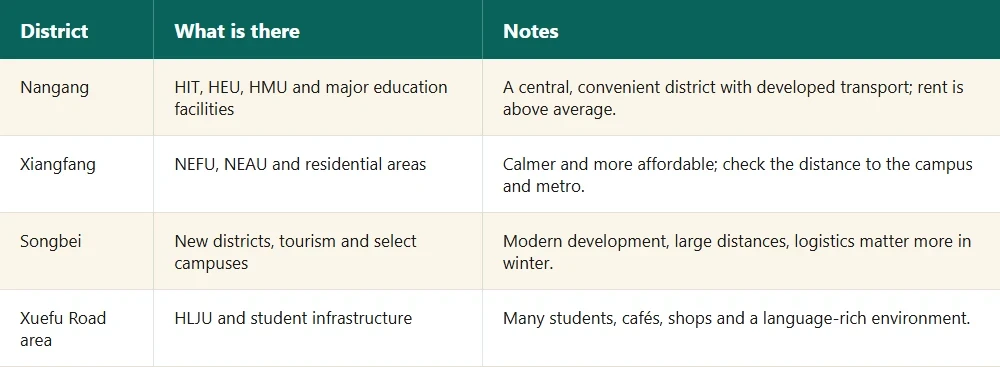
Source: Harbin Institute of Technology, Harbin Engineering University, Harbin Medical University, Northeast Forestry University, Northeast Agricultural University, Heilongjiang University
Harbin has a metro and a developed bus network. In freezing weather, a journey with transfers can be noticeably harder, so the distance from your dormitory to the classroom matters more than in cities with a mild climate.
Climate The average winter temperature in the urban area is around −14.7°C, and on some days it can drop below −25…−30°C. Campuses and dormitories usually have central heating, however. The main adaptation costs are good footwear, a down jacket, thermal wear and skin care for the dry air. |
Winter shapes a unique student life: the Ice and Snow Festival, ice skating, winter sports and international tourism. Summer in Harbin is comparatively short and comfortable, which suits intensive summer study and internships.
Advantages and disadvantages of Harbin
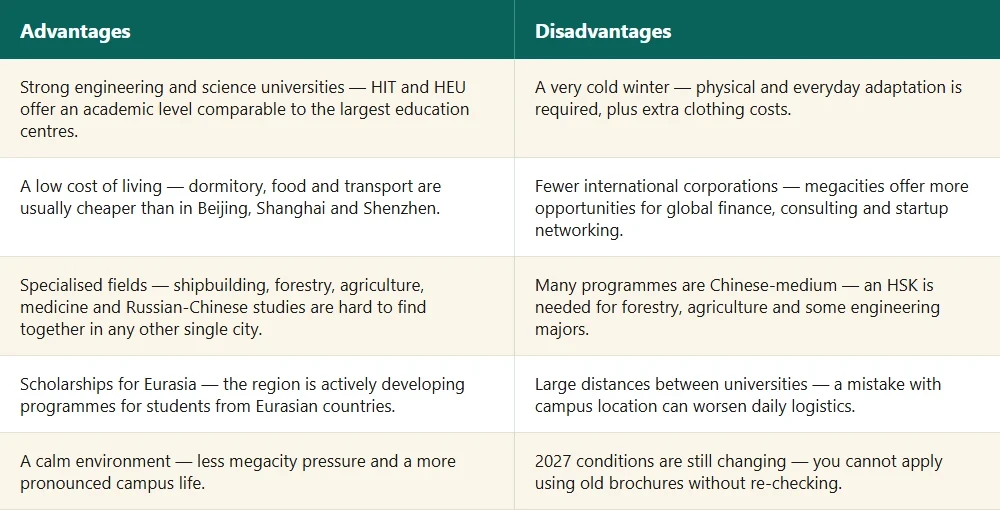
Common applicant mistakes
- Choosing HIT only by ranking, without assessing the difficulty of admission and the academic workload.
- Not checking exactly which campus and dormitory relate to the programme.
- Assuming an English-taught programme fully excludes the Chinese language.
- Missing CSCA or choosing the wrong set of subjects.
- Applying for a scholarship after the main deadline.
- Not budgeting for winter clothing and the first month.
- Confusing Harbin Institute of Technology with Harbin University of Science and Technology.
- Applying to a medical programme without checking diploma recognition and the clinical language.
- Using unofficial rates from intermediaries instead of the university brochure.
- Not preparing a backup university in case the top choice rejects your application.
FAQ: studying in Harbin
Is it expensive to study in Harbin?
By Chinese standards, Harbin is among the affordable university cities. Bachelor’s tuition at many state universities is around 15,500–26,000 RMB a year, and a dormitory often costs 400–1,000 RMB a month.
Which Harbin university is the best?
For engineering and research, Harbin Institute of Technology is most often chosen. For shipbuilding and marine engineering — Harbin Engineering University. For medicine — Harbin Medical University, for agriculture — NEAU, for forestry — NEFU.
Are there English-medium programmes?
Yes. HIT, HEU, NEFU and HMU offer separate English-taught programmes. The list changes every year, so check the guide for the specific intake.
Is CSCA required for admission?
Since 2026, many bachelor’s programmes require CSCA. Subjects depend on the major and the language of instruction.
Can you apply without an HSK?
It is possible for some English-taught programmes or a language/pre-university track. Most Chinese-medium bachelor’s programmes require at least HSK 4.
How cold is it in winter?
Winter is long and cold, with an average winter temperature of around −14.7°C, and frosts below −25°C are possible. Buildings usually have central heating.
How much money do you need per month for living expenses?
Living in a dormitory, many students manage on around 2,000–4,000 RMB a month excluding tuition, but costs depend on the room and lifestyle.
Are there grants for students from Russia and the CIS?
Yes. Alongside CSC, Harbin has the Eurasian Countries Scholarship Program for citizens of a number of Eurasian countries. The list of countries and universities should be checked yearly.
Is Harbin good for medical education?
Yes, primarily thanks to Harbin Medical University. But you need to check qualification recognition, the language of clinical practice, and the full six-year budget.
When should you start preparing to apply for 2027?
It’s best to start in summer–autumn 2026, in time to prepare language tests, CSCA, scholarship applications and documents.
Applying to Harbin with GE Agency
GE Agency helps international applicants choose a university and prepare their application, taking into account major, language, budget, scholarship strategy and the specific university’s requirements.
- a personal shortlist of universities and programmes;
- checking admission requirements, CSCA, HSK and English tests;
- calculating tuition, housing, living expenses and the first month;
- preparing forms, a CV, a study plan, recommendations and a research proposal;
- translations and checking the document set;
- submitting applications and liaising with universities;
- working on scholarship applications;
- obtaining the Admission Notice and JW202;
- visa, pre-departure and organisational support.
Get a personal shortlist of Harbin universities for 2027 and a full budget calculation The GE Agency team will match your major, language, academic profile and financial capacity against the real requirements of the programmes. |