Communication University of China (CUC) in Beijing accepts international students to bachelor's, master's and doctoral programs in media, journalism, film and television. According to the university's international institute, applications are accepted only online and the fee is 800 RMB. Below we cover programs, tuition, HSK and CSCA, documents and deadlines.
Key points • All bachelor's programs for international students are taught in Chinese; the master's level has both Chinese- and English-taught programs. • A bachelor's costs 21,200–30,000 RMB per year, a master's 27,000 or 35,000 RMB, and a doctorate 30,000 or 45,000 RMB. • Bachelor's applicants need HSK 5 and HSKK Intermediate (at least 60 in each section) and a CSCA result. • The application fee is 800 RMB and is non-refundable; paper documents are not accepted. • There is one intake per year, in autumn; applications are usually open from the start of the year until April–May. |
What is Communication University of China and who is it for
CUC is in Beijing's Chaoyang district and was founded in 1954. In its bachelor's brochure the university calls itself the cradle of Chinese radio, television and media talent and lists two leading disciplines: journalism and communication studies, and drama, film and television studies. Majors with a media profile are open to international students: journalism, communication studies, radio and television editing and directing, cinematography, animation, digital media art, theatre, film and TV directing, advertising and brand management, and others.
It suits applicants who want to work in media, film or advertising and are ready to study in Chinese. If you are still comparing universities, start with our overview of the top universities in China.
Programs open to international students
The university accepts international students to bachelor's, master's and doctoral programs, as well as language and preparatory programs.
Bachelor's
The bachelor's for international students is taught in Chinese. It takes four years, with a maximum of six. The university publishes the major catalog on its 2026 undergraduate admissions page. An applicant can apply for no more than two majors.
Master's and doctorate
The master's level has programs taught in Chinese and in English. A professional master's takes two years, an academic master's three years, and a professional doctorate four years. The university set out the rules in its brochure for master's and doctoral students; you can apply to only one program.
Language programs
The preparatory program (Chinese language study) is open for applications year-round. It is for those who want to improve their Chinese before applying, and it costs 12,000–28,000 RMB depending on the format.
How much it costs
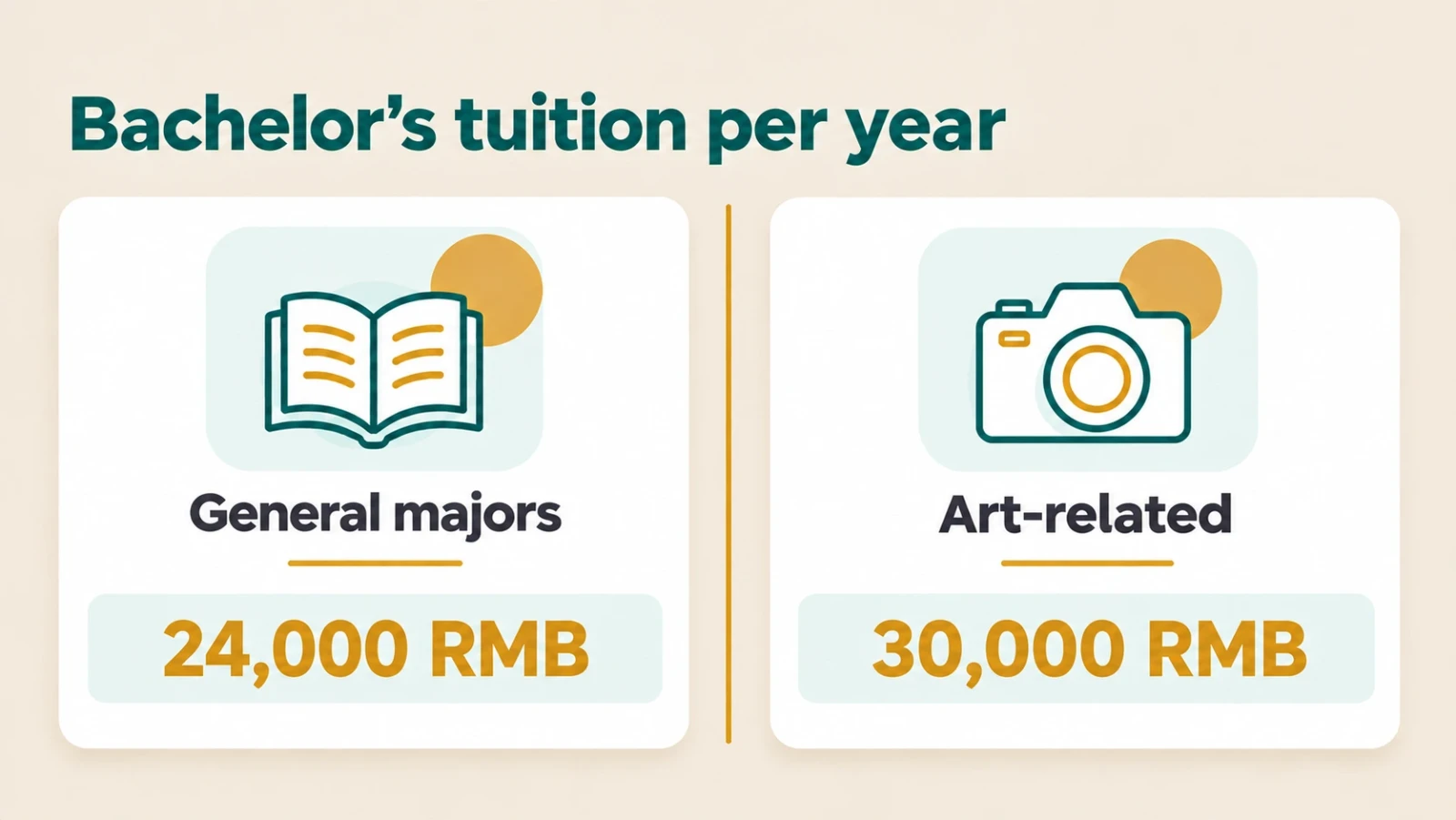
The university publishes a single tuition table. The data come from the Q&A for international students and the brochures:
Level | Majors | Tuition per year, RMB |
Bachelor's | art-related | 30,000 |
Bachelor's | other | 24,000 |
Bachelor's | Chinese language and literature | 21,200 |
Master's | other | 27,000 |
Master's | art-related | 35,000 |
Doctorate | other | 30,000 |
Doctorate | art-related | 45,000 |
Source: CUC Q&A for international students
According to the university, living expenses (housing, food, transport) are roughly 4,000–6,000 RMB per month. The campus has dormitories for international students; places are limited, and the price depends on the room type and is generally 1,400–1,500 RMB per person per month. For a full budget, see our breakdown of the cost of studying and living in China.
Who can apply
For the bachelor's the university names these conditions: the applicant should in principle be between 18 and 25, healthy, hold a high school diploma (by September 1, 2026), hold a valid foreign passport and have no criminal record. For applicants with one or both parents who are Chinese citizens the university requires a foreign passport or proof of nationality issued before April 30, 2022 and a record of at least two years of residence abroad between April 30, 2022 and April 30, 2026; a year counts if you spent at least nine months abroad. The final decision on nationality rests with China's immigration authorities.
For the master's the university states in principle under 40 and a bachelor's degree, and for the doctorate under 45 and a master's degree.
Language requirements
For the bachelor's the university names these requirements. In general you need HSK 5 or above (at least 60 in each section) and HSKK Intermediate or above (at least 60); results must be valid. Exceptions: programs of the School of Broadcasting and Anchoring and of the School of International Studies require HSK 6 and HSKK Advanced, Network and New Media (Operation of Intelligent Media Convergence) requires HSK 6 and HSKK Intermediate, and Chinese Language and Literature requires only HSK 4 and HSKK Intermediate. Graduates of Malaysian Chinese independent schools with a passing Chinese grade in the UEC are exempt from the HSK certificate.
Chinese-taught master's and doctoral programs require HSK 6 with at least 180 points (at least 60 in each section) and HSKK Advanced with at least 60; if your previous degree was taught in Chinese, the certificate can be replaced by an official certificate from the university about the language of instruction. English-taught programs require IELTS 6.5, TOEFL iBT 85 or TOEIC 750, and native English speakers and those who studied in English are exempt from the certificate.
Is CSCA required
Bachelor's applicants need a CSCA result, and at the time of application you may attach a screenshot of the exam registration. In 2026 the university required a result or registration screenshot by April 30. For Chinese-taught programs: science, engineering and some management majors require professional Chinese for science, mathematics and physics; literature, some management majors and arts require professional Chinese for humanities and mathematics. Mathematics and physics must be taken in Chinese. The recommended exam periods in 2026 were January, March and April; see the official website for details. We explain how the exam works in our CSCA guide.
When to apply
Applications are accepted through the university's international online system. According to the 2026 brochure the system was open until 24:00 on May 15, 2026 Beijing time, and the time of the first submission counts as the application date. The university states that there is one intake per year, in autumn, and no spring intake for degrees. The university publishes the 2027 calendar later; usually applications open before the Spring Festival and deadlines fall in April–May.
Documents for a bachelor's
The university accepts only online applications; paper copies are not accepted. It lists this package:
1. The application form, completed in the system.
2. A color photo on a white background.
3. A high school diploma (original or notarized copy in Chinese or English); graduating students submit a certificate of expected graduation.
4. A transcript for all courses.
5. A personal statement in Chinese.
6. A recommendation letter from your previous school or a teacher.
7. HSK and HSKK certificates and score reports.
8. A CSCA result.
9. A passport copy; the passport must be valid after December 1, 2026.
10. A personal identity declaration.
11. A birth certificate and proof of the parents' nationality at the time of birth.
12. A certificate of no criminal record issued within the last six months.
13. A foreigner physical examination form completed in English, valid for six months.
14. A guarantee letter from a guarantor and a commitment letter from the applicant.
15. If applicable, an English certificate, awards and additional materials.
Some majors require additional materials (for example, a portfolio), and some require an online interview with the school. Preliminary review results can be checked within 15 working days after you submit the application and pay the fee (excluding holidays). All originals must be shown at registration after admission, and if discrepancies or forgery are found, admission and student status are canceled. Keep your login and password for the system: the university staff cannot recover them.
Master's and doctoral documents
The package for master's and doctoral applicants differs from the bachelor's. You need a passport copy, a bachelor's degree or certificate of expected graduation and a transcript, proof of language (Chinese or English), a personal statement, two recommendation letters from professors or associate professors, a foreigner physical examination form, a certificate of no criminal record and optional materials: a portfolio, awards and publications. You can apply to only one master's or doctoral program, and once submitted the application cannot be changed.
Scholarships
In its Q&A the university names the China Scholarship Council scholarships (the bilateral program, Category A, and the high-level program for master's and doctoral students, Category B), the International Chinese Language Teachers Scholarship, the Beijing Government Scholarship and the Ministry of Commerce scholarship (only for applicants from developing countries). The Category A Chinese Government Scholarship covers tuition, accommodation, insurance and a monthly allowance: 2,500 RMB for bachelor's students, 3,000 RMB for master's students and 3,500 RMB for doctoral students. Bachelor's students can apply only for the bilateral Category A program, through the dispatching authority in their home country. The Beijing Government Scholarship for freshmen covers tuition and insurance and is available to self-funded students; you apply for it in the university's system. For a broader overview, see our guide to scholarships in China.
How selection works
First the international center checks your eligibility, then the application goes to the school. It evaluates the materials, the CSCA result and, where required, the interview, and draws up a ranked list. All interviews are online, and the invitation arrives by email. If documents are missing, the application is returned through the system for completion by a set date. After admission the university sends the admission notice and the JW202 form, which you use to apply for an X1 visa; read more in our guide to the China student visa.
Frequently asked questions
Does CUC accept international students without Chinese?
Not at the bachelor's level: all programs are taught in Chinese and require HSK 5 or above. At the master's level there are English-taught programs requiring IELTS 6.5, TOEFL 85 or TOEIC 750.
How much is the application fee?
The fee is 800 RMB for self-funded bachelor's and master's applicants and 600 RMB for preparatory Chinese programs. It is non-refundable.
Can I apply for a spring intake?
No. The university runs one intake per year for degrees, in autumn. Preparatory Chinese programs accept applications year-round.
Which HSK level do I need for a bachelor's?
HSK 5 and HSKK Intermediate in general; Chinese Language and Literature requires only HSK 4, and some schools require HSK 6.
Can I transfer to CUC from another university in China?
The university does not accept transfer applications from self-funded students. Chinese Government Scholarship students must first obtain the approval of their current university.
Do I need to mail paper documents?
No. The university accepts only online applications and does not accept paper copies.
When do classes start?
Degree programs start in autumn. The university gives exact dates in the admission notice.
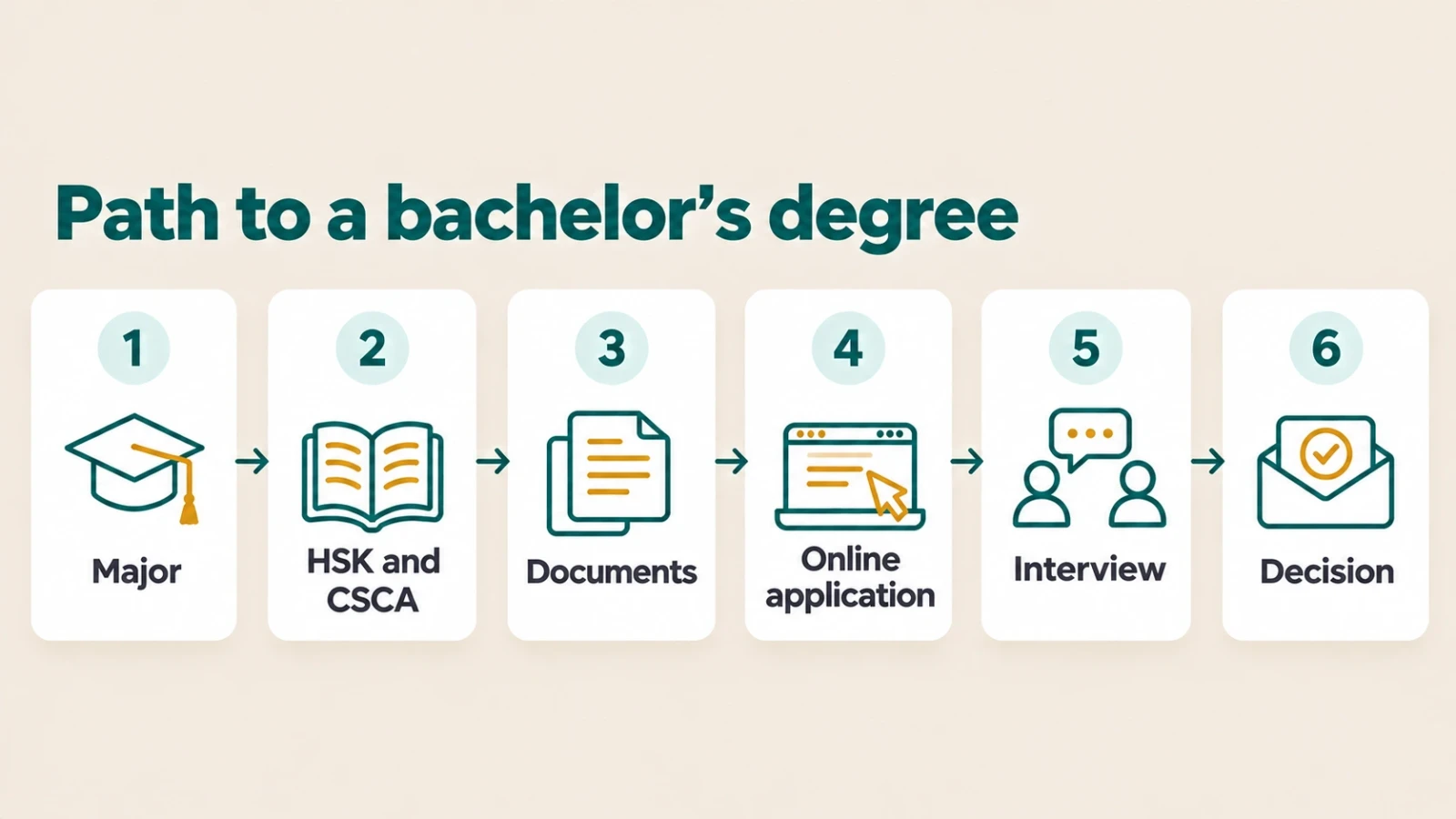
Action plan
1. Choose the level and major and check your school's requirements.
2. Take HSK and HSKK at the required level.
3. Register for CSCA and take the required subjects.
4. Collect your documents: color scans, translations, the non-criminal record, the guarantee letter and the medical form.
5. Submit the application in the online system on time and pay the 800 RMB fee.
6. Take the online interview if required and wait for the result in the system.
We can help you apply to China GE Agency will help you choose a university and program that fits your scores and budget, check your documents and submit your application without mistakes. Book a consultation. |
Information verified on October 19, 2026. Requirements, costs and deadlines depend on the university and may change — always check the official university website before applying.
Useful articles about studying in China
- Bachelor’s Degree in China After High School: Requirements, CSCA, Costs and 2027 Admission
- HSK Levels Explained: the New 9-Level HSK and Which Level You Need for University in China
- How to Apply to Study in China in 2027 — a Complete Guide for International Students
- Master’s Degree in China for International Students: Programmes, Requirements, Costs and Admission