
A China student visa is required to study in China, even if your country has a visa-free arrangement with China: visa-free entry covers tourism, business and visits, not study. You need an X1 visa (study longer than 180 days) or an X2 visa (up to 180 days). Here is how they differ, what documents you need, how to apply and how to get a residence permit after arrival. For how to get admitted and receive your visa documents, see How to Apply to Study in China in 2027.
Key facts • Study longer than 180 days requires an X1 visa; up to 180 days, an X2 visa. • You need your passport, Admission Notice, JW201 or JW202 form and a medical form. • With an X1 visa, you must apply for a residence permit within 30 days of entry. • Visa-free entry to China does not cover study. • Apply only after you receive your Admission Notice and JW201/JW202. |
Can I study in China visa-free?
No. China has introduced visa-free entry for citizens of many countries, but it covers purposes such as business, tourism, visiting relatives and friends, exchanges and transit. For example, the announcement on visa-free entry for Russian citizens (up to 30 days, until 31 December 2027) does not list study among the permitted purposes.
Visa-free entry is handy for an open day, an interview or a campus visit. To study — even on a short language course — you need a student visa.
Common mistake Entering visa-free and starting classes. You cannot get a student residence permit without an X1 visa, and visa-free days run out quickly. |
Types of Chinese visas
There are many Chinese visa types, but two matter for students — X1 and X2:
Visa | Purpose | Who needs it |
X1 | Study longer than 180 days | Bachelor's, master's, PhD, language year |
X2 | Study up to 180 days | Language semester, summer school, short exchange |
L | Tourism | Tourists without visa-free access |
S1 / S2 | Visiting family members who study or work in China | Students' relatives |
Z | Work | Employees with a job in China |
Source: Xi'an Jiaotong University
X1 vs X2: what's the difference?
The key differences are the length of study and the residence permit. An X1 visa is for study longer than 180 days and is followed by a residence permit. An X2 visa is for study up to 180 days and does not require one.
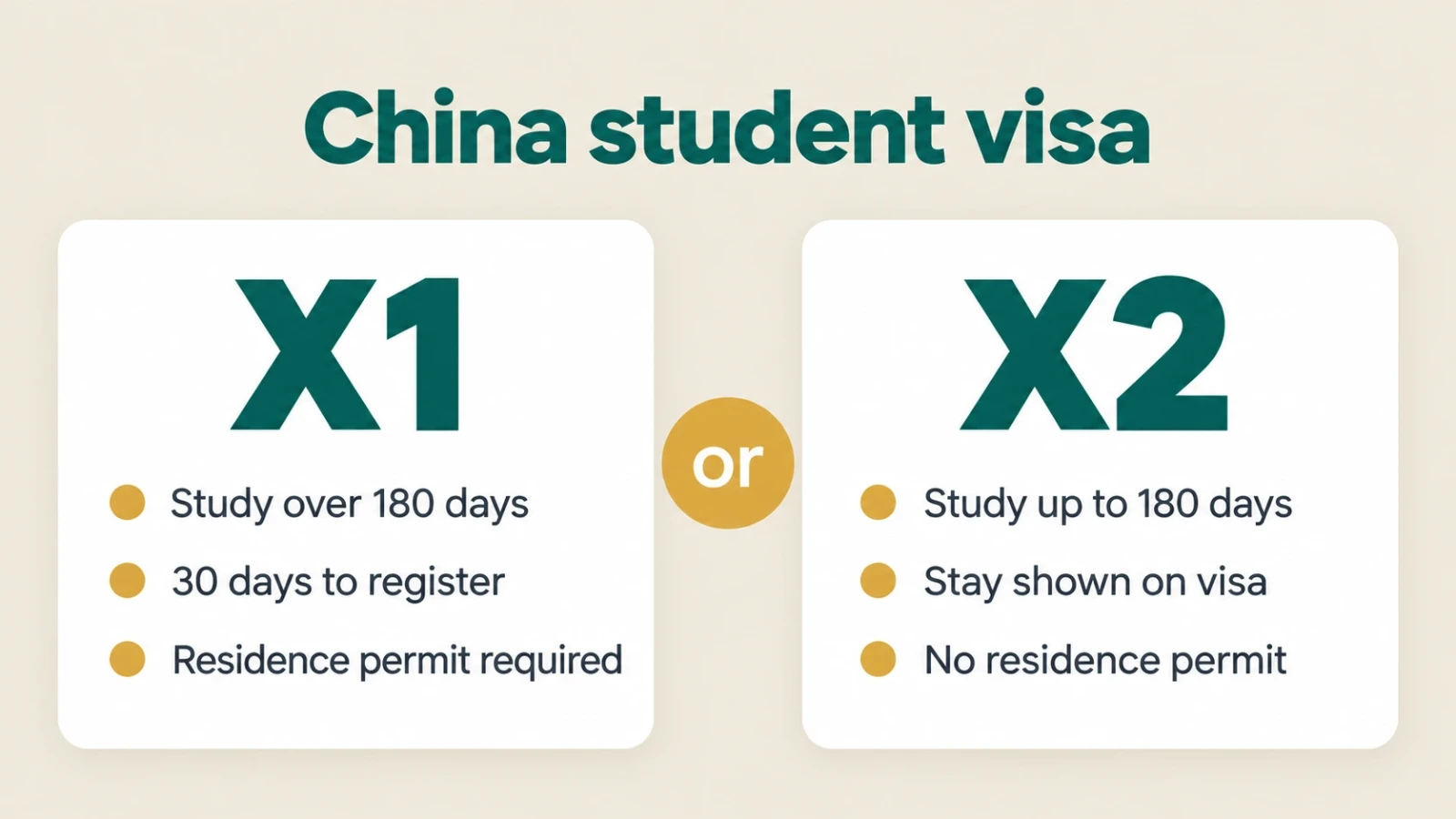
Parameter | X1 visa | X2 visa |
Length of study | More than 180 days | Up to 180 days |
Visa validity | 30 days to enter and register | Stay period shown on the visa |
Residence permit | Required within 30 days of entry | Not required |
Entries | Then unlimited on the residence permit within its validity | Single entry |
Typical use | Bachelor's, master's, PhD, language year | Language semester, summer school, exchange |
Source: Hohai University, Xi'an Jiaotong University
Documents for an X1 or X2 student visa
The document list is short, but the two key documents come from your university — so you apply after admission. A typical list, as published by Hohai University:
1. Valid ordinary passport (original).
2. Admission Notice from the university (original).
3. Form JW201 or JW202 — "Visa Application for Study in China" (original).
4. Foreigner Physical Examination Form.
5. Blood test report.
The embassy or visa centre will also ask for an online application form and a photo. JW201 is issued to scholarship holders and JW202 to self-funded students; universities send it with the Admission Notice, usually in early summer for the autumn intake.
Important Keep the original JW201/JW202 after you get your visa: you will need it in China to apply for your residence permit. |
Where and how to apply
Apply at the Chinese embassy or consulate in your country, or at a Chinese Visa Application Service Center where available. The process is usually:
1. Fill in the online visa application form.
2. Book an appointment.
3. Submit your documents and give fingerprints.
4. Pay the fees.
5. Collect your passport with the visa.
Fees and processing times depend on your nationality and the visa centre — check the fee page of your local centre before applying. To budget for the visa, flights and your first months, see How Much It Costs to Study and Live in China.
After arrival: the student residence permit
An X1 visa gives you 30 days to register — within that time you must apply for a residence permit at the local Exit-Entry Administration of the city where your university is. The international office helps with this, as China University of Petroleum (Beijing), for example, describes.
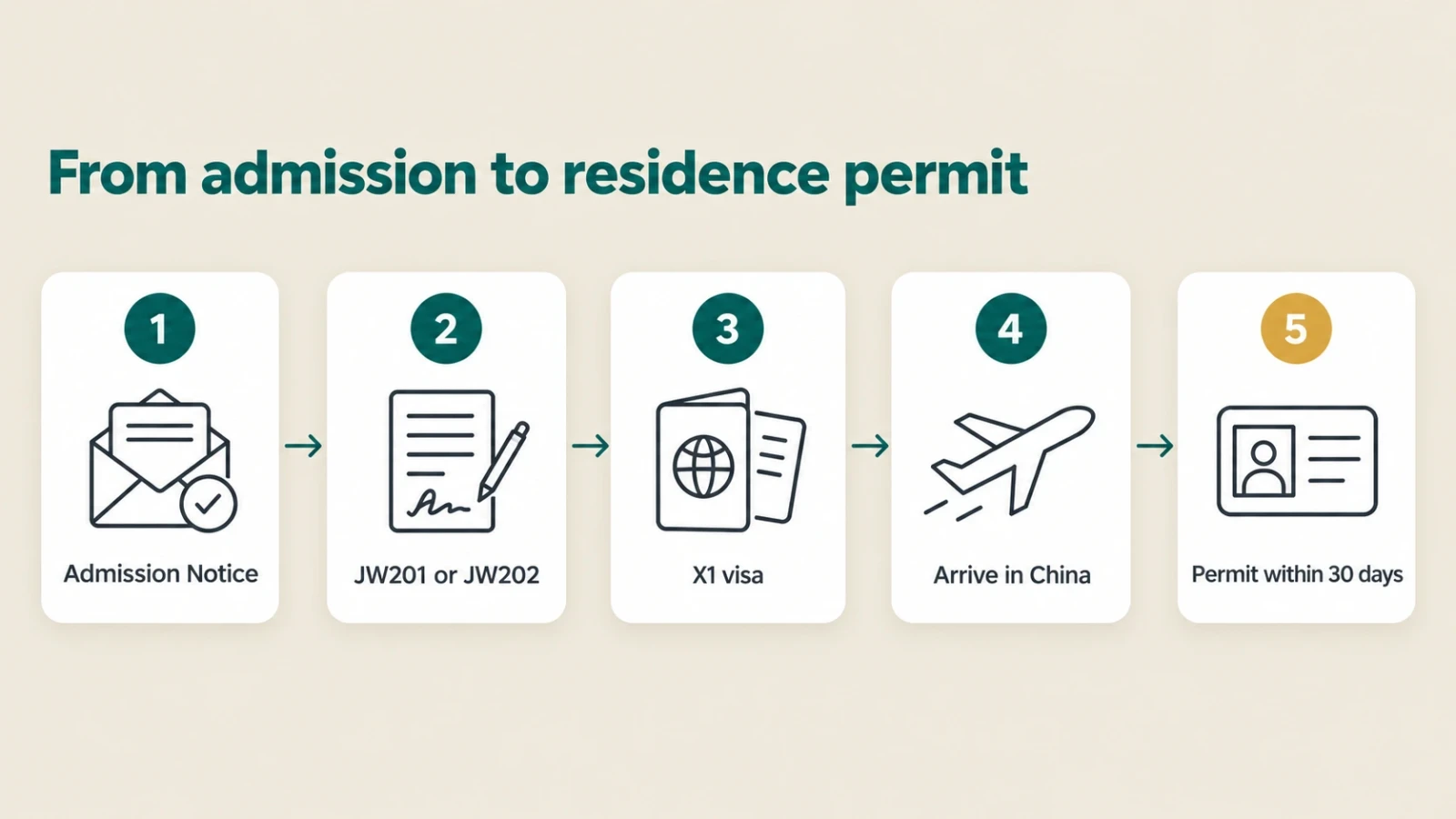
Documents for the residence permit, as listed by Hohai University:
1. Passport with visa — original and copy.
2. The university's official letter and Admission Notice showing the study period.
3. A visa application letter from the international college.
4. The original JW201 or JW202 form.
5. The Application Form for Visa and Residence Permit for Foreigners with a 2-inch colour photo on a white background.
6. Temporary accommodation registration.
7. For students studying more than a year and over 18 — a verified physical examination record from a designated institution.
The residence permit is valid for your study period but not beyond your passport's validity. Renew it in advance — Xi'an Jiaotong University, for example, asks students to apply at least 30 days before it expires. Overstaying counts as illegal residence and leads to fines.
Common mistakes
1. Coming to study visa-free — study is not a visa-free purpose.
2. Applying for a visa before receiving the Admission Notice and JW201/JW202.
3. Losing the original JW201/JW202 — you need it for both the visa and the residence permit.
4. Arriving too early: you can apply for a residence permit only after registering at the university.
5. Missing the 30-day deadline for the residence permit.
6. Getting an X2 visa for a programme longer than 180 days.
Frequently asked questions
Can I study in China visa-free?
No. Visa-free entry covers business, tourism, visits, exchanges and transit. To study you need an X1 or X2 visa.
Which visa do I need to study in China?
X1 for study longer than 180 days, X2 for short programmes of up to 180 days.
What is the JW202 form?
It is the "Visa Application for Study in China" form issued by a Chinese university after admission. JW201 goes to scholarship holders, JW202 to self-funded students. You cannot get a student visa without it.
How long is an X1 visa valid?
The X1 visa itself gives you 30 days to enter and register. Within that time you must get a student residence permit, which is valid for your study period but not beyond your passport's validity.
Can my parents visit me in China?
If your parents' country has visa-free access and the trip fits its purposes and length, they may not need a visa. For longer visits there are S1 and S2 visas for students' relatives.
Quick action plan
1. Get admitted and wait for your Admission Notice and JW201/JW202.
2. Complete the Foreigner Physical Examination Form.
3. Fill in the visa form and apply at the embassy or visa centre.
4. Get your X1 visa and arrive by your registration date.
5. Within 30 days, apply for a residence permit with the university's help.
We'll help with admission and your visa GE Agency supports students from choosing a university to getting the X1 visa and residence permit: we'll check your documents and explain the order and deadlines. Book a consultation. |
Information checked on 4 October 2026. Entry rules, fees and document lists may change — always check the visa centre's and your university's websites before applying.
Useful articles about studying in China
- Scholarships to Study in China: Chinese Government Scholarship, University and Provincial Grants
- Language Year in China in 2027: Cost, Universities and Application Deadlines
- Bachelor’s Degree in China After High School: Requirements, CSCA, Costs and 2027 Admission
- Master’s Degree in China for International Students: Programmes, Requirements, Costs and Admission