To pass the CSCA exam you need to know three things: what the syllabus of your subjects covers, how the online exam at home works and when you can take a "mock test." This article covers preparation; the general exam procedure is explained in our guide to the CSCA exam. The data below come from the description of the exam published by the Institute for International Education of Guangdong University of Foreign Studies on the basis of the organizers' materials; the syllabi are on the official exam website.
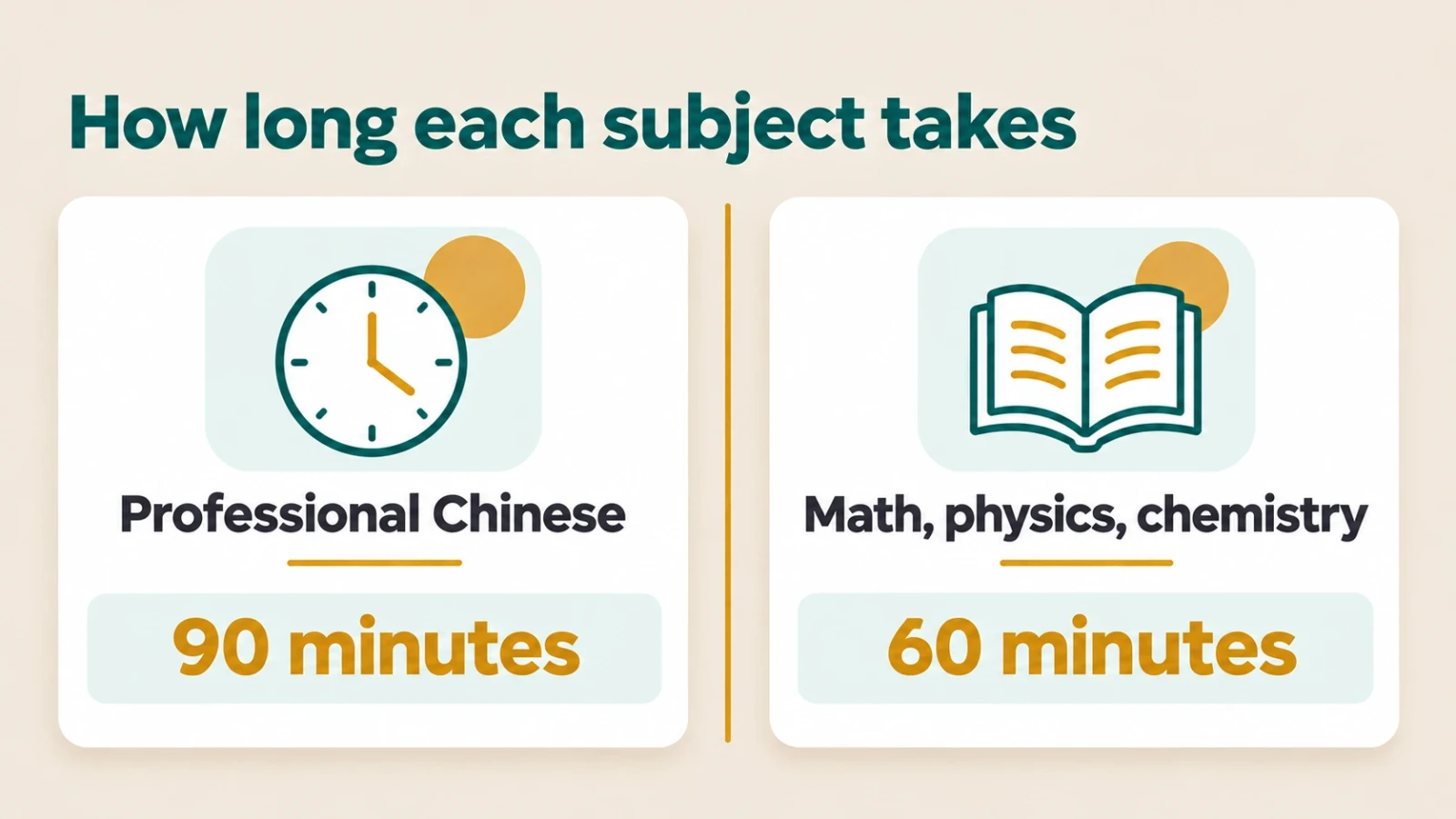
Key points • The exam includes professional Chinese (humanities or STEM), mathematics, physics and chemistry; every question has one correct answer. • Professional Chinese takes 90 minutes and is in Chinese only; mathematics, physics and chemistry take 60 minutes each, in Chinese or English. • The official "mock test" is a platform test and a rehearsal of the whole procedure; in this description the organizers do not name collections of practice questions. • Scores are valid for two years, and the number of attempts is unlimited. • You can take the exam at home under online supervision on a Windows computer with a second device. |
What is CSCA and who needs it
CSCA (China Scholastic Competency Assessment) is a standardized exam for foreigners planning to study for a bachelor's degree in China. It is organized by the China Scholarship Council together with experts from Chinese universities. The exam tests language and academic readiness, and universities use the result in admission and scholarship decisions. Only non-Chinese citizens can take part; holders of Chinese passports and of residence documents for Hong Kong, Macao and Taiwan cannot register.
Which subjects you take depends on the university and the major. Mathematics is compulsory for everyone, professional Chinese is needed for Chinese-taught programs, and physics or chemistry are needed for many engineering, science and medical majors. First open the page of the university you plan to apply to and check the requirements. We covered the general admission route in our guide to a bachelor's degree in China.
How universities use the CSCA result
The organizers write that universities can verify the authenticity of a report in the official system and see the candidate's global percentile ranking. Each university has its own rules. For example, East China Normal University set no minimum score for the 2026 intake and took the result into account in the overall evaluation of the application. Fudan accepted December 2025 results for the first application round and December 2025 and January 2026 results for the second. Communication University of China asked for a result or a registration screenshot by April 30, and Beijing Normal University calls CSCA the written part of its entrance examination. So always check the deadline and the set of subjects on the page of the specific university.
Which subjects are in the exam
Subject | Test language | Duration | Questions | Score |
Professional Chinese (humanities) | Chinese | 90 min | 80 | 0–100 |
Professional Chinese (STEM) | Chinese | 90 min | 80 | 0–100 |
Mathematics | Chinese or English | 60 min | 48 | 0–100 |
Physics | Chinese or English | 60 min | 48 | 0–100 |
Chemistry | Chinese or English | 60 min | 48 | 0–100 |
Source: Guangdong University of Foreign Studies, CSCA description
You can choose the language per subject: mathematics, physics and chemistry are offered in Chinese or English, while professional Chinese is offered in Chinese only. Choose the language that your university requires, and if the university states nothing, you can decide yourself.
What the mathematics syllabus covers
Mathematics is compulsory. According to the syllabus (2025 edition) the exam lasts 60 minutes, has 48 multiple-choice questions and tests fundamental mathematical skills, logical thinking and problem solving. The topics are grouped into four modules:
1. Sets and inequalities: set operations, quadratic and rational inequalities.
2. Functions: domain and range, monotonicity, parity, power, exponential, logarithmic and trigonometric functions, sequences, basics of derivatives and calculus.
3. Geometry and algebra: plane analytic geometry (lines, circles, ellipses, hyperbolas, parabolas), vectors and complex numbers, solid geometry.
4. Probability and statistics: classical probability, mean and variance, the basic concept of the normal distribution.
If you are looking for a CSCA mathematics practice test, start with this list: go through all four modules and check which topics you know least.
What the physics and chemistry syllabi cover
Physics and chemistry take 60 minutes each and have 48 single-answer questions.
Physics has five modules: mechanics (kinematics, Newton's laws, momentum and energy, circular motion and gravitation, oscillations and waves), electromagnetism (Coulomb's law, DC circuits, magnetic field, electromagnetic induction), thermodynamics (gases, the equation of state, the first law), optics (reflection, refraction, interference, diffraction) and modern physics (the photoelectric effect, atomic structure, basics of nuclear physics).
Chemistry has four modules: basic concepts and calculations (classification of matter, equations, concentration and pH, amount of substance), properties and reactions of substances (inorganic chemistry, basic organic compounds, redox and ionic reactions), theories and laws (atomic structure and the periodic law, chemical bonds, reaction rate and equilibrium, electrolytes) and experiments (laboratory safety, preparation and identification of gases, separation and purification, analysis of industrial processes such as ammonia synthesis).
How to prepare for professional Chinese
Professional Chinese comes in two kinds: humanities and STEM. The exam lasts 90 minutes, has a maximum of 100 points and consists of single-answer questions. The modules are the same for both: recognizing characters, choosing the right word, distinguishing words, assembling a paragraph from words, completing sentences and reading. The humanities version tests Chinese in the topics of literature, philosophy, law, education, history, art, journalism and other humanities majors. The STEM version tests the language of mathematics, physics, chemistry and computer science: formulas and symbols, descriptions of lab work, reading tables and graphs, and terms from introductory courses.
The professional Chinese syllabi are published only in Chinese. For preparation this means you need not general vocabulary but specialized vocabulary: study texts from the subjects you chose. You can see which HSK level you need for admission in our overview of HSK levels.
Is there a CSCA practice test
Officially yes, but it is not a collection of questions. The organizers name two events for those who take the exam at home: a platform test and a scheduled mock test. The platform test checks whether your device and network meet the technical requirements. The mock test is a full simulation of the procedure of the real exam: you go through login, identity verification and the interface, and you can spot problems in advance. The organizers announce the schedule of both on the website and by email after the registration deadline.
The organizers strongly encourage candidates to take both. So the honest answer to "CSCA practice test" is this: for content preparation rely on the subject syllabi, and use the mock test as a rehearsal of the procedure. Question collections from third-party websites are not mentioned in this description, and you cannot verify how closely they match the real exam.
How the exam works at home
At first the exam is mostly taken at home (a remote-proctored home-based test), and on-site centers are being opened gradually, the first ones in Vietnam and Thailand. The home-based test is available only where there are no on-site centers. Here is what is required:
- Primary device: a computer with 64-bit Windows 10/11 or Windows 7 SP1 and above (macOS is not supported), a screen of at least 1366×768, at least 4 GB of memory, at least 2 GB of free space, a camera of at least 720P at the top of the screen and the CSCA client installed.
- Secondary device: a smartphone or tablet with a camera on a tripod, which shows your upper body, the screen and your hands from about a 45° rear angle.
- Internet: symmetrical speed of at least 20 Mbps, speed to the platform of at least 500 KB/s, preferably a wired connection and a backup mobile hotspot.
- Room: a separate quiet, well-lit, enclosed room with a tidy desk; taking the exam on a bed, sofa or in a public place is prohibited.
- Scratch tool: a small whiteboard with an erasable marker or a blank sheet in a transparent file bag; paper, sticky notes, pencils and pens are prohibited, and you must erase your notes in front of the proctor.
- Documents: the original valid ID (a digital copy is not accepted) and a printed admission ticket.
You may log in 60 minutes before the start to check your device, face and identity, and after the exam begins, entry is closed. You cannot submit early: the system sends your answers automatically when time runs out.
How much the exam costs and when it takes place
The organizers give the fee: 450 CNY for one subject and 700 CNY for two or more. From 2026 the exam is held five times a year: in January, March, April, June and December. The first session took place on December 21, 2025. For that first session the timetable was as follows (Beijing time): professional Chinese 13:00–14:30, mathematics 15:30–16:30, physics 17:30–18:30 and chemistry 19:30–20:30. Results arrive within seven working days, and you download the electronic report in your account: you do not need to send it separately to the university. For a full admission budget, see our breakdown of the cost of studying and living in China.
How to register
Registration takes place on the official exam website: you need a valid email address, an ID document, a digital ID photo and a Visa or Mastercard bank card for payment. Enter your data exactly as in your document, because a mismatch means you will not be admitted to the exam. After submission your data are locked and can be changed only before the admission ticket is generated. You can withdraw from the exam only before the ticket is generated, and transfers were not permitted in the 2025 cycle. Candidates under 14 can register with the consent and help of a guardian, and there is no other age limit.
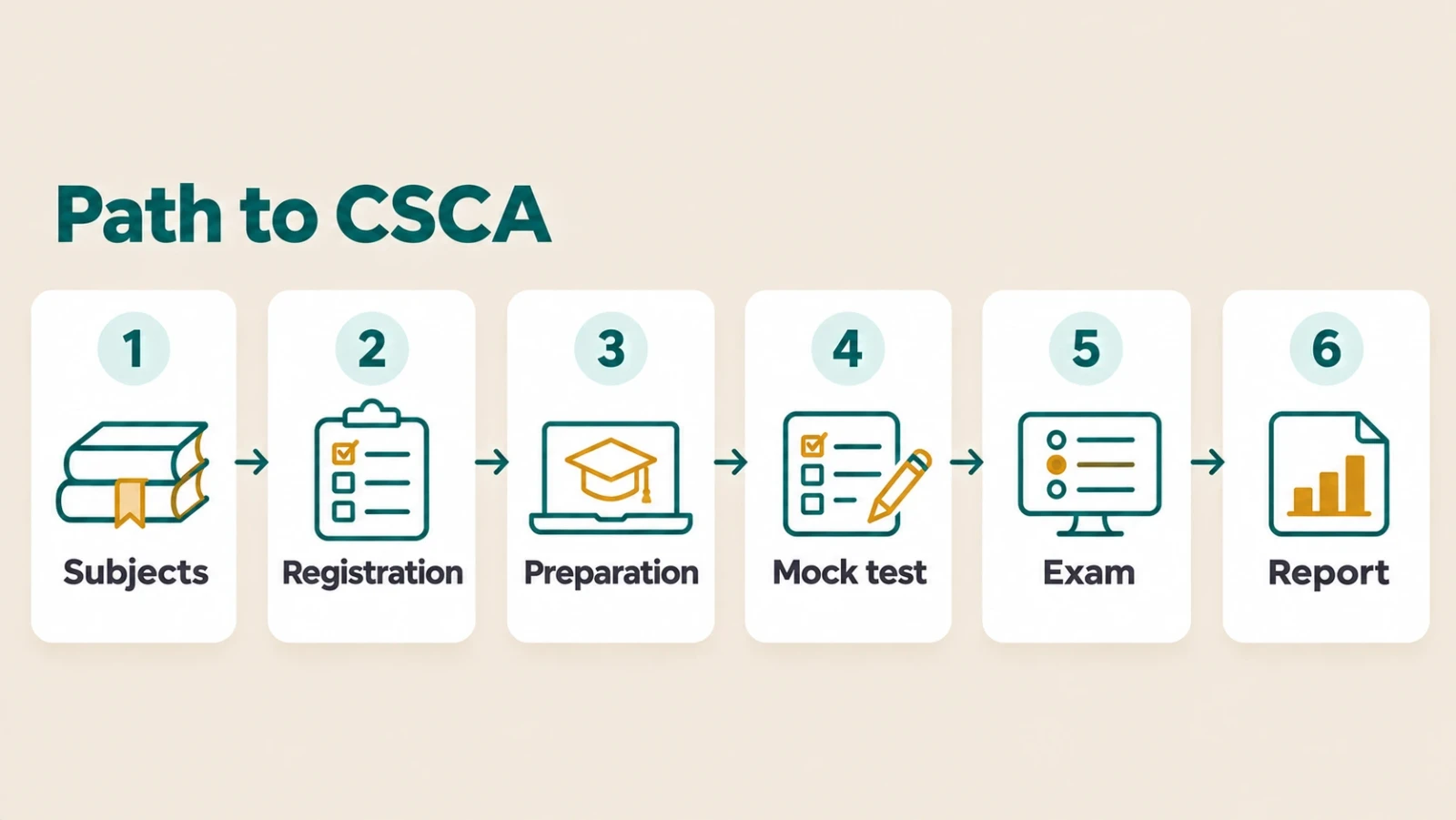
How to pass CSCA: a preparation plan
1. Choose subjects according to the requirements of your university and major.
2. Download the syllabi for your subjects and mark the topics you know least.
3. For professional Chinese, read study texts for your profile: humanities or STEM.
4. Register for the nearest session and check your equipment in advance.
5. Take the platform test and the mock test as soon as the organizers announce the schedule.
6. The day before, prepare your ID, admission ticket, whiteboard and marker, and check your internet connection.
Frequently asked questions
Does CSCA have official practice questions?
The organizers' description names the subject syllabi and a mock test of the procedure, but does not mention collections of practice questions.
How many times can I take CSCA?
There is no limit, and each result is valid for two years. You can submit your best valid result to a university if its policy allows it.
Can I take the exam in English?
Mathematics, physics and chemistry can be taken in Chinese or English at your choice, while professional Chinese is in Chinese only.
What mathematics is on the exam?
Sets and inequalities, functions (including trigonometry, sequences, basics of derivatives), analytic and solid geometry, vectors and complex numbers, probability and statistics.
Do I need a second device at home?
Yes. You need a Windows computer and a second device with a camera on a tripod so that the proctor can see you, the screen and your hands.
How long do I wait for the result?
Results are published within seven working days after the exam. If there is a delay, the organizers post a notice on the website.
Can I finish the exam early?
No. The system submits your work automatically when time runs out, and leaving early counts as a violation, except in approved medical and emergency cases.
Action plan
1. Determine the set of subjects from your university's requirements.
2. Download the syllabi and draw up a study schedule.
3. Register for the exam and pay for it.
4. Prepare the equipment and room for taking the exam at home.
5. Take the platform test and the mock test.
6. Take the exam and upload the electronic report to your university application.
We can help you apply to China GE Agency will help you choose a university and the CSCA subjects, check your documents and prepare you to submit your application without mistakes. Book a consultation. You can see the general admission route in our admission guide. |
Information verified on October 19, 2026. Requirements, costs and deadlines depend on the exam organizers and the university and may change — always check the official exam website before registering.
Useful articles about studying in China
Scholarships to Study in China: Chinese Government Scholarship, University and Provincial Grants
Top Universities in China for International Students: Rankings and How to Choose
English-Taught Programmes in China: Universities, Tuition and IELTS Requirements
China Student Visa: X1 and X2 Visas — Documents, Process and Residence Permit