International students can study clinical medicine, dentistry, pharmacy, nursing, public health and other fields in China. But choosing a medical programme just for its price or an attractive description is not enough for a future doctor: you need to check the language of instruction, the university’s right to admit foreign students, clinical practice, and licensing rules in the country where you plan to work.
The essentials in one minute An English-medium MBBS in China usually lasts six years. Applicants need completed secondary education, strong results in natural sciences, proof of English and, at many universities, CSCA. Chinese will still be needed to communicate with patients. Having the diploma does not automatically give you the right to work as a doctor: after graduation a separate procedure of recognition, document verification, exams and professional registration is required. |
Table of contents
- Can a foreigner get a medical education in China
- Which programmes count as medical education
- What MBBS is and how it differs from Chinese-medium Clinical Medicine
- How to check a university and the official English MBBS list
- Requirements for 2027 admission
- CSCA, HSK and English
- Documents and the admission process
- Clinical practice and Chinese language
- Diploma recognition and a medical licence
- Dentistry and other medical fields
- Cost and grants
- How to choose a programme without risk
- FAQ
1. Can a foreigner get a medical education in China
Yes. Chinese universities accept international applicants for clinical medicine, dentistry and related fields. Programmes may be taught in Chinese, while some Clinical Medicine programmes are fully in English, in an MBBS format.
However, a medical application differs from most other majors. You need to check not only the admission conditions but four levels of the future route in advance:
- Whether the university has the right to run the chosen programme and admit international students.
- What document and qualification will be listed after graduation.
- Where and in what language clinical practice takes place.
- What requirements the medical regulator sets in the country where the graduate plans to work.
If you skip the last point, a student may obtain a full diploma but face additional exams, unrecognised clinical practice, or be unable to apply for a licence without further study.
2. Which programmes count as medical education
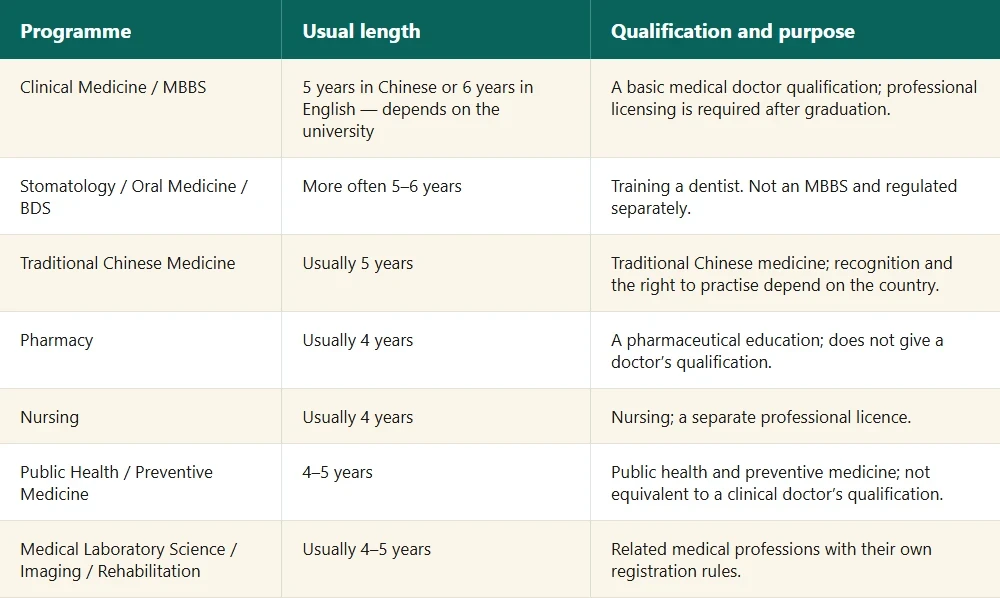
Do not confuse the fields The word Medical or Medicine in a programme’s name does not always mean the graduate gets a primary doctor’s qualification. Before applying, check the official English degree title and the professional registration options. |
3. What MBBS is in China
MBBS is an English-medium bachelor’s programme in clinical medicine for international students. Under China’s Ministry of Education standards, such a programme lasts six years. After completing the curriculum and the university’s requirements, the graduate receives a graduation diploma and a medical degree, whose English title is given as Bachelor of Medicine and Bachelor of Surgery — MBBS.
The six-year cycle usually includes:
- fundamental natural science and medical disciplines;
- anatomy, physiology, biochemistry, microbiology, pathology and pharmacology;
- diagnostics, internal medicine, surgery, paediatrics, obstetrics and gynaecology;
- clinical skills and classes at university or affiliated hospitals;
- Chinese language and medical terminology;
- clinical practice/internship and a final assessment.
The exact curriculum and the length of individual stages differ. Applicants should request the curriculum, the list of clinical bases, internship requirements and graduation conditions before paying tuition.
4. English-medium MBBS vs. Chinese-medium Clinical Medicine
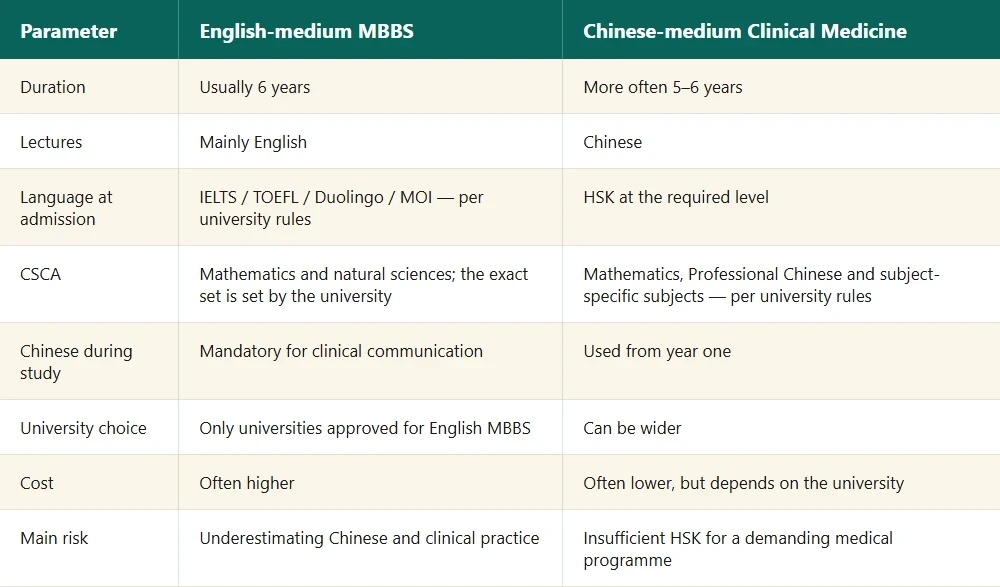
Even if lectures are in English, patients and most clinical staff communicate in Chinese. So a student needs to study general and medical Chinese, and the university may set its own language minimum before clinical rotations or graduation.
5. Which universities can run an English-medium MBBS
China’s Ministry of Education applies separate planned regulation for the English-medium bachelor’s in clinical medicine for foreigners. In the latest official list available at the time this article was prepared, the 2023/2024 academic year listed 44 universities and 3,048 places.
Universities not included on such a list for the relevant academic year should not admit foreigners to English-taught Clinical Medicine or award an English-language degree labelled MBBS. The Ministry separately prohibits bypassing this restriction through nominally "bilingual" programmes.
A mandatory check before publishing and applying The 2023/2024 list cannot automatically be treated as the list for 2027. Before publishing a list of universities and before paying an application fee, find the official MOE list for the relevant academic year and then check the specific university’s admission guide. |
5.1. Examples of officially published 2026-intake programmes
The table below is not a ranking or a complete list — it shows examples of universities that have published official admission terms. 2027 parameters may change.
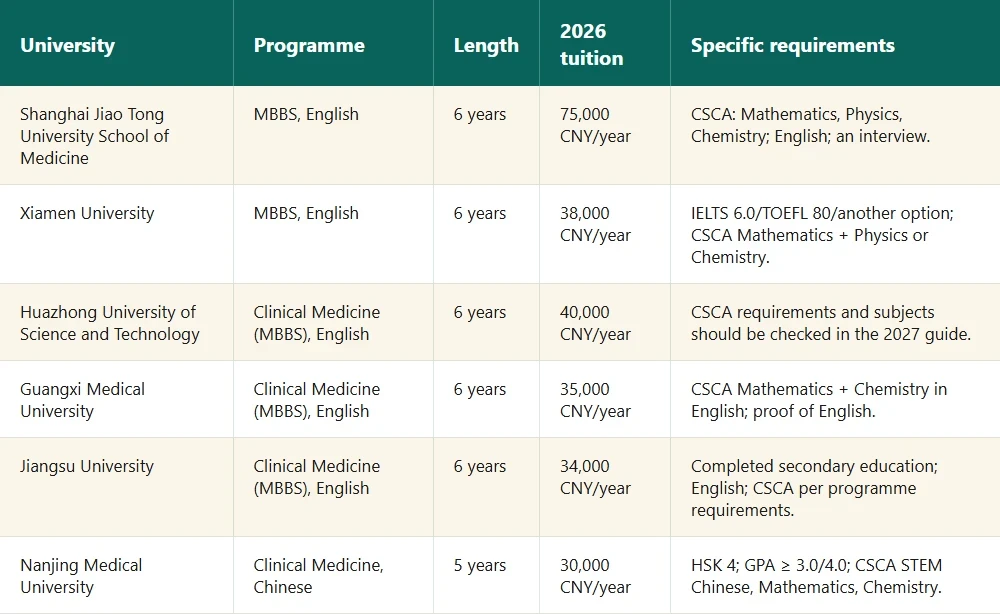
6. Requirements for 2027 admission
There is no universal threshold for all Chinese medical universities. The admissions committee assesses documents, CSCA results, language, school subjects, an interview and the candidate’s overall competitiveness.
6.1. Education and grades
- Completed secondary education or a recognised equivalent.
- Strong results in biology, chemistry, mathematics and physics — the exact set depends on the programme.
- A full high-school transcript; some universities request a school profile and a description of the grading system.
- For the most competitive programmes, simply meeting the formal minimum is not enough.
6.2. Age and health
- The age limit is set by the university; a range of about 18–25 is often seen for bachelor’s admission, but other rules are possible.
- Minors require university consent and documents from a legal representative.
- The applicant must meet the programme’s medical requirements and pass the Foreigner Physical Examination.
- Some conditions may limit study on clinical majors; the decision is made under current rules.
6.3. Interview and additional tests
Medical schools may hold an online interview, a motivation assessment, an English check, a natural-sciences interview, or an internal selection process. Meeting the minimum requirements alone does not guarantee admission.
7. CSCA for medical programmes
Since 2026 CSCA has become an important element of international bachelor’s admission. The specific subjects are set by the university and major.
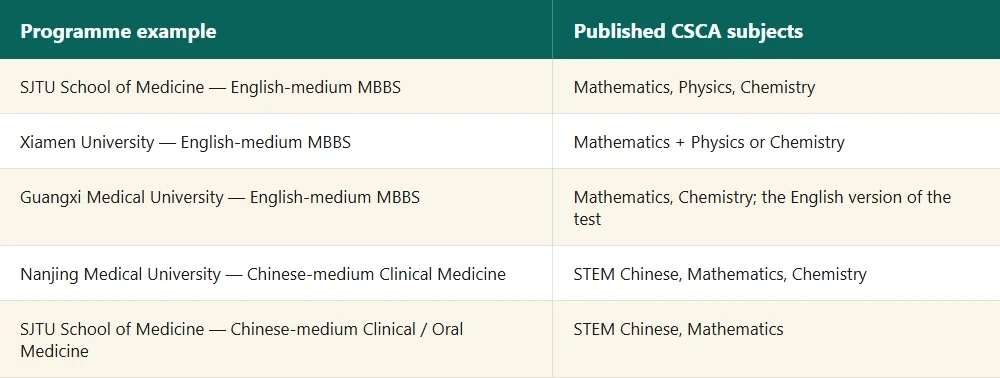
Do not pick subjects from a generic table found online. Before registering, open the rules of each chosen university and put together a single combination of exams that fits your entire application list.
CSCA does not replace a language certificate CSCA checks academic readiness. HSK confirms Chinese, and IELTS/TOEFL and other documents confirm English. A university may require CSCA and a language certificate at the same time. |
8. Do you need an HSK for English-medium MBBS
For an English MBBS application, an HSK is often not required. For example, some official programmes accept IELTS, TOEFL, Duolingo or proof of English-medium schooling. But this does not mean a student can finish medicine without any Chinese.
Chinese is necessary for:
- communicating with patients and taking a medical history;
- understanding how a clinical department works;
- completing some medical documentation;
- clinical exams and practice;
- daily life and interacting with the hospital.
Before applying, request a written answer from the university: what level of Chinese must be reached before clinical rotation, internship and graduation, and what consequences apply if the student does not reach that level in time.
9. Confirming your English
Requirements vary significantly. Published 2026 rules include, for example:
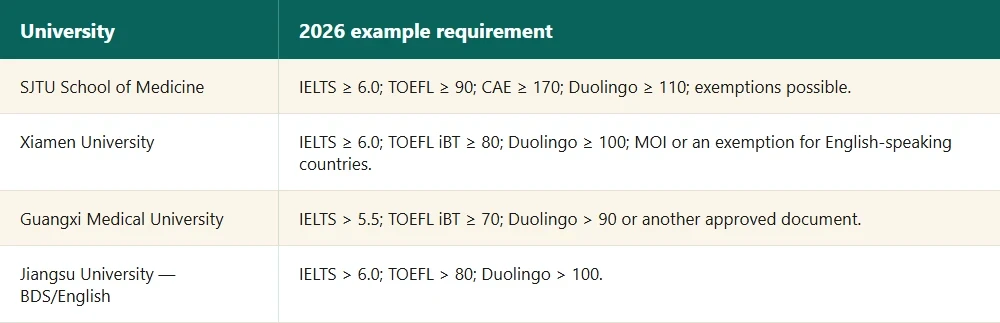
A Medium of Instruction confirmation is not accepted by every university and is usually reviewed individually. Getting an exemption from the exam is not the same as being ready for medical lectures, scientific terminology and clinical communication.
10. What documents are needed
- An international passport with a sufficient validity period.
- A document of completed secondary education or a certificate of expected graduation.
- A full school transcript; if needed, a school profile and a description of the grading scale.
- Notarised translations of documents if the original is not in Chinese or English.
- CSCA results for the subjects set by the programme.
- HSK for Chinese-medium programmes, or an English certificate/MOI for MBBS.
- A Personal Statement / Study Plan.
- Recommendations — if required by the rules.
- The Foreigner Physical Examination Form.
- A police clearance certificate.
- A financial guarantee or bank statement.
- A photo, a form and additional documents per citizenship.
- Interview or internal-test results.
The final list is only formed once specific programmes have been chosen. Medical universities often require more documents than typical bachelor’s programmes.
11. How clinical practice works
Clinical practice is a key element of a medical programme and one of the main factors in future licensing. Do not limit your research to the length of study and the tuition fee.
11.1. What to request before applying
- A list of the university’s and affiliated hospitals.
- The length of clinical rotations and internship.
- The language of communicating with patients and the language of clinical exams.
- The minimum HSK or an internal language test before practice.
- The format of the clinical logbook and confirmation of practice hours.
- Whether an internship abroad is possible and who approves the placement.
- What documents are issued at the end of the practice.
- Whether the practice meets the requirements of the regulator in your future country of work.
If a student plans to return home or move to a third country, the question of practice needs to be agreed on before starting the programme, not in the sixth year.
12. What recognition of a medical diploma means
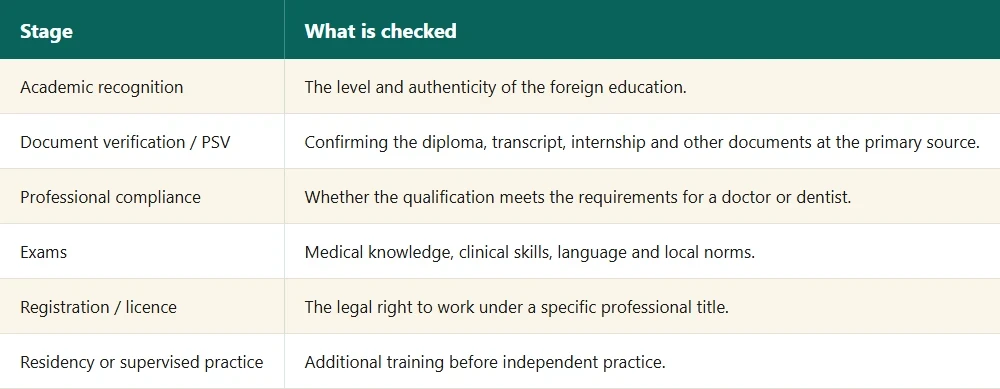
A key conclusion A Chinese university diploma can be valid and academically recognised, yet the graduate may still need a professional assessment, exams, an internship, residency and a licence. No agency or university can guarantee a doctor’s admission to practice in every country. |
13. How to check whether you can work in a specific country
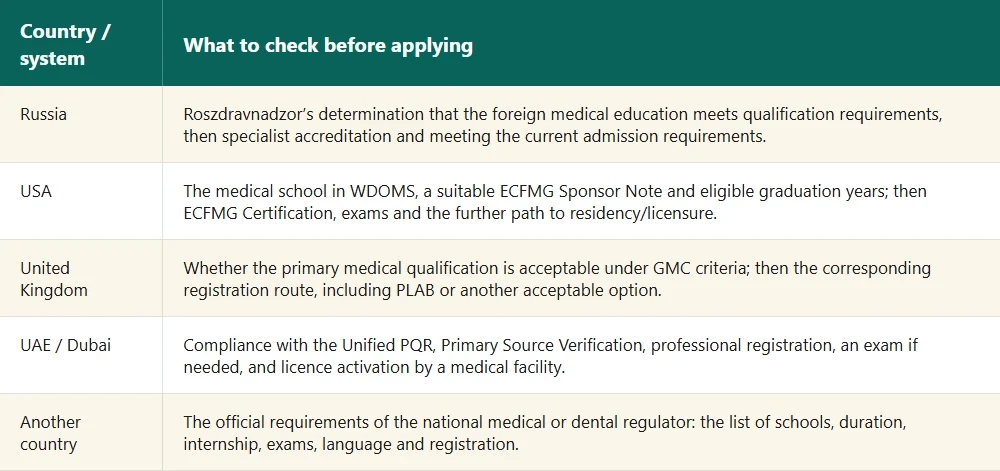
This check should be done for the specific university, programme, language of instruction and expected year of graduation. Requirements can change over six years, so it is advisable to keep curricula, a logbook, proof of practice and official replies from the regulator.
14. WDOMS, ECFMG and WFME: what they mean
14.1. World Directory of Medical Schools
WDOMS is an international directory of medical schools. A school’s presence in the directory alone does not mean accreditation, a recommendation, or automatic diploma recognition.
14.2. ECFMG Sponsor Note
For the US route, you need to open the Sponsor Notes tab in the school’s record and check whether it meets ECFMG requirements and covers the expected graduation year. ECFMG explicitly states that it does not accredit or recommend medical universities.
14.3. WFME Recognition
WFME does not accredit individual medical schools. Its Recognition programme assesses national or regional accreditation agencies, which then accredit schools and programmes.
15. Dentistry in China
Stomatology, Oral Medicine or BDS is a separate educational track. It is not MBBS and should be checked against the rules of the dental regulator in your future country of work.
For 2026, official programmes show different models:
- Peking University Health Science Center offers a five-year Chinese-medium Oral Medicine programme.
- Shanghai Jiao Tong University School of Medicine offers Chinese-medium Oral Medicine, five years, with HSK 5 and CSCA.
- Jiangsu University publishes an English-medium Bachelor Degree of Dental Surgery lasting six years, with proof of English and CSCA.
Before choosing dentistry, separately check clinical hours, the list of practical subjects, the possibility of working with patients, the title of the final degree, and the requirements for dental licensing in your country.
16. Other medical and related programmes
Pharmacy, nursing, public health, medical laboratory diagnostics, imaging and rehabilitation can be good career routes, but they do not give a doctor’s qualification. Each profession has its own recognition and registration rules.
Before applying, compare:
- the official title of the programme and degree;
- the length and volume of practice;
- the professional title after graduation;
- the regulator’s requirements in your country of work;
- the need for a master’s degree, an internship or a professional exam.
17. How much medical education costs
The medical route needs to be calculated for the whole period, not just the first year. An English-medium MBBS usually lasts six years, so even a small difference in the annual price significantly changes the total budget.
17.1. Examples of tuition under published 2026 rules
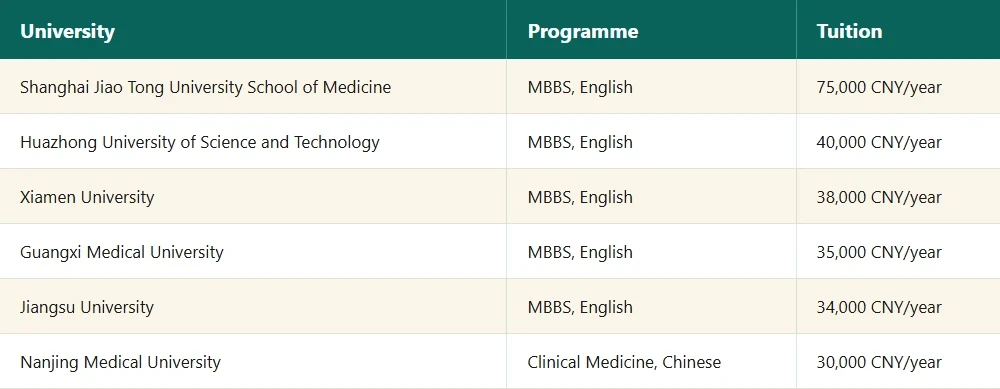
These are examples, not a single price range and not a GE Agency offer. The 2027 rates need to be updated based on official admission guides.
17.2. What the full budget includes
- five or six years of tuition;
- application fee and registration fees;
- dormitory, deposit and utility costs;
- insurance, a medical check-up and the residence permit;
- textbooks, lab materials, a uniform and medical equipment;
- food, transport, communication and personal expenses;
- flights and holiday costs;
- documents, translations and legalisation;
- post-graduation exams, PSV, recognition and licensing.
Financial safety It is not recommended to build a six-year plan solely on an assumed grant or the possibility of part-time work. A medical programme has a heavy study load, and scholarship and renewal terms can change. |
18. Grants and scholarships for medicine
State, regional and university scholarships can cover tuition fully or partially. However, for medicine, and especially an English-medium MBBS, funding is often limited and competition is high.
- CSC may not be available for every language and programme; conditions depend on the application channel and the university.
- Some grants only fund Chinese-medium medical programmes.
- A scholarship may cover tuition, but not flights, an application fee, a deposit or post-graduation licensing.
- Renewal often depends on academic performance, discipline and an annual assessment.
- Receiving a grant does not confirm the programme’s international recognition.
19. The step-by-step selection and admission process
- Decide on your profession: doctor, dentist, pharmacist, nurse or another specialist.
- Decide on the country where the graduate plans to get licensed.
- Check the regulator’s requirements for the university, duration, internship and exams.
- Choose the language of instruction and honestly assess your English or Chinese level.
- Check the current MOE list for English MBBS and the official admission guide.
- Match the CSCA subjects across all chosen programmes.
- Request the curriculum, clinical bases, internship and graduation requirements.
- Prepare documents, language, CSCA and the interview.
- Calculate the full budget for the entire term plus a reserve for extra expenses.
- Submit several balanced applications and only pay for tuition after checking the conditions.
20. How GE Agency checks a medical programme
Before recommending a medical programme, we need to check not just whether an intake is open but the entire education route:
- the university’s official status and the programme for the relevant year;
- inclusion in the current MOE list for English MBBS, if applicable;
- the language, duration and exact degree title;
- CSCA, HSK, English and entrance tests;
- the curriculum and clinical bases;
- internship terms and the documents issued;
- the preliminary requirements of the chosen medical regulator;
- the cost of study and living for the whole term;
- the real conditions of a grant, without promising it.
Get a review of a medical programme and diploma recognition Tell us your citizenship, future country of work, biology and chemistry grades, language, budget and desired field. GE Agency will check available programmes, CSCA/HSK requirements, clinical practice and the key conditions for future licensing. A preliminary check is not a guarantee that a professional licence will be issued. |
21. Common mistakes made by medical applicants
- Choosing a university only by low price.
- Believing the phrase "recognised worldwide" without checking the regulator.
- Enrolling in a bilingual MBBS outside the current MOE list.
- Assuming any medical field is a doctor’s qualification.
- Confusing MBBS with dentistry.
- Checking WDOMS but not opening the Sponsor Notes.
- Ignoring Chinese until clinical practice.
- Not checking the format and location of the internship.
- Not keeping the curriculum, logbook and proof of practice.
- Relying only on a grant with no financial reserve.
- Leaving the question of licensing until the final year.
22. FAQ
Can you apply for MBBS in China without knowing Chinese?
For some English-medium programmes — yes, if the English and CSCA requirements are met. But Chinese will still be needed for clinical practice and communicating with patients.
How long does MBBS last in China?
The official English MBBS standard is six years. Chinese-medium Clinical Medicine can last five or six years depending on the university.
Do you need IELTS?
It depends on the university. IELTS, TOEFL, Duolingo, MOI, or a set exemption may be accepted.
Which CSCA subjects are needed for medicine?
There is no single combination. Published requirements include Mathematics, Chemistry, Physics and STEM Chinese. You need to check each programme.
Does CSCA replace HSK or IELTS?
No. CSCA checks academic readiness, while a language certificate confirms proficiency in the language of instruction.
Can every university offer an English-medium MBBS?
No. English MBBS is governed by a separate list from China’s Ministry of Education for the relevant academic year.
If a university is listed in WDOMS, is the diploma automatically recognised?
No. WDOMS is a directory, not a guarantee of accreditation or a licence.
Can you start working as a doctor right after MBBS?
Usually not. Recognition or a qualification check, exams, professional registration, and sometimes an internship or residency are required.
Is a Chinese MBBS recognised in Russia?
A graduate of a foreign university must go through the established procedure of confirming education compliance and specialist accreditation. Conditions should be checked with Roszdravnadzor at the time of graduation.
Does a Chinese MBBS work for the US?
You need to check the school and its ECFMG Sponsor Note in WDOMS, the eligible graduation years, and meet ECFMG requirements and the further licensing path.
Can clinical practice be done at home?
Sometimes a university allows an external base, but this must be agreed on in advance and meet the university’s and regulator’s requirements.
Are there grants for MBBS?
Yes, but not for every programme and language. Funding is often limited and not guaranteed.
Is English-medium dentistry available?
Some universities publish English-medium BDS programmes, but the choice is narrower, and recognition needs to be checked separately.
Which is better: English-medium MBBS or Chinese-medium medicine?
It depends on language, budget, universities and your future country of work. A Chinese-medium programme gives deeper clinical immersion but requires a strong HSK.
When should you start preparing to apply for 2027?
Ideally 9–15 months in advance: choose the country of licensing, prepare language and CSCA, check programmes and gather documents before deadlines open.
Conclusion
Medical education in China can be a strong route for an international applicant: modern universities, programmes in Chinese and English, clinical bases and different cost levels are all available. But the decision should not be made based on the name MBBS, a ranking or the price alone.
The right choice starts with your future profession and country of licensing. Then you check the programme’s official status, language, CSCA, clinical practice, final qualification and the full six-year budget. This approach significantly reduces the risk of ending up with a diploma that requires unexpected extra study or does not allow you to start your professional career right away.